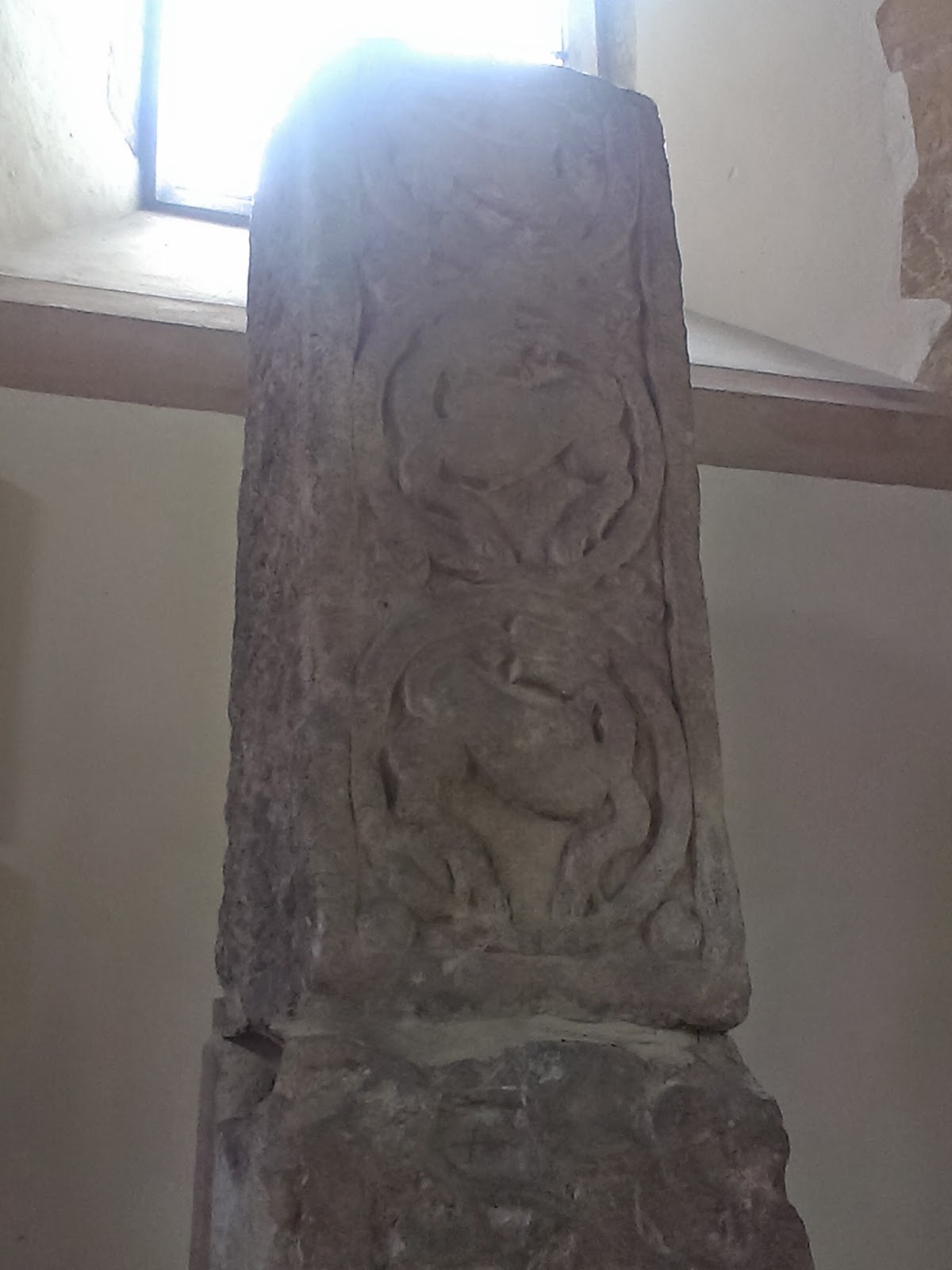
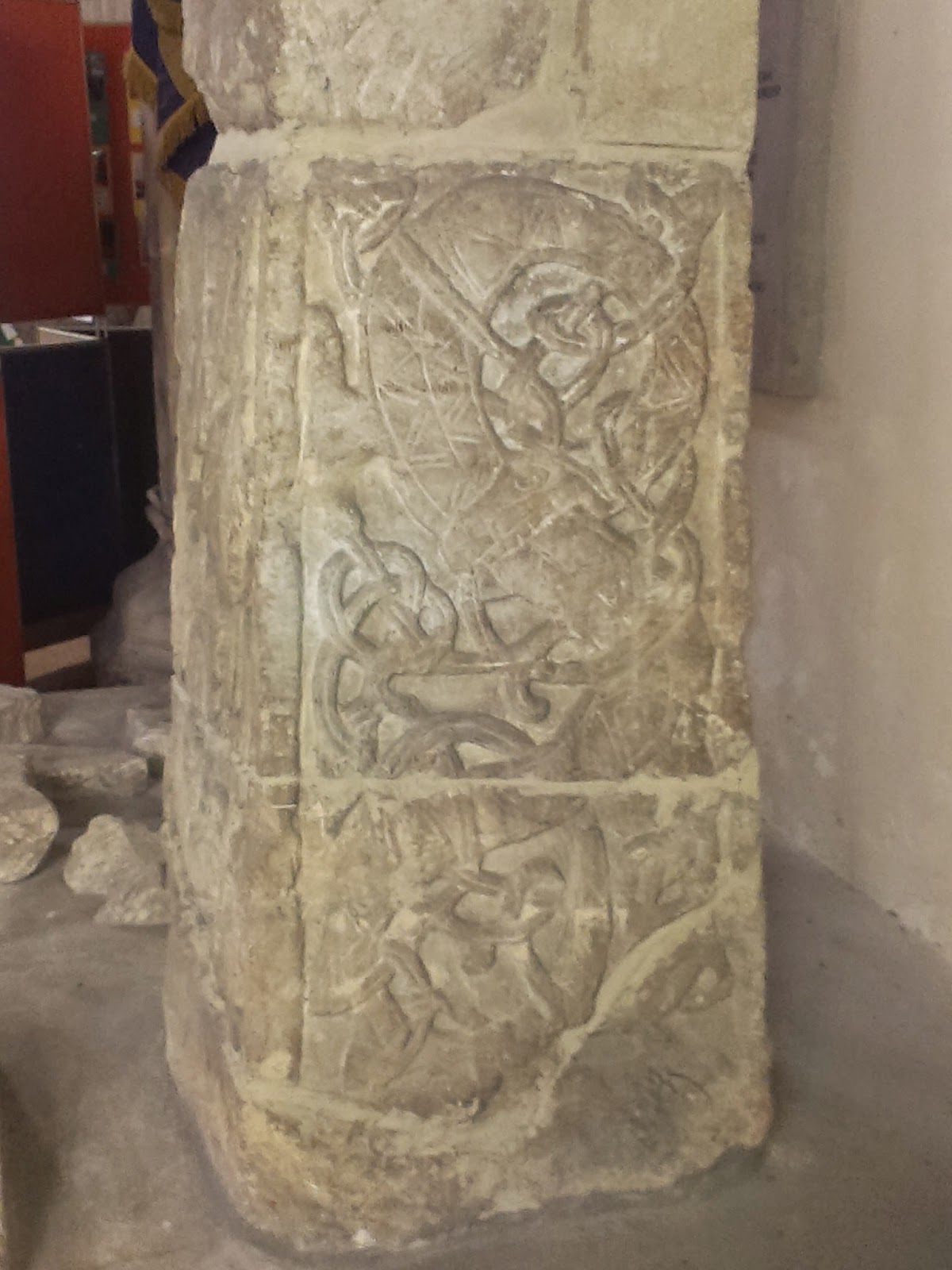
Showing posts with label birds. Show all posts

Saturday, 7 July 2018

Chilling in the sun

As part of an extremely relaxing week off, we fitted in some visits to some old favourites and a few new delights. First up was nearby Lullington, of beakhead fame. The church is kept locked (as are many we have come across in Somerset) and so to save a wasted trip I went to get the key from a nearby house. The man who came out, lovely barking dog in tow, reminded me of the man with the dog from Detectorists. The church key was pleasingly huge and opened the door to some wonderful gems inside. The cool interior was a welcome change from the burning sun that we have been having for so long now.

 Lullington's font is elaborately decorated with some nice arches, flower shapes and faces. More unusually it has writing around it and on the top. There are some pleasing capitals above the columns, with patterns, faces and creatures, including a very fetching pair of birds who reminded me of dinosaurs because they had scaly tails. Some relaxing drawing was enjoyed.


The beakheads were baking in the sunshine and I had forgotten that they are less well defined than many we have seen. Unfortunately they have been more exposed to the elements. But each creature has appeal and there is an amusing variety of creatures and faces.

At the end of the week, a return trip to the idyllic spot of Little Langford beckoned, and luckily there was a triangle of shade in which to stand to draw the marvellous tympanum. I checked the visitors' book and it was a surprising 4 years since we first visited. My sister did an impressive drawing of the hounds beneath the main picture and I tried to draw the man and the birds. The font there, although simple, is pleasingly wonky and as such definitely Norman.


After a rather hot and slow trip through Salisbury we found Pitton. Here the font had a deceptively simple band around it, which on closer observation was not quite as simplistic as you might first think. The chevron pattern reminded me of plaited material or two lines of bread dough wrapped over each other - the carver had smoothed off each separate shape and the overall effect was of plump material or something soft. All such designs would transfer nicely to another medium such as fabric. It is time to get on with something artistic and create something using these carvings as inspiration.


It was too hot to drive looking for other places so we came back via Wood Henge, a very interesting and atmospheric spot, marred slightly by the couple who chose to set up their deckchairs and have a drink at the far side of it, as if it were a picnic area. Very odd. Perhaps the heat was getting to them. Luckily we did not wander around Amesbury (having seen recent news) and actually went past the mysterious Porton Down and Boscombe Down (no photos allowed) on the way back through the weirdness of Wiltshire.

Monday, 21 September 2015

Leominster Priory

Following a trip to Shropshire, we found ourselves, as usual, passing through Leominster on the way home. Now always thinking about nearby fonts and tympanums, we wondered if we should stop off (just quickly) to see what Leominster Priory had to offer. We could see a spire from the nearby petrol station. Could that be it? It was, and it wasn't far to go.  Walking up to it, I was amazed how large it was but how well hidden from view when you were in the town.

So, Pevsner mentioned some carved capitals with various animals, people and plants... Sounded promising. We wandered up to the west doorway. And gasped. Six columns each with a carved capital - all different and all remarkably well preserved and intricately carved. Wow, it must have been like cinema back then to the people - you could really enjoy looking at the pictures, as we do today, and working out what they were.  There was one of some sort of cereal - we have seen something similar - one of foliage and snakes, one with two men (which is quite unusual) who looked like they were wearing striped pyjamas; two birds which were definitely in the same style we have seen before; and two animals sharing a head - again, something we have seen before at... hmm, where was it... Avening in Gloucestershire.

So there is a definite and recognisable style - and these carvings fall into the "Herefordshire school" style, examples of which we have seen Stottesdon (in Shropshire) and Castle Frome. We have seen birds (pigeons? doves?) like that at Durnford and Hinton Parva as well. They are quite pleasing and always seem amused, to me. They have real character.

Pevsner briefly mentioned some carvings inside, so we went to look for those. Once we'd got over our surprise at the sheer size of the place, including enormous fat Norman columns the like of which I've never seen, we were excited to discover that the carvings inside were equally as detailed and pleasing as those outside. They were basically in the same position, on the inside of the doorway, with another 4 columns each with carved capitals, and some other details further up. These had some interesting faces, perhaps Green Man-ish, one with a plaited beard? and the other with the "raspberry" type fruits (or maybe, more realistically, grapes?) that we have seen in other carvings.

All in all it was well worth stopping off at Leominster, which we'd done on a whim.  A couple of other people came in while we were there, took a cursory walk and glance round the place, missing out the carvings and left. I think they missed the best bits.

Saturday, 20 September 2014

Hot water bottle cover

I have previously tried using the delightful font at Hinton Parva for inspiration for art, and so from initial trials in felt, I decided to make something bigger.

The creatures and patterns on fonts and tympanums, which we have seen in our travels, lend themselves perfectly to creating something new and artistic. I wanted to do a bag, but not being that sure what sort of bag to make, I settled for a hot water bottle cover, the instructions for which I found online.

First I looked for inspiration in my sketchbook, from all the places we have visited. One of my favourites is the font at Hinton Parva, with its happy snake, birds, fish and unspecific quadruped. It is perhaps he (or she) whose jaunty stance appeals to me most. So I had my main motif for the hot water bottle cover. I then wanted to use some of the symmetrical designs we have seen to decorate above and below.

The zigzags with circles in that we have seen around several arched Norman doors seemed perfect for the purpose, so I used the sketch from Whaddon. I also chose part of the design from our lovely font at Christian Malford, and also the shell shapes from Bremhill for the neck of the bottle.

Not wanting to overload the bottle with creatures, instead of a lamb of God, I chose a pattern for the bottom half of the back, adapted from the doorway decoration at South Stoke, back before the blog began.

Here is the finished result. I am quite pleased with it, and even more pleased to pass it on to my sister, because it is through her interest in these fabulous works of art, that we have both been inspired to create our own artwork.  She made the observation that no one will ever have made a hot water bottle cover with this design before!


Saturday, 30 August 2014

South West Wiltshire fonts (and into Dorset)

There seemed to be a cluster of fonts worth seeing in the south west corner of Wiltshire and just over the border into Dorset, so it was to these we set off on a sunny day.

Fontmell Magna
First stop was the one furthest afield, near Shaftesbury in Dorset. Fontmell Magna is a very cute village with charming houses of brick and flint. As you enter the church, which is perched up high, the Norman font is the first thing to greet you. We were keen to see it because around the bowl are eight carvings of birds: they look most like ducks or pigeons, with fat bodies and rounded heads. Each one was slightly different, which was pleasing. I drew two; one with a sort of diamond pattern on its neck and the other with a pattern of triangles. At the back of the church was a slightly neglected looking font bowl which was labelled Anglo Saxon. This was plainer and more worn.

Compton Abbas
Up the road we stopped at Compton Abbas church - there was a woman vacuuming so I said hello to alert her to our presence but that made her jump a foot in the air. We settled down on a pew to draw the pleasingly carved font. This one had been "recarved" in Victorian times and the foliage pattern stood out plainly from the bowl. However it was an interesting, varied design and the lines were flowing and organic.

Donhead St Mary
We drove back northwards and stopped at Donhead St Mary, another very quaint spot. This church had a lovely view of the hills and we saw the Red Arrows go over. I particularly liked this font, it was a lovely big chunky font with arches and little pillars. Above this was a complex interlacing design. I tried my best to draw what I saw and am quite pleased with how it came out. The church had a restful atmosphere.

Ansty
Further east, we stopped at Ansty, a small out of the way place with a beautiful old building next to a pond. It seemed a popular spot.  The church was small and plain inside but with a charmingly simple font, small and carved simply with a circular design, or droplets. They reminded me of Christmas baubles. It was a test to see if we could actually draw what was there.

Ebbesbourne Wake
Finally we drove on to Ebbesbourne Wake - one of a series of villages set high up on a ridge, which felt strangely out of the way from anywhere else. After getting unnecessarily lost looking for the church, we recognised the design of the font as similar to Steeple Langford. On a much smaller scale, but nonetheless just as pleasing. It was also in marble, but without any face details on the top side.  Each side had a different design, just like Steeple Langford. We did not do any drawing here but decided to head home.

We drove past a very cute little church at Fifield Bavant, perched on a hill in a field. We were just going to see if it was by some miracle open, when we realised there was a large horse between us and the church and then a dog wandered over from the farm opposite to see what we were doing. Not wishing to be attacked by either of them we decided to head home, as chances were such an out of the way tiny place would be locked anyway.

Friday, 30 May 2014

Ramsbury and Hinton Parva

Wanderings recently took us to the beautiful village of Ramsbury, near Swindon, with narrow streets and old buildings. This was quite an unusual visit, as in contrast to the normal peace and quiet of the church, we were treated to the conversation of the cleaner and her friend, followed by the whine of the vacuum. However, this did not detract too much from the fine display of Saxon carving proudly displayed in one corner of the church. There were coffin lids and stones, with some very intricate patterns on all sides. The lines weaved under and over each other, and two sides also had a snakey or dragonesque creature. It was reminiscent of Colerne and the dragon carvings. The vacuuming ceased but was replaced by more melodic sounds, when the organist came to do his practice. This was quite enjoyable background music as we drew. You have to concentrate quite a lot to draw the lines accurately as they weave over and under. All the carvings were worn so in places you end up guessing what is going on, so that you can create a finished drawing. Above the knotwork and serpent, were three creatures in circles, all biting their own tales.
Our next stop was a little village called Hinton Parva, which was a much quieter spot. The church itself was smaller and lighter and suffered a little from damp. But it holds the most appealing font, with some delightful creatures and patterns. One half of the decoration is a series of figures of eight that intertwine. These are uniform until one end, where the pattern goes pleasingly wrong and completely out of line with the rest of it. We were joined by a member of the church who told us a bit more about it and also found the carver's "mistake" quite endearing. The other half of the decoration is really very entertaining. It is as you or I might draw creatures, which is why I like it so much. At one end is a snake, in the shape of a pretzel, with two birds and two fish. All of them have tiny dots for eyes. Around the side, after some foliage, is a four legged creature, on its side, resting its bottom on another bird. It is biting the end of some foliage. It is all very appealing.