Showing posts with label fonts. Show all posts

Saturday, 26 August 2017

Avebury and Winterbourne Monkton

With the pressures of modern life keeping our brains in a whirr (I have been forgetting to do the meditation you can tell), admittedly not the pressures of being down a mine a hundred years ago, but relief is still found in the soothing pleasures of a trip out fonting.  As it had been some time, (although a whole trip to Bristol needs updating on here), it was nice to get out, sit down and take up a pen. (My new pens. More on them later).

We travelled a by now familiar route out towards Devizes, through the weird hills and villages of Wiltshire.  Then further on to Avebury, home of the Stones.  It always strikes me as strange how many other people wake up and have exactly the same thought as we did, to go and visit them on that very day. (Although they had not had the same thought about visiting the font). However it wasn't heaving, and there were large enough spaces between other visitors not to feel like we were at Stonehenge or something.  As I had forgotten the tea flask we used it as an excuse to have a cream tea at the cafe, which was very nice.  Then we had a wander around the Stones, which are remarkably large, solid and smooth in places, and you have to wonder what it was all about. Even though we were walking round them in a circle, I got a bit disorientated but I enjoyed the calm feeling and seeing the sheep grazing in the middle.


Our main objective was of course to see the font in the local church, which has a fair few more visitors than your average village church. Most people just glanced at the font, if they noticed it at all, even though we were both sitting attempting to draw the detailed and swirling design on it, that is worn with time. The main features are two dragony/wyverny creatures with what I think were unusual amounts of detail, in the patterning down their sides. Very pleasing. I was drawing one with a particularly delightfully curving tail.  There was also a human figure, face bizarrely obliterated by a metallic thing, perhaps part of an old lock.  Above the figures were swirls reminiscent of several places, I shall have to look up - and below, an interlinking archways/pillars design very reminiscent of Durnford font.  I am sure with our extensive knowledge now, we should write a book making observations, as we have been able to see many links and similar designs throughout our travels that other people (the handful who also have this obsession) may not have seen.

We decided to squeeze in another font, just up the road in the next village, Winterbourne Monkton. My sister has visited both before as I remember seeing her previous drawings, but it is always nice to re-visit. And for me they were both new. We really were out in the middle of nowhere, or so it felt, and there were butterflies joining us as we had our picnic lunch.  This font was another elaborately carved and very striking design, which carried traces of paint from years ago, including blue and red. Then it seemed only too fitting that I used my new colour pens in their fancy case, which are fine-tipped. I am quite pleased with my drawing as I depicted different areas of the design in different colours. The bold zig-zag band that forms the main part had traces of blue on it. There is a human-oid figure with splayed out legs and arms, possibly other bits, or is this part of the whirly flower design that fits neatly above and below the zigzags. I think it was put there because if you imagine it removed, the zigzag design would not meet up neatly - you can imagine, can't you, the carver getting round to the end of the pattern and realising it was not really going to work out. A bit like the strikingly free-hand looping patterns at Hinton Parva.  I was not good at depicting the deep cut trumpet design below the zigzags, something my sister did with much more 3D success.


Tuesday, 12 April 2016

Michael Corbidge workshop

The Time is Now has been quiet of late, as there has been nothing uplifting to report (aside from some fonting which I have not yet blogged). However, I am pleased to say that one such day has put some of the zing back.

As part of the ALPs production of The Taming of the Shrew (18 to 21 May), we were lucky enough to have a workshop given by voice and text coach to the RSC, Michael Corbidge. I had made the mistake of looking at clips online and it worried me that we would be made to run around the room and do things outside my comfort zone. But I was wrong and the clips were misleading. Mr Corbidge was a wonderfully down to earth, humorous man who we all warmed to. He has worked with loads of famous actors but he never once mentioned this and I didn't like to ask. He was passionate about what he did and his enthusiasm was infectious. He made no apologies for it and this made it easy to throw yourself into it all and not feel self conscious.

We began with a warm-up which involved warming up your body and voice. Possibly actors resist doing this but in fact we could feel the benefit once we had done it. It helps to throw off the worries and thoughts of the day, or yesterday, and then you can be focussed on what you are doing. We stood in a circle and did various movements and made various sounds but none of it felt silly as everyone was doing it and there was a purpose, plus it was as if we had been given permission to do these things so there was no need to feel daft. I quite enjoyed it anyway and afterwards it did help you to feel positive. Michael focussed on posture and the best way for your body to be for speaking - head up, eyes forward, jaw relaxed, and standing on the balls of your feet, the middle point, rather than leaning back or slouching in our normal habits. There was the image of being pulled up by a golden rope through the top of your head.

It was a full and intense day so don't expect me to remember everything but I will try to give you a flavour of what we did. We covered many things such as how words convey their meaning - for example try saying "plain Kate" and making plain sound exciting or interesting. Plain conveys its meaning in the sounds. Michael connected us to the language - something that made a huge difference to me - by saying don't be shy of enjoying the words, enjoy saying them - their consonants, their vowels. And actually, when you start to say every word clearly instead of swallowing it or hurrying it, you start to enjoy it. Shakespeare's language is great and that is one reason the plays have endured - and I'd forgotten that. I know that sounds mad. I have to confess I wasn't really feeling my parts as a servant and a fruit seller, and I wasn't feeling enthused about the humour of the play. But Michael brought me back in touch with what I have always loved at school and beyond: language. Words. And actually for me (maybe hormonal who can tell) it was quite emotional to reconnect.

It is amazing how much he helped us achieve in one day. He had various techniques to help people say their speeches, so the key characters in the play such as Kate and Petruchio, Gremio, Biondello, Lucentio and Tranio, all had a go at saying their speeches. Michael would suggest small changes and ask them to say it again. And then again, with another change, and so on. By the third or fourth time, the speech had been transformed into something much clearer, more engaging, more exciting. Michael helped us to think about the meaning of the words and to bring out the important words, like people's names or places in the opening speech of Lucentio, and the importance of pronouns - I, my, you, your etc. He did exercises to help people respond to what was being said, rather than just saying their line back. He also helped people to say things in a much more natural way - this was through doing something else at the same time, so Kate had to put on a huge pile of jumpers while she was speaking and we all had to give Gremio an item to hold when he was listing his riches. It was a surprisingly effective method: suddenly the speaker had two things to concentrate on and they began to speak in a more natural way so it did not sound like a recited speech. Gremio (Jules) was saying how his brain had been concentrating on the second thing so he was not worrying about the words so much.

There were so many things he touched on, like thinking about the way you say monosyllabic words, or polysyllabic words. And turning things on their head, like getting Petruchio and Kate to have their war of words but to be meaning "I love you" when they were saying it. And softening voices so that you had somewhere to go - higher and louder and more exciting, instead of coming in like that with nowhere to take it. How you have to respond to someone immediately (start thinking of it four or five words before rather than taking a breath and having a pause after their line), how to stop breathing out between lines but perhaps to use sound with breath instead. How not to be afraid of sounds or words.  Someone in his past had advised him to think of a blind person, a deaf person and a foreign person sitting up in the gods and he had to make sure they understood the play, so you have to use visuals as well as your voice. A bit like TEFL teaching in fact where you use every means of communication.

Biondello had a long list of things to report which are supposed to be funny, but half the problem is the language now is things we don't understand, about horses and clothing. So he asked Marc to imagine he was a stand up comic live at the Apollo, to tell a funny story, and to put the speech into his own words. He then progressed to miming the story he was telling and it didn't matter that the words were strange because you got the sense from what he was doing. It was perfect for Marc because he never stops telling jokes - I had them all through Season's Greetings where he was my stage husband. So it was great to see him in this role - good casting.

So it was a very productive and positive day. Everyone enjoyed it and got something out of it. I am sure it is going to lift the rehearsals and the production.  So do come along. I have now got a small role as a prostitute in one scene as well as fruit seller and servant. (It was bound to happen). For me, he came along just at the right time, after feeling rather demoralised about the job hunting. It gave me a lift and reminded me about what I love and what is important. Sometimes a person crosses your path who is full of enthusiasm and life and energy and it's infectious and they remind you of all the good things and give you a bit of zing back again and you remember actually you must never lose that passion, whatever it is you are passionate about. Fonts, chickens, language, whatever. And he keeps chickens, so what more do you need to know.


Tuesday, 10 November 2015

Bumps and fonts

I had an interview last week, 3 and a half hours in total: a tour of part of the school, two 15 minute group discussions with students, a 45 minute IT test and an interview with three people. I got to know the other candidates (two internal) over the course of the morning, so we had fun, even if I did not get offered the position. It was only part time, so I am hoping to hear from a similar school which has a full time position and is nearer.

Rehearsals last week were interesting: we all seemed to fluff our lines on Thursday night and took forever to get through one scene, but perhaps you have to do this to get it right. On Sunday we went up to the wardrobe section and I tried on some outfits for Pattie. Turned out I had been wearing the bump upside down, and now that the kind wardrobe lady has helped me with it, it looked much better, with an added bit of padding too. It took some squeezing under a couple of dresses.  The director asked us to look at the recent comedy series, The Kennedys, which is set in the 70s like Season's Greetings, and has a pregnant character. He asked me to look at how she walks, moves etc. I was watching an episode and recognised the actress but couldn't think where I'd seen her.  When I looked online, guess which school she went to. Only the one where I'd had the interview.

Work-wise I am trying many avenues but not all of them lead where I want to go. Time is ticking on and I do want to get something soon. It can get very disheartening. Beggars can't be choosers, but then again I have good qualifications and experience and know perfectly well I am capable of a lot. If everything wasn't so expensive I would not be in this situation. Supporting yourself also makes things more expensive but don't for one minute think I'm hooking up with anyone just for their money. I keep having the weirdest, unpleasant dreams, mostly about being trapped, funnily enough.

I still have my articles to write for Wiltshire Life magazine about our font obsession. I had great fun making my sister a quiz all about the places we have been, including a photo montage at the end. Choosing the photos made me realise just how many places we have been to and how many marvellous things we have seen, adding in photo after photo of fonts and doors and creatures and designs. It was quite moving in fact. I fail to see how anyone could not be excited by some of it. But I understand that they're not... It's quite funny now that we only want to talk about these places and when I'm not talking about that I'm talking about the play. Turned into a right bore.

I don't care. I know what I like and what I can do. Still having fun doing logic puzzles and getting paid for them. Inspired by the Antiques Roadshow, my current one is on antique finds. Every week on that programme someone has found something valuable in their garden or in a skip. I saw a lovely little gravy boat in the charity shop yesterday, from a Staffordshire pottery. Things do shout quality, it's true.


Monday, 2 November 2015

Gloucestershire

Hallowe'en is always going to be a strange day, in my opinion, as the two worlds of so-called reality and spooky things are at their closest. Strange things have happened historically and today was no different. Well, for a start it was gloriously sunny, which was unusual. We had decided that it might be one of the last good days this year for getting out to places (sob!) so we set off, this time in The Van, which was a pleasant change and meant that anyone who did hurtle down narrow lanes towards us would have to do the reversing this time...

So we set off further afield than usual, all the way out past Cirencester in Gloucestershire. It is an area we visited once before and so we were recalling the delights of Langford, Inglesham, Highworth, Ampney St Mary etc and the not so delightful drizzle in which we visited them. Gloucestershire seemingly has a wealth of things to visit and we were absolutely spoilt with what we found. It was one of those trips that was just one gasp after another. And we increasingly laugh about how probably no one else really understands our excitement. Although there are a few people who have shared or share our interests.

First stop (and what a stop), was St Swithins, Quenington, a place near where we'd been before and nearly visited, but ran out of time and energy.  We were without our usual information books, but my sister remembered that Quenington had "beakheads" - the ones where animal heads grip the arch above the doorway in their beaks or mouths. Always entertaining and always worth visiting.  So we found the cute old village of Quenington, complete with 15th century stone gateway, the "knight's arch" and stream. The church notice proudly declared "NORMAN DOORWAY" which boded extremely well, as when the church cares about its romanesque architecture, you can be sure they have looked after it well. (It is a Grade I listed building, I am glad to read). So we walked with anticipation up the long pathway craning a little to get the first look at the door, expecting something exciting. (It's always exciting that first glimpse...)  Gasps ensued. The doorway has a wealth of excitement. It's as if the carver got carried away and did everything he could. Arch decoration, capitals with fabulous faces, flowers, interlacing patterns, and a complicated tympanum showing Jesus standing on the devil, spearing him in fact and 3 figures - with what looked like rabbit ears but must have been hair. There was also a ram's head (date unsure) over the top. It is all a little overwhelming when there is so much to see. It is almost as if the carver is showcasing his talents.  So we stood there, marvelling at it in excitement, and a woman (I can't remember if she said she was the churchwarden or vicar) came along. She seemed rightly proud of the door and gave us an information leaflet.

We decided that, although R had been sure there had been beakheads, perhaps she had got muddled with somewhere else.  But as she was reading about the north doorway, she read on and spluttered in excitement that there was also a south door! Not believing our luck, we hurried round the side of the church and were amazed to see a second equally elaborate doorway, with carved arches and tympanum, this one even more complicated. It was apparently, the coronation of the Virgin and there she was with the figures of the evangelists (their animal forms) and a house (for good measure). And more importantly - there were the beakheads! Around the archway were some delightfully comic beakheads, clutching the archway in their mouths for all eternity, including a wide-faced horse, a boar(?) with little teeth and a hare.  Fabulous.  The "hinge" design up the sides of the door was just the same as the one at South Cerney, also in Gloucestershire - it must surely be the same carver. This sort of thing is exciting for me because how many people (except Pevsner and one or two many years ago) have gone round viewing carvings and comparing them, to the extent that they know the same person must have done their special design in more than one place? We were joking that we could set ourselves Mastermind questions on the subject (but apparently we have better things to be getting on with).

So Quenington was rather exciting and we returned to the van feeling that the day could not get any better, because one amazing door is something, but two is just fabulous. The Knights Templar ran the church so perhaps this has something to do with how ornate the doors were.

Next stop was nearby Coln St Aldwyn's where we went to see two dragon heads. You can't beat a good dragon's head and these two were some of the finest we've seen. Both had lovely toothy grins and had more detail than some, and I was rather pleased with my drawing too.


Finally we finished up at Southrop, where there was another woman who told us about the church. The font there was just inside the door and was very elaborate. It had a fancy band all around the top, which was a very complicated design with a rather pleasing "buckle" part.  Below this (we read) were some figures standing on other figures and spearing them. They were the virtues conquering the vices. It was interesting but I don't care for designs with people as much as patterns, I've decided. I didn't really care for the bloodthirsty depiction of these virtues either, and it was an echo of a very unpleasant scene we had inadvertently driven through to get there. We'd been going through country lanes and the sides of the road were cluttered with stupid people waiting to watch a hunt go through. I won't rant here but you will get the point that we were not on their side. Anyway - the font seemed to echo this in tasteless violence.  There was an arch inside that had a similar pattern to that at Ditteridge.
   

The wealth of riches in Gloucestershire (there were many places we had to leave for another day) was a bit tiring and so we headed home before the sun set.

Sunday, 18 October 2015

Dinder, Doulting, Chesterblade, Holcombe, Leigh on Mendip

Back on the road and this time we ventured into Somerset, out towards Shepton Mallet area. First stop was Dinder, where we found some creatures who were possibly dragon heads, like we have seen before, but on closer inspection seemed more like dogs. They definitely had dog noses, and no dragons' teeth, and pointy ears. So dogs they were. A knowledgeable and interested woman who was helping out in the church took the time to talk to us about them and seemed genuinely interested in art. Not one of these people who can't understand why we are drawing them. Which was a nice change.  The dogs had been rescued from somewhere and had been placed end to end over a window, so that they were not in the usual dragon door arch position. They were quite pleasing, as was the pretty and hidden village of Dinder (despite "no turning" notices where there was really no need. We turned anyway, at speed).

St Aldhelm's well
When we finally got to Doulting (because I was once again too slow to signal the turning), we investigated the church (some unusual capitals in the foyer) and then made our way down a slope to a spring, St Aldhem's well.  Surprisingly it was a busy spot as two cars came to fill up a variety of vessels with the holy water while we were there.  I learned to recognise a liverwort (there were some fine examples) and there was some moss as well. The water was (although it is a cliche) crystal clear, quite remarkably so, and being a holy well I had to sample the water. It tasted slightly minerally but not unpleasant. The water poured out from a hidden and peaceful channel at the back, through into a deep animal trough, which I thought was nice. It was pleasing to think of cattle and horses drinking from the holy spring.

Chesterblade
On to Chesterblade, a tiny, quiet spot with nice views over the hills. The church was small and cute and had a pleasingly tub shaped font. Very appealing. We examined it in detail, as a church leaflet made out it had once had a carved band around the middle. There was a slight discolouration in the stone there at about that spot, but neither of us could see evidence that it had been chipped away or bring ourselves to believe that anyone would have gone to such trouble. Now, convinced we are like experts on the Antiques Roadshow who have seen enough examples of something to recognise things by sight, we did not know of any example of anyone defacing a font in this way and for no obvious reason. So we concluded the chap who drew the font with the band on it had either embellished it himself or got confused with another font (as it is easy to do if you do not write down where you have been). Either way it was rather bizarre and my sister was right to question. Do not believe everything just because it is written down. If we have learnt one thing, it is surely that.   The doorway had two lovely capitals, one a face, with unusually prominent ears, and the other a very pleasing swirly design which on reflection reminds me of a Walnut Whip.  There were also two tiny faces, which proved harder to draw than bigger ones.  Oh and apparently we missed a lamb of god, outside. Our favourite. But sometimes you just get overloaded.

Holcombe Old Church
Next stop (it is remarkable afterwards how long we keep going for), in the quiet spot of Holcombe Old Church, down a lane out of the way and a really peaceful place if you are going to be buried somewhere.  A load of ducks were nearby as we could hear raucous quacking from somewhere. They always sound like they're laughing at something.  Holcombe had a rather appealing porch archway, with a two twirly columns and a really nice interwoven design which could be good for inspiration for making something one day.  I liked how we are now so confident in our churchyard environment we just moved a bench and sat in front of it to draw - well it is tiring to stand all the time - and of course no one came and said, what are you doing, anyway. It was too out the way.

On the way back we squeezed in one final stop (well, it seems worth it when you still have some energy) at Leigh on Mendip. The font here was a simple two-scallop design that reminded both of us of a bottom - it had that pleasing shape about it, it has to be said. There was a little bit of embellishment on the curved corners, but overall it was quite a chunky and cheeky font.


Tuesday, 28 July 2015

Back again

It hasn't seemed worth blogging until now about being back in the UK, but here I am again. It's been 6 weeks and the things I miss most are the coffee, sunshine and Jo. And nice looking ragazzi. And some of my students. And the food. But at the moment, mostly the sunshine and coffee, it being cold and rainy here. A day of ceaseless rain on Friday is enough to make anyone head to the easyjet website.

However, I don't think that is the answer right now. A recent birthday was my annual time for reflection (maybe I should have these more often) and perhaps I should think about what I want from life a bit more and actually take action to get nearer that. Running back to Italy is tempting (especially when Jo has been talking about returning to exotic locations), but there are things here that I could be focussing on. We will see.

I've been in touch with some of my students and occasionally heard from the nice floppy haired Back to the Future fan, so I have some sort of connection with the land of lovely Etna. (I failed to say I miss her but I do, very much). It is currently pushing 37 degrees there, which is too hot even for them, what a shame, but I dare say they prefer it to what we have at the moment.

Here I am experiencing a new part time summer job at a small international school which prepares students for UK boarding schools. They are mostly from China, Russia and Japan, with a sole Italian boy who I make read in class so I can hear the lovely accent. It is different to what I was doing in Italy and I hope to learn a few things about teaching while I am there. The teachers are all nice and supportive and the kids are pleasant enough, very polite and really just typical teenagers, who'd rather be sleeping sometimes than working. But what's new. I have enjoyed working with one smaller child and encouraging him with his spelling and reading. Another bonus is having tea breaks and a hot lunch all together. But boarding school life with its regulations and so on is quite a different thing but I think I've got used to it now and the children seem happy there. It's nice that everyone knows each other by name and they all look after each other.

Aside from that, it will be back to the job hunting again and also thinking of long term plans; where do I want to be, who do I want to be there with, etc etc. Meanwhile work and feeling generally knackered seem to get in the way of more exciting things like Fonting and writing and finding a way out of having to work.  But some fonts have been visited (yey!) which was a great relief and helped establish equilibrium again. More on those to come. And if it is all too much here, then I know Etna is only a 3 hour plane trip away, even for a quick burst of sunshine and a much-needed caffè.


Saturday, 30 August 2014

South West Wiltshire fonts (and into Dorset)

There seemed to be a cluster of fonts worth seeing in the south west corner of Wiltshire and just over the border into Dorset, so it was to these we set off on a sunny day.

Fontmell Magna
First stop was the one furthest afield, near Shaftesbury in Dorset. Fontmell Magna is a very cute village with charming houses of brick and flint. As you enter the church, which is perched up high, the Norman font is the first thing to greet you. We were keen to see it because around the bowl are eight carvings of birds: they look most like ducks or pigeons, with fat bodies and rounded heads. Each one was slightly different, which was pleasing. I drew two; one with a sort of diamond pattern on its neck and the other with a pattern of triangles. At the back of the church was a slightly neglected looking font bowl which was labelled Anglo Saxon. This was plainer and more worn.

Compton Abbas
Up the road we stopped at Compton Abbas church - there was a woman vacuuming so I said hello to alert her to our presence but that made her jump a foot in the air. We settled down on a pew to draw the pleasingly carved font. This one had been "recarved" in Victorian times and the foliage pattern stood out plainly from the bowl. However it was an interesting, varied design and the lines were flowing and organic.

Donhead St Mary
We drove back northwards and stopped at Donhead St Mary, another very quaint spot. This church had a lovely view of the hills and we saw the Red Arrows go over. I particularly liked this font, it was a lovely big chunky font with arches and little pillars. Above this was a complex interlacing design. I tried my best to draw what I saw and am quite pleased with how it came out. The church had a restful atmosphere.

Ansty
Further east, we stopped at Ansty, a small out of the way place with a beautiful old building next to a pond. It seemed a popular spot.  The church was small and plain inside but with a charmingly simple font, small and carved simply with a circular design, or droplets. They reminded me of Christmas baubles. It was a test to see if we could actually draw what was there.

Ebbesbourne Wake
Finally we drove on to Ebbesbourne Wake - one of a series of villages set high up on a ridge, which felt strangely out of the way from anywhere else. After getting unnecessarily lost looking for the church, we recognised the design of the font as similar to Steeple Langford. On a much smaller scale, but nonetheless just as pleasing. It was also in marble, but without any face details on the top side.  Each side had a different design, just like Steeple Langford. We did not do any drawing here but decided to head home.

We drove past a very cute little church at Fifield Bavant, perched on a hill in a field. We were just going to see if it was by some miracle open, when we realised there was a large horse between us and the church and then a dog wandered over from the farm opposite to see what we were doing. Not wishing to be attacked by either of them we decided to head home, as chances were such an out of the way tiny place would be locked anyway.

Monday, 18 August 2014

Sutton Benger, Lower Seagry, Christian Malford, Tockenham

Part of what I like about our travels is choosing where to go; sometimes it feels like it has to be further afield these days as we have been to so many spots in Wiltshire! But it is not the case, there is still much to be discovered and so this time we chose just north east of Chippenham, where we found plenty to keep us entertained.

Sutton Benger was the first stop, and unusually we found an old woman doing something at the front of the church. Although we rarely meet anyone on our travels (a telling sign for the Church today surely), we are never that comfortable when we do. I mean, it is hard to explain to people what we are doing and why; we understand, but I am not sure that they would. Luckily the object of our visit was outside and we were amused and surprised by its size and shape. It was a huge animal shape set high up on the outside wall, possibly as a gargoyle, possibly not - the front of its mouth was broken so we could not tell. I have never seen such a large carving set on the wall and it was the subject of great debate as to what creature it actually was: my vote is with cow, as it had the solid, rounded body of a cow and hooflike feet. It also had little ears and a rounded face. My sister however thought it might be more bear-like. I thought I could see a swishy tale. But like with a lot of these worn carvings, it takes a great deal of observation and sometimes some guesswork to figure out what they originally looked like. And does it even matter, as the form it is in now is just as pleasing to look at.  What amused us both as well as the size of it, was how one hoof was up to its face - it really looked like it was on the phone - or moo-bile, perhaps.

At Seagry, one of those places where you have to get the enormous church door key from a neighbour, there were two figures - a Norman knight and a woman. There were also some weird skull shapes on the wall as part of some memorial tablet. If ever we needed reminders that we are all mortal and that "the time is now", to seize the day, we get enough traipsing through churchyards. Seeing gravestones and sometimes catching sight of people who died young is enough to remind you to get on with things.

On to Christian Malford, no, not the name of an American filmstar but it could be. What a beautiful chunky font met our eyes as we went in. I am becoming quite fond of fonts and how each one is unique in its design. They share patterns such as zigzags, dots, curves but each one is always a surprise. This one was quite low, fat and squat. It was in quite a large church and we enjoyed sitting drawing it quietly.

Our final stop on this trip was Tockenham, where again we found another font, and although it had similar arches to the one in Christian Malford, it was different - this one was higher off the ground and very solid looking. The church also had a possible Roman figure in the outside wall.


Friday, 25 July 2014

Teffont Magna, Stapleford and Codford St Peter (and Britford)

We had one day before I headed off to sunnier climes and so it was with some feeling of urgency that we set off to squeeze in some last minute drawing and visiting. Well, you have to take the opportunities. First stop was another of seemingly countless delightful "English" villages that I thought only existed in Midsomer Murders, one Teffont Magna, off the beaten track in Wiltshire. Inside a simple church building was some Saxon knotwork, set firmly into the wall, thankfully. There was a hole in one part of it, not sure why, and a complicated knotwork pattern. It is absorbing to set about trying to draw the interlacing lines and invariably I go wrong, but it's not really a problem; it's my interpretation. Some of it was quite worn so that part always needs a little imagination, unless you can see that the pattern was repeating and try to recreate it.
If my memory serves me correctly we went on to Britford near Salisbury next. And ended up wishing we had never been. In fact the less said about it the better, but there were some fabulous examples of knotwork there and other patterns. They were sort of hidden in a corner in the dankest, darkest, vilest smelling place I have ever been. It was not, I don't think, just damp. It felt wrong in there. Just a weird, unwelcoming feeling. It was dark: we searched on every wall for light switches, but there were none. There were high pews on the side: I peeked in gingerly and then ran away as there were strange jars all along them. I can't explain it but neither of us felt right and we simply had the strongest urge to leave. It wasn't the baby's grave in the graveyard, it wasn't just the smell, there was something not conducive to staying and certainly not to drawing. Both of us were disappointed because the carvings were fine examples, but I could not even bring myself to keep my photos of them and we spent the rest of the trip trying to rid ourselves of the taste/smell and put it out of our minds. At Stapleford we tried to focus on what was there to get back into the groove - a sweet little church with some rather amusing faces on the inside columns. I tried to draw them but my heart wasn't in it.
Things improved measurably when we decided to stop at Codford St Peter as our final stop - we have been before but not done drawing. It has a truly wonderful Saxon carving of a figure, who looks like he is dancing and holding a branch. It is done in beautiful detail and I love how light of foot he is! It seems like something that might be celebrating fertility or the harvest, with the branch. On each side of it is more carving and we have long laughed at something that described it as having "dace" and "an otter" when proper (and even brief) examination will tell you there is no fish nor otter anywhere! I thought my imagination saw things that were unlikely but really, there is nothing shaped like either creature. Codford St Peter is a calm and restful place to draw and I enjoyed having a go at drawing the carving and also the rather charming font.

Friday, 30 May 2014

Ramsbury and Hinton Parva

Wanderings recently took us to the beautiful village of Ramsbury, near Swindon, with narrow streets and old buildings. This was quite an unusual visit, as in contrast to the normal peace and quiet of the church, we were treated to the conversation of the cleaner and her friend, followed by the whine of the vacuum. However, this did not detract too much from the fine display of Saxon carving proudly displayed in one corner of the church. There were coffin lids and stones, with some very intricate patterns on all sides. The lines weaved under and over each other, and two sides also had a snakey or dragonesque creature. It was reminiscent of Colerne and the dragon carvings. The vacuuming ceased but was replaced by more melodic sounds, when the organist came to do his practice. This was quite enjoyable background music as we drew. You have to concentrate quite a lot to draw the lines accurately as they weave over and under. All the carvings were worn so in places you end up guessing what is going on, so that you can create a finished drawing. Above the knotwork and serpent, were three creatures in circles, all biting their own tales.
Our next stop was a little village called Hinton Parva, which was a much quieter spot. The church itself was smaller and lighter and suffered a little from damp. But it holds the most appealing font, with some delightful creatures and patterns. One half of the decoration is a series of figures of eight that intertwine. These are uniform until one end, where the pattern goes pleasingly wrong and completely out of line with the rest of it. We were joined by a member of the church who told us a bit more about it and also found the carver's "mistake" quite endearing. The other half of the decoration is really very entertaining. It is as you or I might draw creatures, which is why I like it so much. At one end is a snake, in the shape of a pretzel, with two birds and two fish. All of them have tiny dots for eyes. Around the side, after some foliage, is a four legged creature, on its side, resting its bottom on another bird. It is biting the end of some foliage. It is all very appealing.

Tuesday, 20 May 2014

Fantastic Fonts

The obsession is now reaching more and more counties. My sister has read Pevsner's books on different counties and noted the Norman and Saxon carvings which we must now somehow get to see. I even found myself reading Pevsner last week and watching a dvd about him. At the weekend we were lucky enough to be driving through Shropshire and Herefordshire and this meant that we went near to two fonts which Pevsner described as outstanding examples of what is known as the "Herefordshire School" carving, which refers to what may have been a certain group of masons working in this area, and Worcestershire, in the 1100s. The most well known example is Kilpeck, which I am sure we will get to one day.  But the two fonts we saw over the weekend were in one word, amazing.

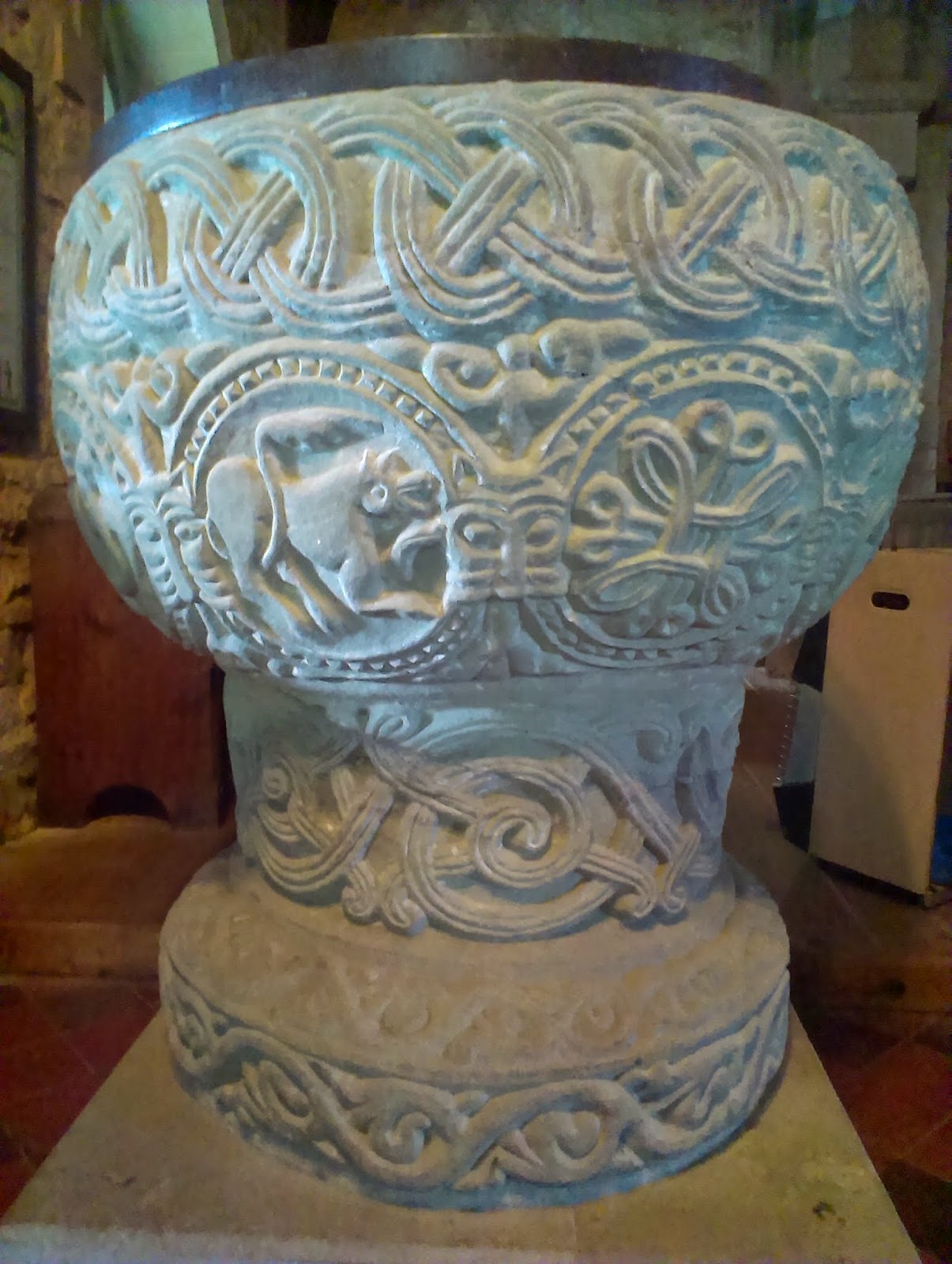
The first one seemed to be in the back of beyond, in Stottesdon, a village in Shropshire. It was tucked out of the way and it seemed very dark inside, so that we had to open the front doors to get a decent look at the font. It was very large, and covered in the most impressive carvings. Both of us stood and stared in amazement (once we could see it clearly). The top has a wide band of interlaced plaiting around it, the centre has animals in circles, and cats' faces where the circles touch. We were both thrilled to see another lamb of God and this one - yet again - looked like a dolphin's head. Perhaps it is hard to carve lambs or perhaps they were copying the style of the time.  There was a rather appealing bull/cow/type creature, a dragon biting its own tail (possibly) and some excellent birds. The base was very fancy as well, with interlacing designs. It was all very impressive.

Hidden out of view, behind the ugly organ, was a tympanum over the south door. It was hard to see in the gloom and looked quite worn anyway - there were two upside down creatures and a third upright one.

We were unimpressed by the arrival of a woman who was more bothered about why we had (inadvertently) turned on the lights at the end of the drive, instead of sharing with us how lucky she was to be a member of a church with such an amazing example of a font of the Herefordshire school.

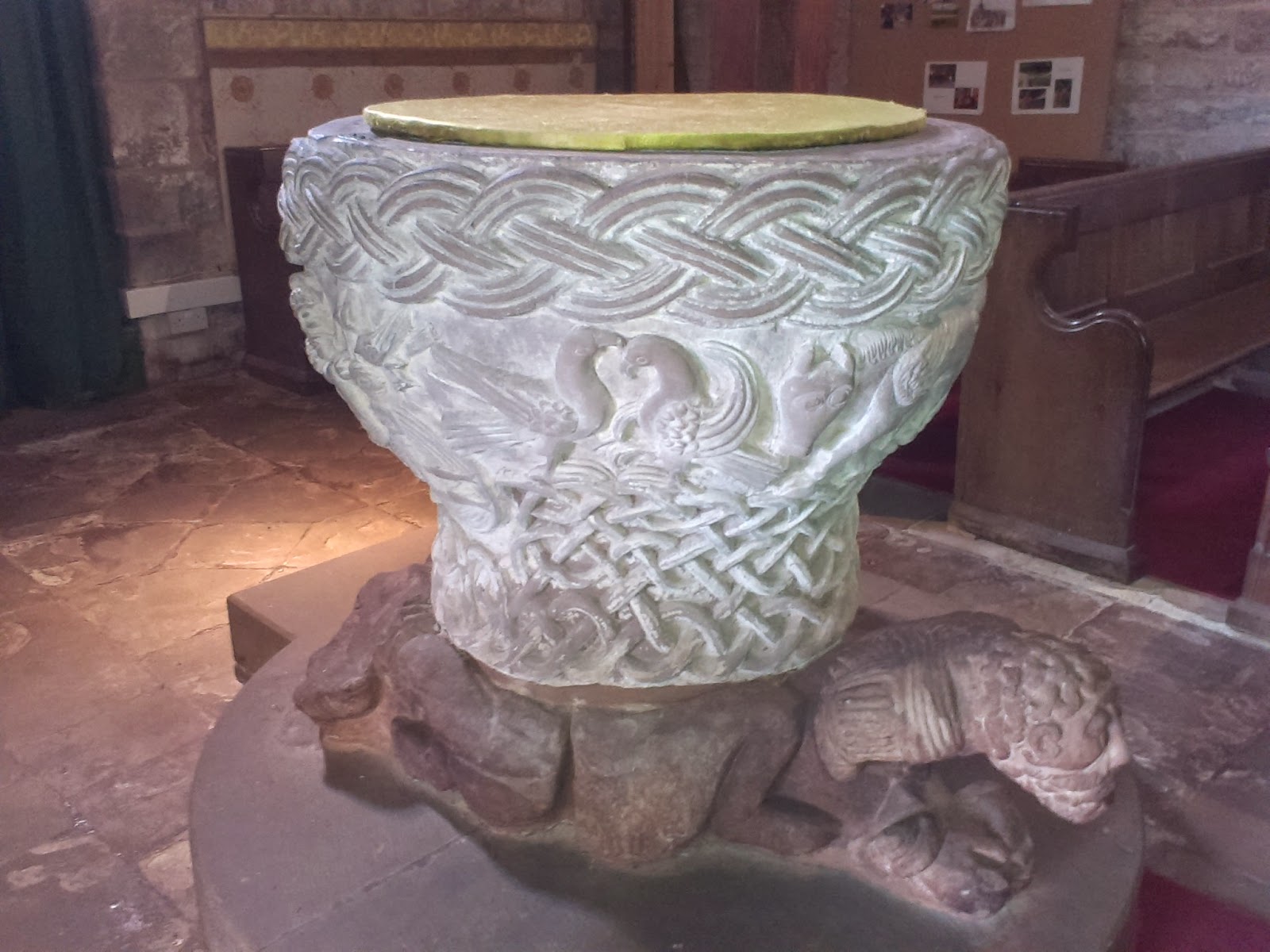
But if we thought that was good, Castle Frome held even more excitement. We nearly didn't stop to see it and we nearly didn't find the right village, but it was a good job we did. The church is really sweet and sits out of the way of the village. The outside is unusual and the porch and doorway is plain - because of this I wondered naively whether it would be good. But the door swung open and my sister literally gasped with excitement: inside, not hidden this time in darkness, is a marvellously ornate and beautifully carved font - very large and round, carved from one block, sitting on a base of strangely crouching figures (two that have lost their heads). The carving on the font was deep and sort of chunky, very tactile, although I managed to keep my hands off it, and so impressive. Around the bowl are the four evangelists in symbolic form: an angel, an eagle, a lion and a very charming bull. There are also two wonderfully observed birds, with their claws touching and their beaks jaunty, as well as a depiction of Jesus at his baptism, with John the Baptist, the hand of God and the Holy Spirit in the form of a dove. Jesus is particularly well done as he is standing in a pool of rippled water and you see the shape of his body through the ripples. In the pool are some fabulous fish.  My sister noticed that the human figures all had ankles with little circles on them, like an ankle joint.

It was better than tv and I imagine that these sort of pictures would have entertained the people of their time in much the same way that good tv can do these days. We were pleased because we actually noticed some similarities to the other font, and how the creatures all have long claws, and how the lion's tail comes up and curves over his body, exactly like the creatures at Ampney St Mary. We then read that these are features of the Herefordshire School style.

The base of the font was an intricate knotwork of patterns. No doubt it would have been tricky to draw. Sadly we were unable to stay long enough to draw this font, but it is one I would love to return to. The birds were particularly pleasing and the whole thing was beautifully preserved. The church community seemed to value and appreciate what they have there, from what I could see. If you are ever passing by, pop in. You will not be disappointed.

Monday, 12 May 2014

Colerne and Ditteridge

Having been far in our recent travels, into Gloucestershire, we stayed local this weekend by visiting nearby Colerne and Ditteridge. (We still had to stock up on lunch snacks. Drawing requires energy).  We had visited these churches together last year but I was not into drawing things then so this time it was more memorable.
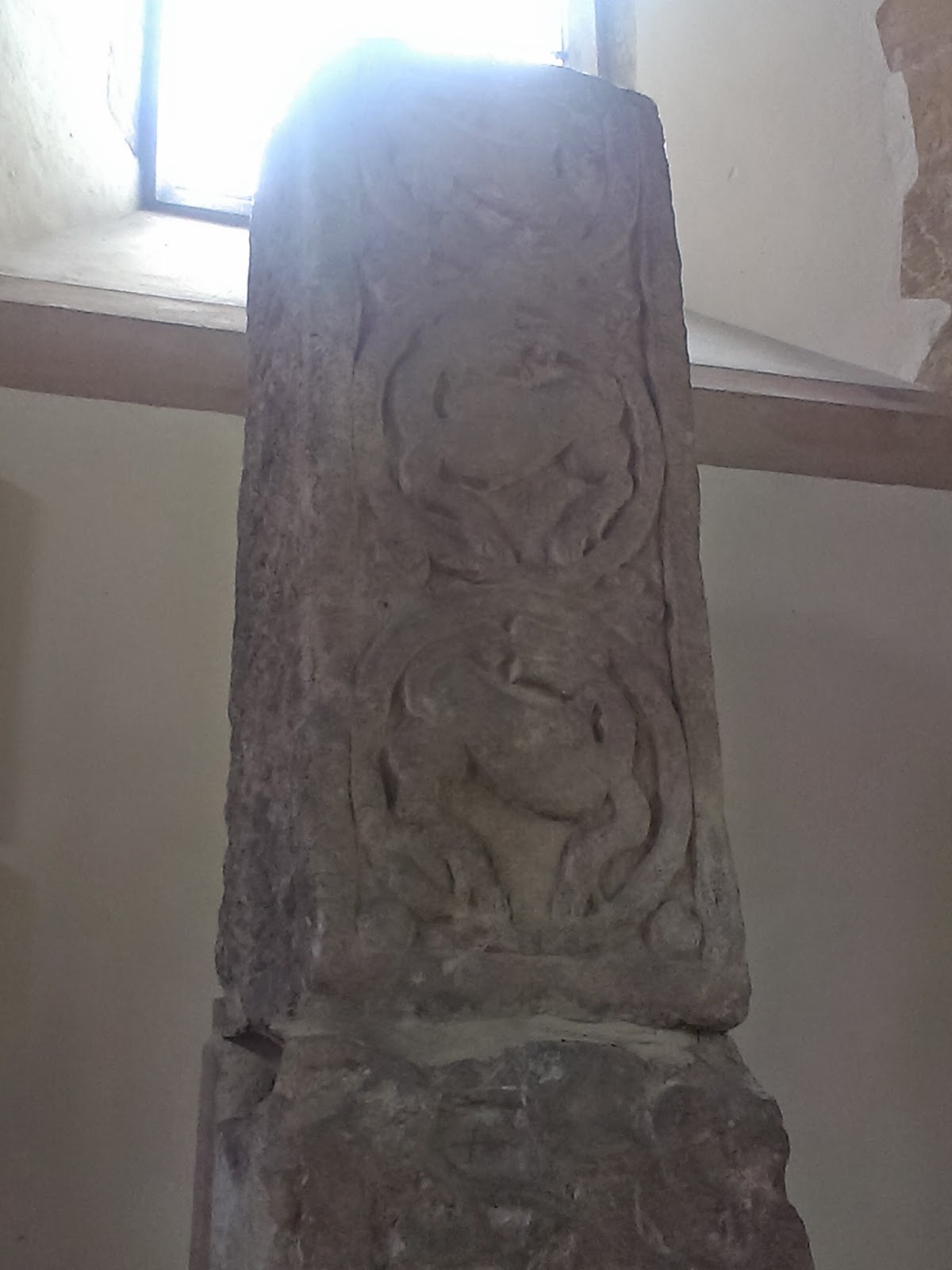
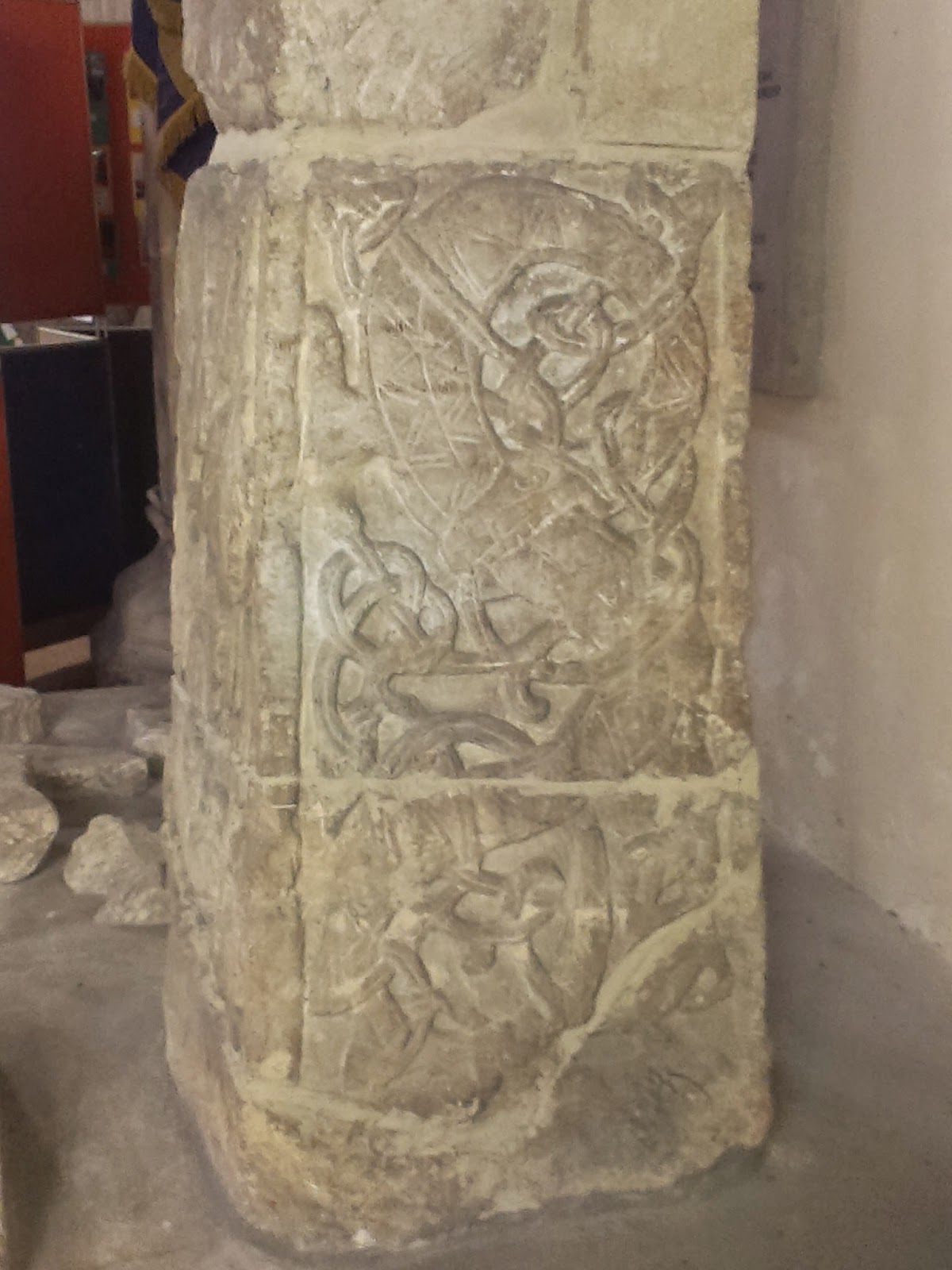
Colerne church has two parts of a Saxon cross, associated with St Aldhem's burial in Malmesbury abbey in 709AD. They are set into the wall of the church, having been found in the 1800s. It means they could be 1200 years old, which is astonishing. Both were well worn. It was hard to see what was shown on one of them, but both had interlacing figures or designs, which were quite complex. The one we chose to draw was clearer to see: it depicts two dragons, with ridged bodies and long legs that inter-weave. They appear to be biting tails as well, and I thought I could see a hint of a wing at the end of one body - but a few of the details had to be imagined, particularly for the drawing. I enjoyed drawing something quite challenging, trying to show accurately how the legs crossed over and under each other. That forced me to look properly before applying pen to paper and we stood there for quite some time (as swifts screamed outside.) Once we were home, we both realised that if we turned the dragons on their side, the drawing was symmetrical and it was much easier to see what was in the picture. We decided that it would make more sense if the stone was on its side and that originally it was probably ninety degrees to how it is currently presented.
                  Dragons on their side in Colerne
    Dragons at 90 degrees
  Then we went on to nearby Ditteridge, which continued the recurring dragon theme. Here were two dragons on the top of columns either side of the door. Facing inwards, between the door posts, were two faces, one with a curly beard. I drew both dragons, and am thinking I would quite like to do a larger piece of art with dragons as the theme.  The one on the left reminded me of the one at Harnhill, as neither of them seem to have back legs. I particularly liked how this one curved and I am pleased with my drawing.


                            Ditteridge dragon

font, Ditteridge
We had to shelter inside the church as the heavens opened (there I go again with the biblical language), and there is a lovely Norman font with circles and lines on it which I rather liked. My sister also liked the thin Norman window which had bright colours and criss crossing patterns. She has taken inspiration from our previous trip to Steeple Langford to produce a large piece of artwork, based on the designs around the Norman font there. I am impressed by its boldness and how well it evokes the sturdiness of the original stone.