Showing posts with label foliage. Show all posts

Saturday, 30 August 2014

South West Wiltshire fonts (and into Dorset)

There seemed to be a cluster of fonts worth seeing in the south west corner of Wiltshire and just over the border into Dorset, so it was to these we set off on a sunny day.

Fontmell Magna
First stop was the one furthest afield, near Shaftesbury in Dorset. Fontmell Magna is a very cute village with charming houses of brick and flint. As you enter the church, which is perched up high, the Norman font is the first thing to greet you. We were keen to see it because around the bowl are eight carvings of birds: they look most like ducks or pigeons, with fat bodies and rounded heads. Each one was slightly different, which was pleasing. I drew two; one with a sort of diamond pattern on its neck and the other with a pattern of triangles. At the back of the church was a slightly neglected looking font bowl which was labelled Anglo Saxon. This was plainer and more worn.

Compton Abbas
Up the road we stopped at Compton Abbas church - there was a woman vacuuming so I said hello to alert her to our presence but that made her jump a foot in the air. We settled down on a pew to draw the pleasingly carved font. This one had been "recarved" in Victorian times and the foliage pattern stood out plainly from the bowl. However it was an interesting, varied design and the lines were flowing and organic.

Donhead St Mary
We drove back northwards and stopped at Donhead St Mary, another very quaint spot. This church had a lovely view of the hills and we saw the Red Arrows go over. I particularly liked this font, it was a lovely big chunky font with arches and little pillars. Above this was a complex interlacing design. I tried my best to draw what I saw and am quite pleased with how it came out. The church had a restful atmosphere.

Ansty
Further east, we stopped at Ansty, a small out of the way place with a beautiful old building next to a pond. It seemed a popular spot.  The church was small and plain inside but with a charmingly simple font, small and carved simply with a circular design, or droplets. They reminded me of Christmas baubles. It was a test to see if we could actually draw what was there.

Ebbesbourne Wake
Finally we drove on to Ebbesbourne Wake - one of a series of villages set high up on a ridge, which felt strangely out of the way from anywhere else. After getting unnecessarily lost looking for the church, we recognised the design of the font as similar to Steeple Langford. On a much smaller scale, but nonetheless just as pleasing. It was also in marble, but without any face details on the top side.  Each side had a different design, just like Steeple Langford. We did not do any drawing here but decided to head home.

We drove past a very cute little church at Fifield Bavant, perched on a hill in a field. We were just going to see if it was by some miracle open, when we realised there was a large horse between us and the church and then a dog wandered over from the farm opposite to see what we were doing. Not wishing to be attacked by either of them we decided to head home, as chances were such an out of the way tiny place would be locked anyway.

Friday, 29 August 2014

Bank holiday bonanza

As it was a Bank Holiday it somehow begged to be spent on a bit of a mega-trip seeking more Norman excitement - and despite the weather we did just that. It rained from the minute we set out to half an hour after we got in - but we did not let that put us off.

We decided to go to what is known by us as a "pink area" - which means that there is a cluster of churches in one area which have been rated (by us, via Pevsner) to have top quality carvings. Our ratings are based on what has been said in the book rather than our appraisal of it post-visit, and so they do not always prove accurate, but pinks usually have more than one thing of interest. It is amazing that this particular area, north of Swindon, is jam-packed full of churches with pink status, so much so that we could barely drive in any direction without encountering a pink village. Talk about being spoilt for choice.
Kencot

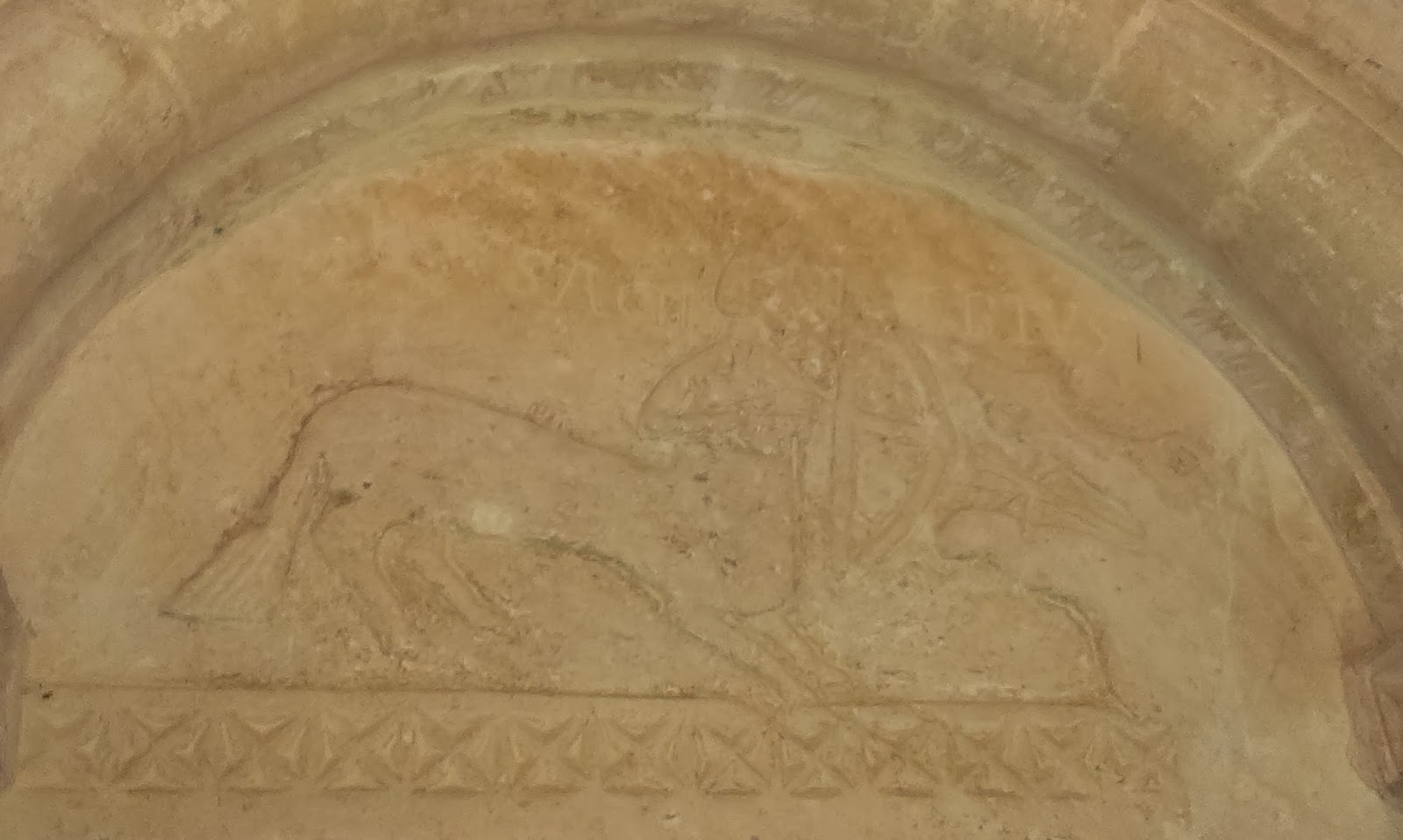
We drove to the furthest one north so that we could work our way back (probably wise, given that otherwise we could have been "just having a look at the next village" all day long).  Kencot in Oxfordshire (near to the wonderful Cotswold Wildlife Park) had a delightful little church and an equally delightful tympanum set over the main doorway. It featured Sagittarius with a bow and arrow drawn on a poor dragon's head. I loved the dragon's head, it was big and bold with a comical look and a pleasing eye and ear. Sagittarius had well observed legs and hooves and his name "Sagittarius" across the picture, which I was stupid enough to begin to write in the wrong place on my drawing!
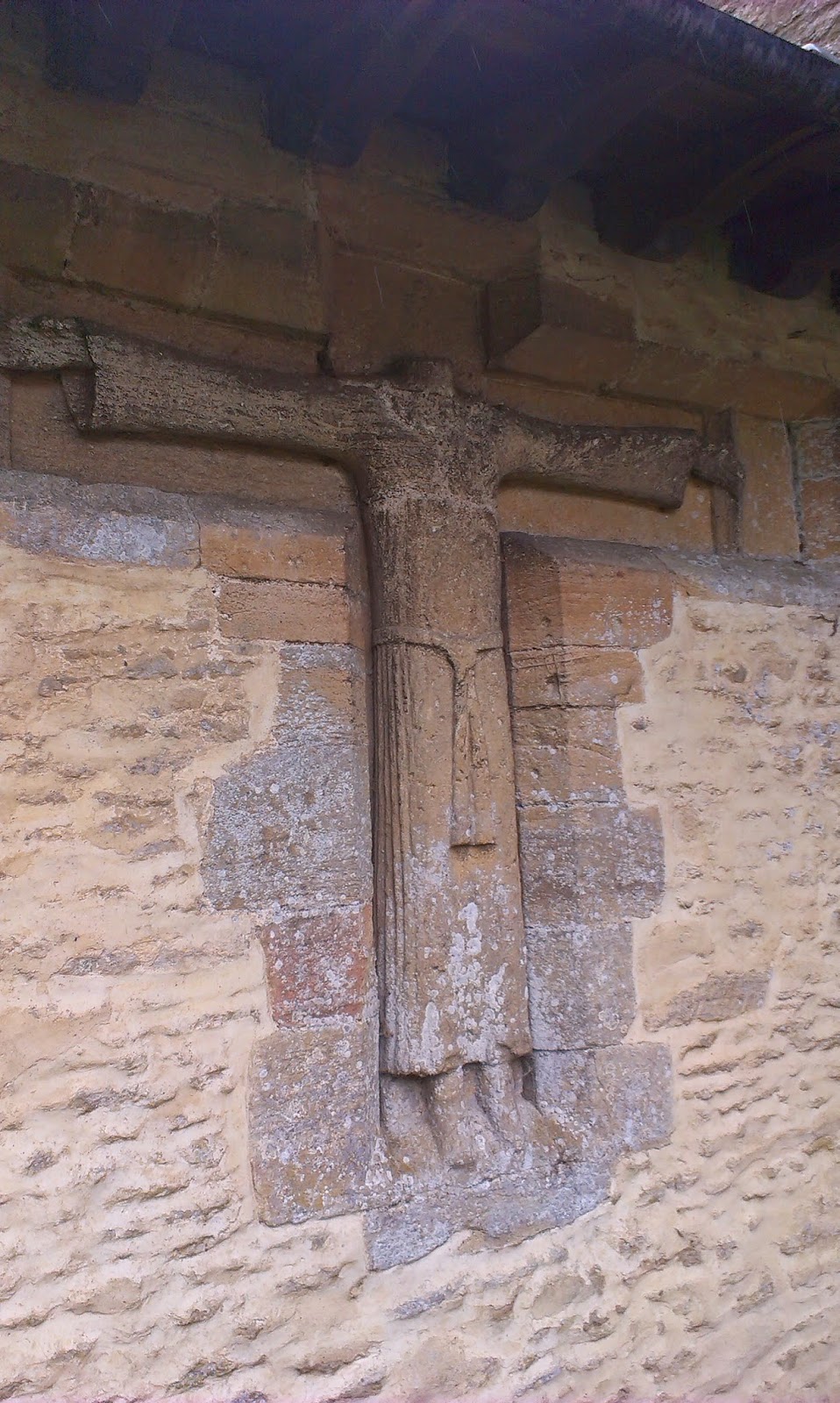
Our next stop, on the road back south, was Langford, Oxfordshire. As soon as we approached we were amazed to see a large Saxon figure of Jesus (minus his head, poor chap) on the side of the porch. It looked very similar to the wonderful carvings at Daglingworth, Gloucestershire, because of the proportions of the figure, quite thin, with a long tunic and a rope tie around the tunic. We would have loved to draw Saxon Jesus but the rain just would not stop and it was not possible. Inside the church (accompanied by a faintly unpleasant smell) was a nice window of St Francis of Assisi and lots of birds.

Heading south again, we stopped at Inglesham, back inside the border of Wiltshire. We were not expecting what we found: the church is not one in active use but is preserved by the Churches Conservation Trust. It has escaped the sometimes ghastly make-overs done by the Victorians and as such you could see what churches used to be like before those times. Of Anglo Saxon origin, it has traces of wall paintings, wooden box pews and ancient memorials. There in the corner was an Anglo Saxon carving of Jesus and Mary, looking for all the world like some weird creepy alien face from modern times. I am not being sacrilegious, but simply describing what I saw. The features of Mary's face were rather strange, and although Jesus's facial features were a bit worn, we both thought he looked like he was an adult form on her knee, rather than a baby.

Our next stop was at the larger Highworth, where we glad to get out of the rain and find a re-positioned tympanum, over the entrance but inside the church. It was a touch too high up to see well and I did a most unsatisfactory drawing of it, but it was an interesting subject: Samson and the lion. Samson, in cloak and dress, had both hands on the lion's mouth. I feel he should have left him alone really. 

Disappointingly, Stanton Fitzwarren church was locked, despite proclamations on the notice board that we were welcome to come in and look at its history. I had been looking forward to seeing a font with detailed carvings of figures, but there are times when you are just not in the mood for ringing the church warden, especially when it was still raining and there were simply loads of other "pinks" to choose from along the way.

So we back-tracked north a little to visit Castle Eaton, and I was pleased to actually navigate accurately to the church for once. We were greeted by a pleasingly chunky font in the belltower, with a swirly foliage band around the centre, and also two more of the beautiful dragon head carvings on either side of the main entrance. These were smaller versions to the ones we have seen, but for me, equally appealing with their big toothy grins. And indeed we had had plenty to smile about in such a packed day and who cares that it rained all day, that is traditional.

Saturday, 9 August 2014

Potterne, Chirton and Upavon

Not only is the hunt for more Norman sculpture becoming increasingly interesting in terms of what we find, it is also a great way of seeing different parts of the countryside. I feel I have covered a lot of Wiltshire now and it is such a pretty county. We have seen so many quaint English villages, you begin to think that everyone lives in beautiful old cottages.

On a trip out to the Devizes area we first stopped off in Potterne, to have a look at the font there which is large and plain but unusual in that it has writing around its rim.

Then it was on to Chirton, which has a double whammy with a door adorned with beakheads (aka beaky creatures) and also a fantastic font, containing twelve carved figures - you've guessed it, the twelve apostles. The beakheads were, I hesitate to say "the usual" because clearly I'm becoming too used to seeing such fun and fine carvings - they were recognisably the same sort of style as many others we had seen, fairly chunky and with the same wide variation between faces - some with horns, some with beaks, some with teeth, some with long ears - even a hand. One looked like a dog with floppy ears, or a pig which was rather unusual.

The font was interesting because each figure was different and I expect if you had known what to look for, you could perhaps identify some of them from what they were holding. The only one we knew was Peter, who is always shown carrying keys. My sister had read that he has 2 keys in many pictures. I guessed this would be one to the front gate of Heaven and one to the back? We also both liked the elaborate foliage/organic design around the top and bottom of the font bowl. The figure I drew had rather appealing rolled hair and nicely observed folds in his gown.

Travelling onwards on the edge of Salisbury Plain, via the super quaint Urchfont, we arrived at Upavon. Here there was a most unusual font with eight sides, two of which had creatures, one had figures and five had foliage designs. The draw of this one had been the promise of two leopard like creatures - and we were not disappointed. Two panels show what we decided were more likely to be lions, and they were carved in lovely detail with a long curling tail, furry legs, and possibly a mane. They also had long claws. I was intrigued to later learn that Upavon was the setting for a big cat sighting; could the two somehow be related?

By the way, do take care if you go to Upavon as there were a gaggle of most entertaining but bolshy geese on the bridge. They even had their own sign to warn drivers - we saw them in action, coming on to the path and chasing off anyone who wished to go past, especially dogs and they were apt to cross the main road at any time, holding up traffic.

Friday, 25 July 2014

Avening and Cherington

Avening and Cherington are both in Gloucestershire and provided some key drawing opportunities. We hadn't been out drawing for a month, so we took our usual provisions and art things and set out to get back into it. Avening had quite a large church with many things to see - it was a little bit dark inside (it was a rainy day) and so we stuck to drawing what was outside the church. As you go in there is a porch and in the porchway two lovely columns with spirals. At the top of one, an unusual and interesting carved figure, which has two bodies and one head - or is it one figure but seen from both sides, as it were - slightly Picasso-esque? It had the recognisable Norman style tail heading up from underneath its body and over its back and jaunty feet. Behind its head was something indistinct like a tree.

On the other side of the door above a second column was a complex carving of foliage - with appealing chunky central shapes that looked a bit like a raspberry. It reminded us both of Rodbourne and the tree of life - similar lines and two leaves that looked almost like wings. There is a repeating theme we have seen at Whaddon where lines are joined together by a horizontal band. Like an idiot I forgot to take the photos off the temporary phone I was using so I do not have them. Inside the church were many different things including some Saxon work set in the wall and some very appealing capitals that were based on nature - there was one that had shapes which looked like ears of corn or wheat. And another a bit like grass or feathers. All very appealing but again we could not find light switches to illuminate them adequately for drawing. We managed to find a red light that turned some of the church an eerie colour, and quickly turned that off again.

Cherington just 5 minutes away, promised a Norman tympanum of two lions. We braved it through a downpour to have a look. They were quite simple figures facing each other, over the church entrance, with tails aloft (but not curved under the bodies) and surprisingly small heads. No doubt carvers had not seen many lions and these had small round faces - not quite lions - with solid stumpy legs. My sister was not totally convinced of their age but I felt they looked that old.