Showing posts with label art. Show all posts

Wednesday, 11 March 2015

Castello Ursino

Castello Ursino in Catania is a thirteenth century castle that once stood by the sea, but since the eruption of 1693, it is now inland, as lava surrounded it. It is a solid looking thing and still in good repair, with four round towers at each corner. Not far from the centre, it now houses some modern art and some ancient artefacts.

I thought it was a pleasing space to walk around, as the conversion to an art gallery has been sympathetically done and so you can still get a feeling for the castle building itself, whilst looking at the paintings and sculptures in a light and airy setting. There are three floors; the top one being an exhibition space.

The art was mostly twentieth century Sicilian artists, alongside some ancient Roman or Greek carvings, statues and some display cabinets with urns and other bits and pieces. I wasn't particularly blown away by much of the art - perhaps I was not in a very receptive mood that day - but I kept an eye out for an artist my mother had asked me to look for, namely Renato Gattuso.  His were the best thing in there, in my opinion.

I also liked a figure of a sheep with curly wool (headless).
And these octopuses reminded me of some certain squid.


Friday, 30 May 2014

Ramsbury and Hinton Parva

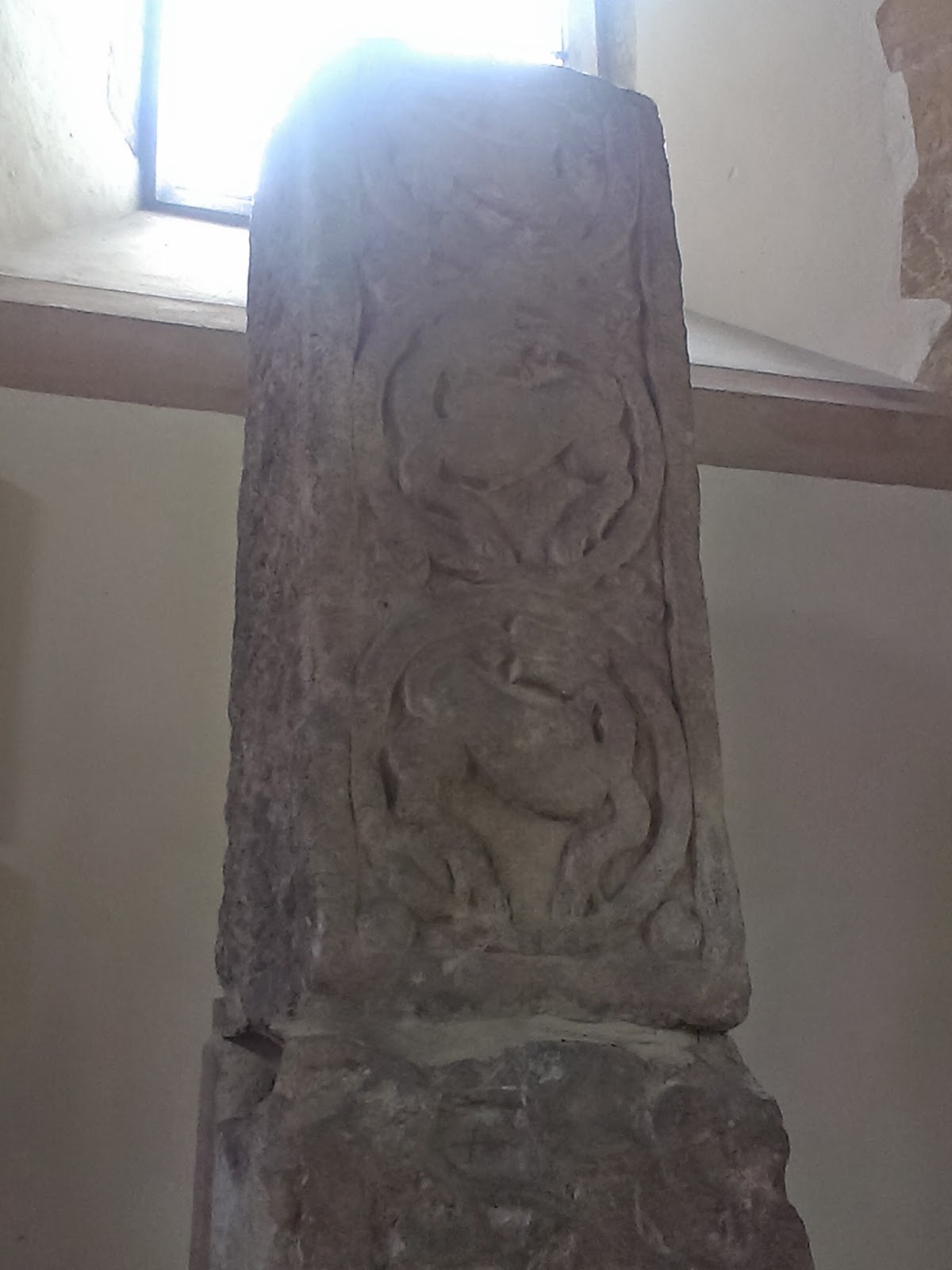
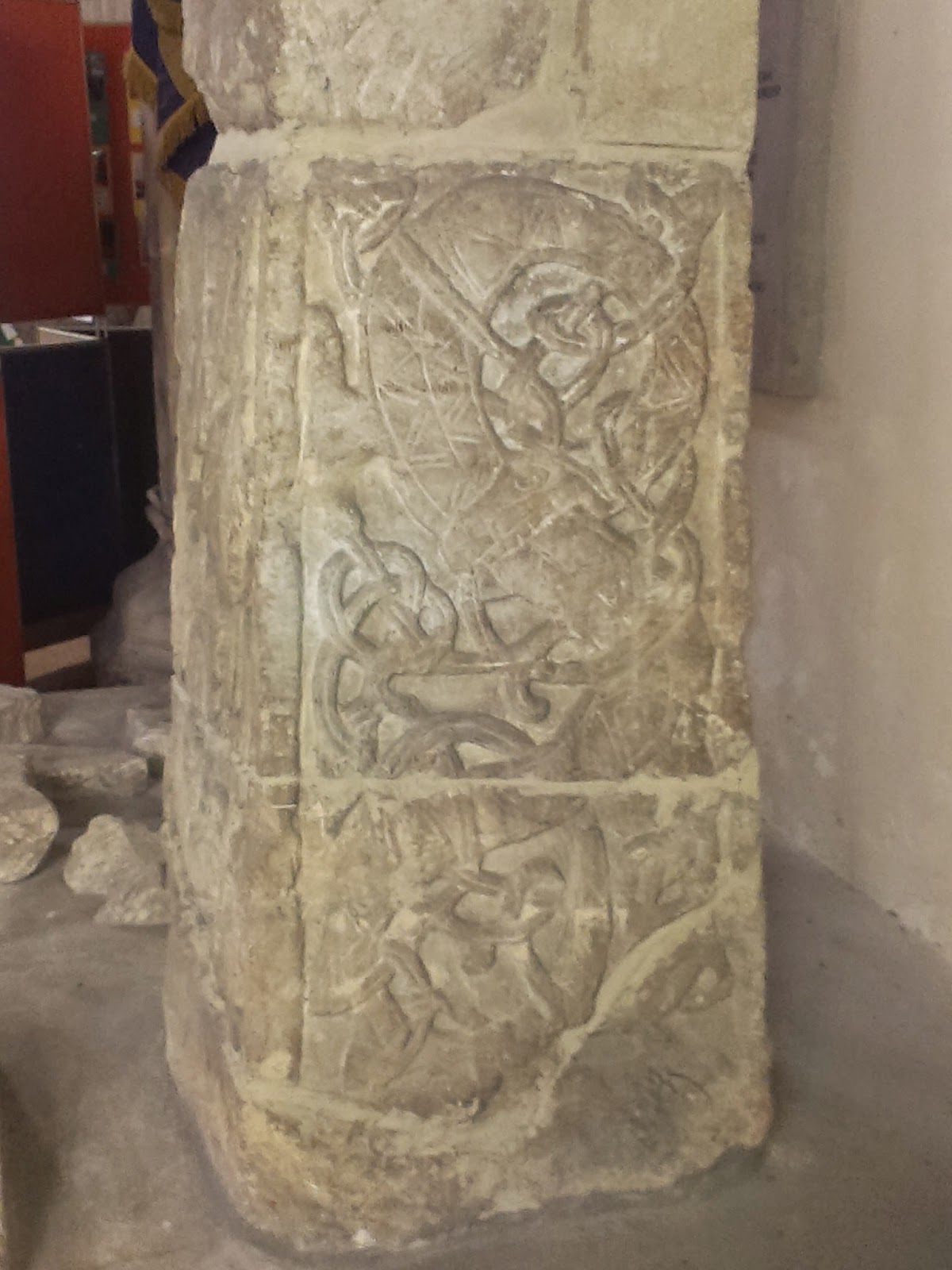
Wanderings recently took us to the beautiful village of Ramsbury, near Swindon, with narrow streets and old buildings. This was quite an unusual visit, as in contrast to the normal peace and quiet of the church, we were treated to the conversation of the cleaner and her friend, followed by the whine of the vacuum. However, this did not detract too much from the fine display of Saxon carving proudly displayed in one corner of the church. There were coffin lids and stones, with some very intricate patterns on all sides. The lines weaved under and over each other, and two sides also had a snakey or dragonesque creature. It was reminiscent of Colerne and the dragon carvings. The vacuuming ceased but was replaced by more melodic sounds, when the organist came to do his practice. This was quite enjoyable background music as we drew. You have to concentrate quite a lot to draw the lines accurately as they weave over and under. All the carvings were worn so in places you end up guessing what is going on, so that you can create a finished drawing. Above the knotwork and serpent, were three creatures in circles, all biting their own tales.
Our next stop was a little village called Hinton Parva, which was a much quieter spot. The church itself was smaller and lighter and suffered a little from damp. But it holds the most appealing font, with some delightful creatures and patterns. One half of the decoration is a series of figures of eight that intertwine. These are uniform until one end, where the pattern goes pleasingly wrong and completely out of line with the rest of it. We were joined by a member of the church who told us a bit more about it and also found the carver's "mistake" quite endearing. The other half of the decoration is really very entertaining. It is as you or I might draw creatures, which is why I like it so much. At one end is a snake, in the shape of a pretzel, with two birds and two fish. All of them have tiny dots for eyes. Around the side, after some foliage, is a four legged creature, on its side, resting its bottom on another bird. It is biting the end of some foliage. It is all very appealing.

Tuesday, 20 May 2014

Fantastic Fonts

The obsession is now reaching more and more counties. My sister has read Pevsner's books on different counties and noted the Norman and Saxon carvings which we must now somehow get to see. I even found myself reading Pevsner last week and watching a dvd about him. At the weekend we were lucky enough to be driving through Shropshire and Herefordshire and this meant that we went near to two fonts which Pevsner described as outstanding examples of what is known as the "Herefordshire School" carving, which refers to what may have been a certain group of masons working in this area, and Worcestershire, in the 1100s. The most well known example is Kilpeck, which I am sure we will get to one day.  But the two fonts we saw over the weekend were in one word, amazing.

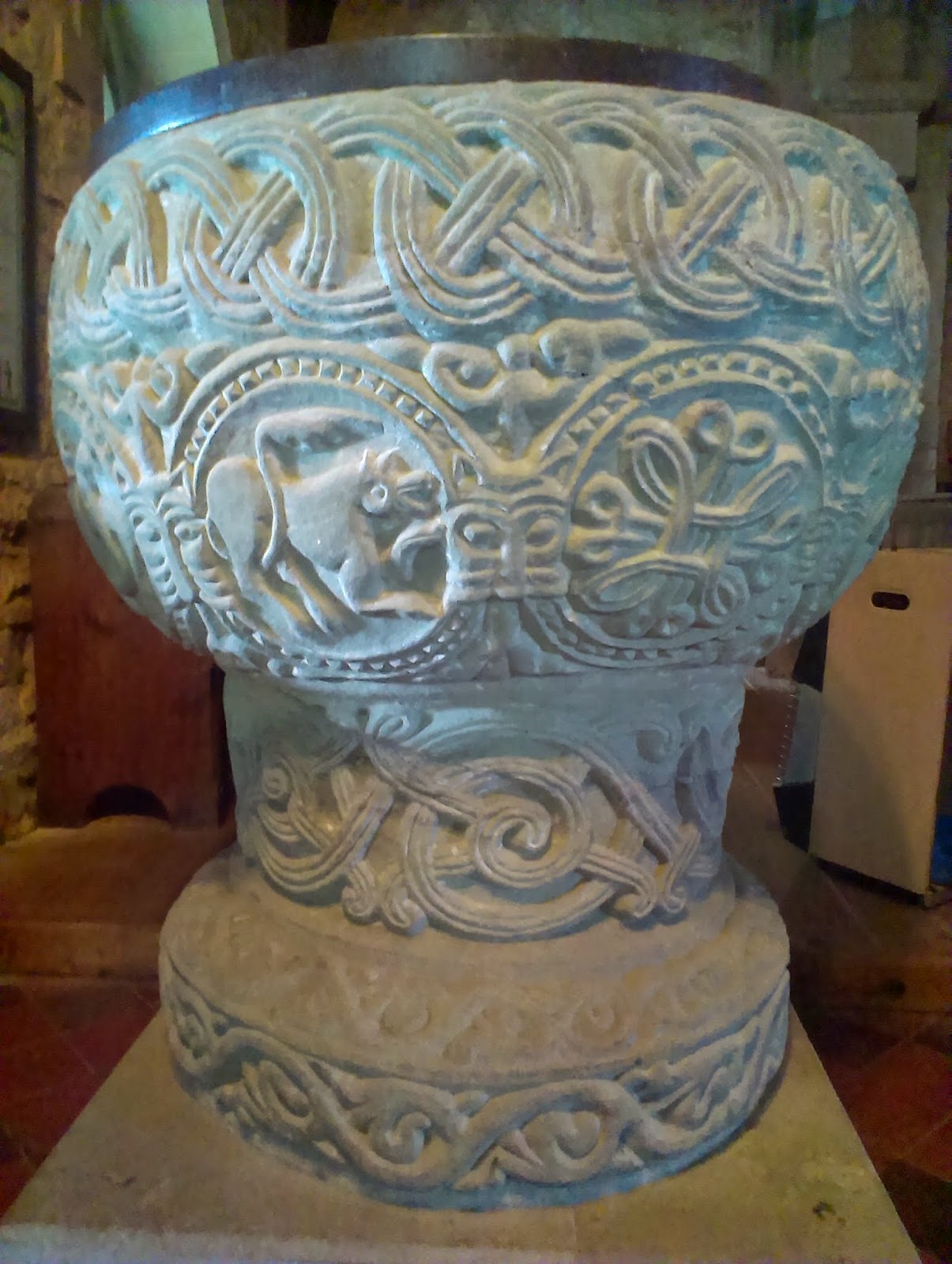
The first one seemed to be in the back of beyond, in Stottesdon, a village in Shropshire. It was tucked out of the way and it seemed very dark inside, so that we had to open the front doors to get a decent look at the font. It was very large, and covered in the most impressive carvings. Both of us stood and stared in amazement (once we could see it clearly). The top has a wide band of interlaced plaiting around it, the centre has animals in circles, and cats' faces where the circles touch. We were both thrilled to see another lamb of God and this one - yet again - looked like a dolphin's head. Perhaps it is hard to carve lambs or perhaps they were copying the style of the time.  There was a rather appealing bull/cow/type creature, a dragon biting its own tail (possibly) and some excellent birds. The base was very fancy as well, with interlacing designs. It was all very impressive.

Hidden out of view, behind the ugly organ, was a tympanum over the south door. It was hard to see in the gloom and looked quite worn anyway - there were two upside down creatures and a third upright one.

We were unimpressed by the arrival of a woman who was more bothered about why we had (inadvertently) turned on the lights at the end of the drive, instead of sharing with us how lucky she was to be a member of a church with such an amazing example of a font of the Herefordshire school.

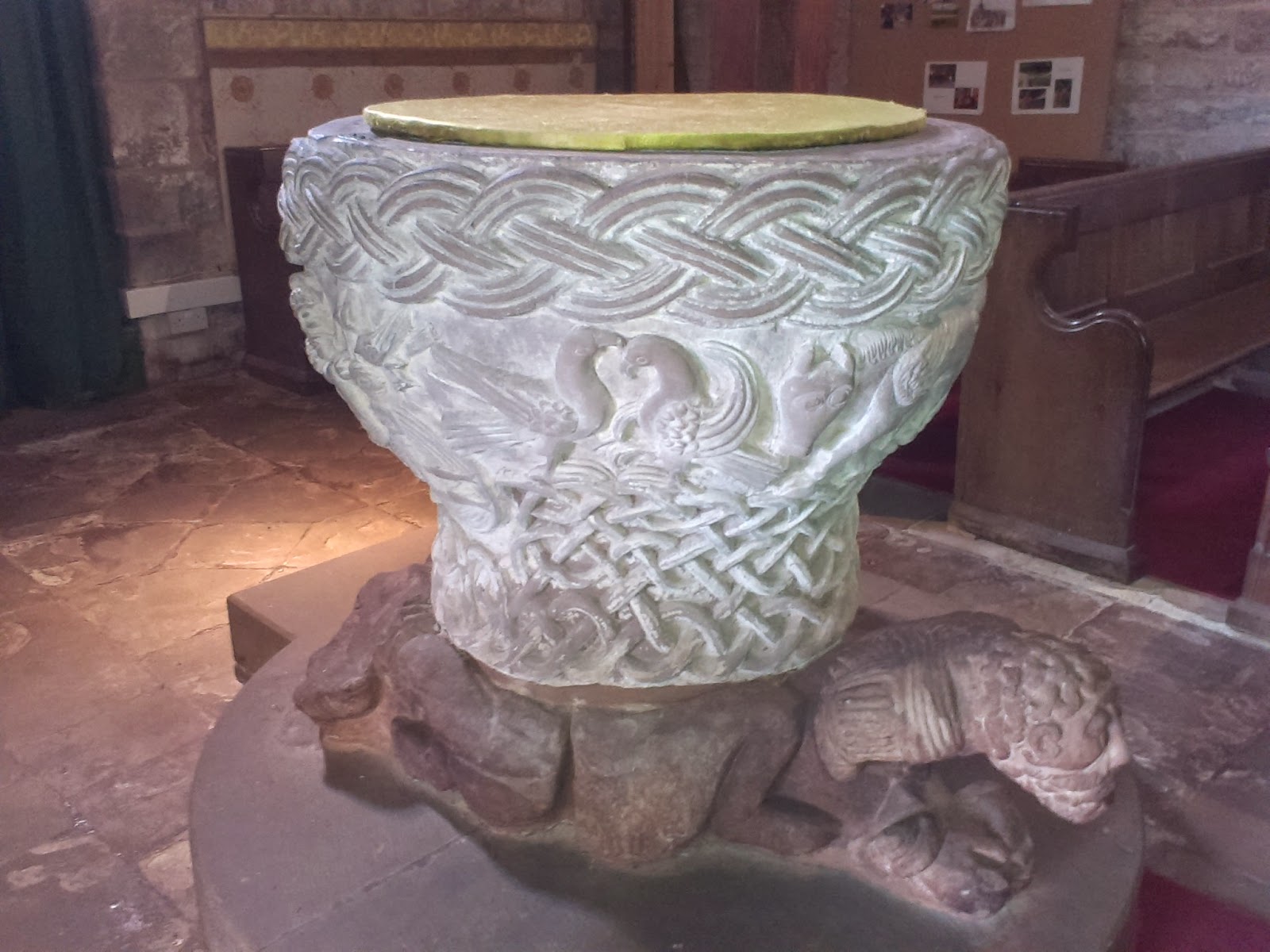
But if we thought that was good, Castle Frome held even more excitement. We nearly didn't stop to see it and we nearly didn't find the right village, but it was a good job we did. The church is really sweet and sits out of the way of the village. The outside is unusual and the porch and doorway is plain - because of this I wondered naively whether it would be good. But the door swung open and my sister literally gasped with excitement: inside, not hidden this time in darkness, is a marvellously ornate and beautifully carved font - very large and round, carved from one block, sitting on a base of strangely crouching figures (two that have lost their heads). The carving on the font was deep and sort of chunky, very tactile, although I managed to keep my hands off it, and so impressive. Around the bowl are the four evangelists in symbolic form: an angel, an eagle, a lion and a very charming bull. There are also two wonderfully observed birds, with their claws touching and their beaks jaunty, as well as a depiction of Jesus at his baptism, with John the Baptist, the hand of God and the Holy Spirit in the form of a dove. Jesus is particularly well done as he is standing in a pool of rippled water and you see the shape of his body through the ripples. In the pool are some fabulous fish.  My sister noticed that the human figures all had ankles with little circles on them, like an ankle joint.

It was better than tv and I imagine that these sort of pictures would have entertained the people of their time in much the same way that good tv can do these days. We were pleased because we actually noticed some similarities to the other font, and how the creatures all have long claws, and how the lion's tail comes up and curves over his body, exactly like the creatures at Ampney St Mary. We then read that these are features of the Herefordshire School style.

The base of the font was an intricate knotwork of patterns. No doubt it would have been tricky to draw. Sadly we were unable to stay long enough to draw this font, but it is one I would love to return to. The birds were particularly pleasing and the whole thing was beautifully preserved. The church community seemed to value and appreciate what they have there, from what I could see. If you are ever passing by, pop in. You will not be disappointed.

Sunday, 27 April 2014

Carved creatures, South Gloucestershire


South Cerney door
The list of places to visit to see carvings, in particular carved creatures, is increasing weekly. My sister has now been through a book about Gloucestershire and we have marked churches of interest on the Gloucestershire map. Enticingly, there were many which we gave the highest ranking, based on the fact they had very unusual things there or many different things in the same church. It was too tempting to take a longer trip than usual, heading off on a sunny day to villages south of Cirencester.  There was a whole cluster of churches in a small area, all with our top ranking.

Our trips are so that we can have fun drawing. I have a new sketchbook, which is larger and allows me to draw more freely. Armed with our usual snacks, three-coloured crayons, ink and watercolour, we set off to discover yet more Norman and Saxon inspiration.

Saxon door, inside
outside
We stopped off first at Somerford Keynes, where the church has an original Saxon doorway possibly dating from the 8th century. It is not every day you see something from around 700AD, and this doorway was a real treasure. I did not know what to expect, but as you came in through the front door, (an old wooden door with a fabulous opening mechanism), the Saxon door was just to the left on the facing wall. In Saxon style it was tall and narrow. A member of the parish had been good enough to pay for its preservation; it was open to the outside, rather than blocked in, with a very tasteful panel of engraved glass across the space. It let in the light to the church and made a real feature of the Saxon door. Full marks to whoever designed this. Outside, you had a real sense of the history and atmosphere of the doorway, and could easily imagine Saxon people using it to go into their church.  It had 2 rope-like motifs over the top, and was beautiful in its simplicity.  Inside the church, we were disgusted to read that a fragment of Saxon stone carving had been stolen a couple of years before.

beaky creatures
Further north we stopped at South Cerney. From the book, we were expecting to see "beakheads" or as we call them "beaky creatures" - a feature of Norman doors that can be found in this area. Previous beakheads we have seen are of creatures' faces over the archway of a door, some of them gripping the archway in their beaks or mouths. We approached the church and were both very excited by what we saw. There were many beaky creatures gripping the archway, plus some beautiful carvings above the door posts and forming the archway. The whole doorway was very ornate and must have taken ages. You didn't know where to look, or what to draw first, such was the detail.Inside there were some Saxon crosses, later carvings and a resin copy of a wooden head and foot from a rare 12C crucifix.

It wasn't far to the next village, Ampney St Mary, but finding the church proved a little more difficult. It was not actually in the village, but a small distance away, on the main road. It turned out the original village had been evacuated due to the Black Death and since then the new village had grown up further away from the church. This church has a carving over a now blocked up doorway, which is very unusual and appealing. It has a long-bodied, skinny lion, with long legs, stretched over two faces that look almost cat-like, but are attached to long, almost crescent shaped bodies - who knows what they really are (some suggest a serpent
Ampney St Mary
but I am not convinced). Next to them is a creature with a bird's head, four legs and a long forked tail. (Both this tail and the lion's tail curl up over the bodies). The inside of the church was equally pleasing and there is a nice atmosphere: all over the walls are the remains of some medieval murals, which must have been very impressive in their day. There is another ancient wooden door and a simple and sturdy Norman font with a zigzag design. If you venture up towards the altar, you will see a stone screen and suddenly notice that one side of the church is leaning outwards at an alarming angle, which is a shame.

On the route back, we passed Harnhill, so we had to call in and see St Michael fighting a dragon, over the doorway. It was a little green, but the actual carving was charming and very bold. The dragon had its tongue out and was a really nice shape; I also liked St Michael's clothes, and noticed he too had wings...
St Michael and dragon, Harnhill

At our last stop, Siddington, we were disappointed to find the church padlocked at the gate. I find it hard to believe this is necessary in these small places. It prevented us from seeing the Norman font which sounded like it had impressive decoration. However, we could peak through the netting across the doorway to look at yet more beaky creatures - these however, did not somehow hold the same appeal as those at South Cerney. We thought maybe it was because they seemed more uniform, more flatter, and also looked newer - although I believe were also Norman. An interesting and unusual thing to note about them is how one beakhead had two arms, each reaching out to its neighbour and holding their beaks shut! The beak of the creature on the left was even pulled slightly towards the hand.


Wednesday, 23 April 2014

Drawings and dragons


Who would have known that inside the many churches throughout the country, lie so many interesting and different things to discover? My sister is very interested in Norman and Saxon carvings, which we have been drawing and which become an inspiration for artwork. She has devoted her time to going through the Wiltshire volume (and others) of Pevsner, picking out the churches where there are carvings and effigies that date back one thousand years or more. The earlier the better. She has joked that it is an obsession, as now there is a map of Wiltshire which we have colour coded to show the villages where there are carvings we wish to see. We have our work cut out, as there are many, but it is proving to be a great way to discover parts of Wiltshire which you would otherwise never see. The map helps us see where there are places near each other so we have been able to visit 2 or 3 places in one day.

Malmesbury Abbey entrance
 Our most recent trips took us to North Wiltshire, to the area around Malmesbury. If you want some idea of the peak of Norman carving, Malmesbury Abbey is the place to go: the doorway to the abbey is spectacular. There are no less than eight arches forming the entranceway, three which depict many scenes inside circles, such as people in boats, or animals, or people talking to each other. In between these are swirling designs, some like vegetation, others more geometrical. It must have taken the carvers a long time and would have been amazing in its time. It still is amazing, although some of the lower part is quite worn so it is hard to make out what the figures are doing. Within one circle, which I drew, it really seemed that someone was ironing great swathes of material; hard to imagine what else they were doing.  In the porchway are sitting figures, very well observed, although we felt their heads seemed squashed in under another figure.  Unfortunately for us we went along on Good Friday so the place was busy, but we managed to sit in the sunshine on a bench and the time flew by.

In contrast, we visited a tiny place in the middle of fields, called Little Langford, in the Wylye valley. It was a beautiful spot, undisturbed except for the passing trains, but a cool and inviting little church away from the village. It had over its door a wonderful early carving of a figure with three birds in a tree, and below him a boar, surrounded by three dogs, and a person. My drawing of it looked crude and childish but in fact the figures were simple and not entirely realistic in shape or size; the boars' feet were more like paws, and the dogs had long skinny bodies, but it was a very pleasing tympanum and I am happy with my effort. The archway over the top, a commonly found zigzag pattern, was notably different to usual zigzags in that it was not uniform in size; some zigzags were shallower than others and this asymmetry was very appealing.
Little Langford tympanum

I am constantly surprised by the differences between places; some churches are small and inviting; others are unexpectedly large in the middle of a small village. We have seen amusing heads of creatures (Steeple Langford), Jesus on a dragon (Stanton St Quentin) and a "tree of life" (Rodbourne). Rodbourne was particularly nice as it also had a small stained glass window of Adam and Eve by Ford Madox Brown, next to one of the Ascension by Dante Gabriel Rosetti. Who would think that they would come across Pre-Raphaelite glass in such a tiny place?
Tree of Life, Rodbourne
What is frustrating on our tour, for it is turning into that, is that in some places we arrive in anticipation of seeing something exciting, and yet when we try the big iron handle of the church door, the door is locked. It might have instructions as to where you can find the key (as in Rodbourne) or it might not; in which case it means we cannot see these things. I doubt there is a need to keep churches locked up as the crime rate in Wiltshire is surely low, and if there are items of worth in the church then keep them locked up. It strikes me as odd that churches of all places are not accessible, but we rarely see anyone on our travels anyway, not that this bothers me at all. 

My drawing is noticeably improving which is good and I am still using crayon to give an impression, rather than spend hours drawing the details. There are many more churches we wish to visit, such as yesterday, when we went to Whaddon.
Whaddon
Whaddon

Monday, 24 March 2014

Knook and Berwick St Leonard

While I am living in Wiltshire, I have been exploring the area with my sister. We have been going to churches which have interesting historical carvings from hundreds of years ago, including Norman and Saxon times. Neither of us are religious but we are interested in the carvings and we both like to draw them. My sister has compiled a list of churches which have interesting features, so we have spent many a happy weekend visiting a few at a time. The carvings are often very impressive and it must be because they are part of the church that they have survived so well.

Today we went to the village of Knook, in Wiltshire, to the small church of St Margaret. On the back wall of the church, outside, is a carved tympanum, over what is now a blocked up doorway. This is thought to be pre-Norman carving, and although it has weathered, you can see something which looks like curving foliage, or a pattern, and perhaps figures of animals. I find I can see figures of animals in most carvings, but that is because animals are a source of great pleasure to me. My sister could see two animals' heads near the top and we both thought there appeared to be two creatures facing each other in the middle, at least one had a tail and a foot showing.  Drawing them was very absorbing and good fun. I am not excellent at drawing but as with all creative things, it is good to practise. I find it therapeutic and satisfying. While you are concentrating on seeing the shapes and interpreting this on paper, you are not thinking about anything else. It is a welcome break from day to day issues. We were being observed by a couple of churchyard rats, from time to time.

Inside the church, (a welcome respite from the cold wind), there were two Norman carvings at the tops of pillars. One was more detailed than the other and had two images of flowers/plants (pictured). The other was more asymmetrical with a less well defined but more organic, like interlacing stems or plants. I thought I could even see snakes, or a dolphin shape.

After a brief look at the nearby River Wylye, we drove on further south to Berwick St Leonard. Above the door into the church is an "agnes dei" or Lamb of God. It is of Norman origin and high over the door.  I liked it as it had quite a jaunty figure and I was pleased with my drawing. It looked to me like it was holding a handbag between its front legs. I don't suppose it was, but I could only see it in that way and so that is how I drew it. As we drew, two lovely partridges hopped over the churchyard wall. On the outside of the church there was another Norman tympanum, with flower shapes. My sister drew this but I chose to say hello to the real lambs in a nearby field.

As we left the churchyard, we came across a rather beautiful beetle, who was quite large and had a lovely blueish purple tinge. We think it is a black oil beetle.

There is something refreshing about going to see these carvings and drawing them. How strange it would be for the person who carved them to imagine that in 1000 years' time, some people would be looking at them and drawing them in multi-coloured crayons. When you look at them and then try to create an impression of them on paper, you are really seeing what is there, rather than just glancing at things as we do every day. It takes time to observe them and I feel that it makes a connection across time to the craftsman, when we stop and consider how much time and skill he put into it originally. Thinking about the centuries between us somehow gives me perspective on things today and it positions me in time; centuries of people have gone before us and centuries of people will follow. What will people be drawing in 1000 years from our time? And will there still be drawing then?

Friday, 21 March 2014

Salford Comedy Festival and LS Lowry

I am just back from my trip to Salford for two talks at the Salford Comedy Festival, at the BBC. So now the hard work begins... I have heard lots of good advice on how to write a well-crafted sitcom, who to pitch it to, and what not to do.  I went to talks given by a commissioner for the BBC, as well as writers and producers for radio and television comedy. A lot of the advice is common sense, but it sounds as though the same mistakes are made in many of the submissions they receive.

Writing for radio or for children's television is a good way in to comedy writing. It costs less to produce radio shows and you can submit sketches for topical news shows, like Newsjack or That Show What You Wrote. Producers will pick out people who make a good impression, and perhaps contact them to write something further down the line.

Key points to bear in mind when writing a sitcom are to have a well plotted story, with a structure and a decent end, rather than a series of gags. You also need to have well defined characters, who are original and whom the audience cares about, with a character flaw. Plus it has to be funny. So although the task of writing funny shows is not easy, it was good to hear how they encouraged us to submit scripts to the Writers Room, because they are always looking for something new, exciting and original.

I will be looking for inspiration everywhere I go now, and in everything I hear or see. I enjoyed my trip to Manchester/Salford, as it was all new to me. I got the tram from Picadilly right out to Salford Quays. It was fun to float through the streets in the tram, looking at the buildings and people. I had relatives who used to live in Manchester so it was nice to think of them having been there. I loved the trams: they are so clean, efficient and quiet. I saw a couple of people having to step back when the driver tooted at them, because they had not seen or heard the tram coming.  We crossed the Manchester Ship Canal - I knew it was that because it was so wide, and I saw Old Trafford (enormous) on the other side of the quays. MediaCityUK has the BBC and some of Salford University. It was modern and nicely set out. I expect it is a pleasant place to work.  On the other side of a bridge was ITV, where they film Coronation Street. All very exciting.

The Lowry is also at the quays so I was pleased I had time to visit. The galleries were very well presented. I did not know much about L.S. Lowry, so I watched a short film about him. I disagreed in places with the assumptions of the voiceover, particularly about his private erotic drawings, which the film implied meant he was weird. But these were pre-internet times and I did not see anything too unusal in them. Nor did I like how a journalist had taken photos of the rooms in Lowry's house, after Lowry had died. It felt intrusive and ghoulish. So what if he had pictures of Rosetti's women on his bedroom walls?

His less well known work was also interesting. There were a lot of pencil sketches (he sketched on anything to hand) and some paintings of the sea, which had a white sky and a white sea. A quotation next to it said that Lowry was painting his loneliness, and that also his well known crowd scenes depicted loneliness, as there was no lonelier place than in a crowd. But I am not sure they say this to me: the most famous ones, "Coming from the Mill" and "Going to the Match" were wonderful to stand in front of, letting your eyes roam from figure to figure. "Going to the Match" was particularly good how the figures, pouring towards the ground, led your eye to the same point from several directions. It evoked match day perfectly; I have only been to a couple of games but I remember all the people walking in the same direction and how weird it felt.

Despite having the song "Matchstick Men and Matchstick Cats and Dogs" going round my brain, I did not think the figures were as simplistic as matchstick men. You could tell the era the painting was done from the fashions; in the 20s, women had cloche hats, and in the 60s and 70s you could recognise the modern clothes. I loved the dogs, their simple shapes were comical.

If you are in Salford then I recommend that you visit the Lowry. I am hoping my visit will inspire my comedy writing.