Showing posts with label Saxon. Show all posts

Sunday, 11 June 2017

Combe St Nicholas, Isle Abbots, Huish Episcopi and West Camel

Heading down in a similar direction to the Dorset day out, we set out to our furthest point, Combe St Nicholas in Somerset, with the intention of heading back and stopping off at various points between here and north of Yeovil.

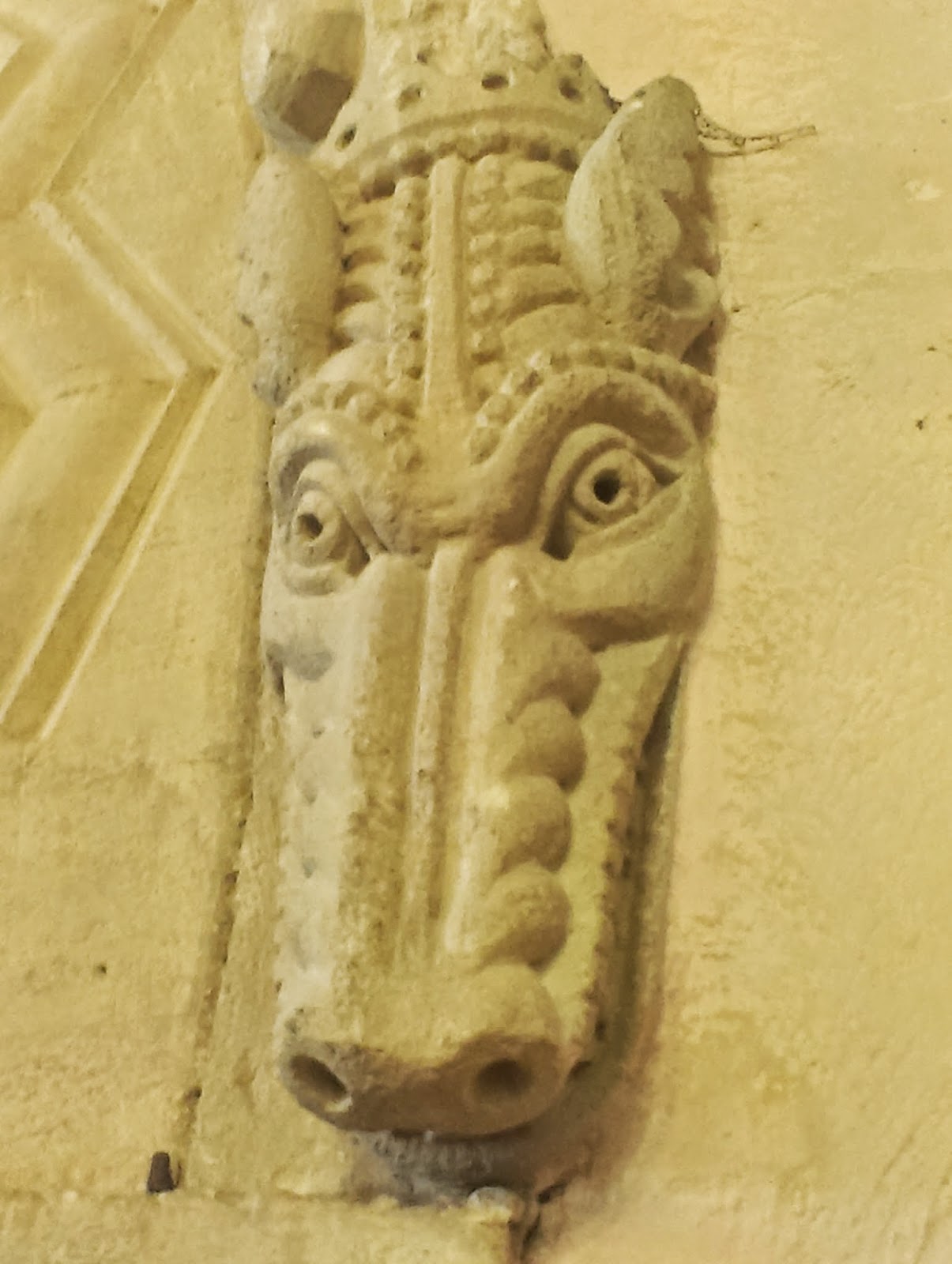
First stop Combe St Nicholas, which is in rather pleasing, hilly countryside.  The outside doors were ominously shut but luckily for us, none of the churches we visited were closed that day. Once inside the church, we were immediately faced with the creature we had travelled to see.  On the right hand side as you enter the building, what can only be described as a cow type creature looked down at us from atop a column. It was quite chunky with a definite square-faced, cow type mouth and nose, and cowy ears. From its mouth came lines of swirling pattern that looped round and about, ending in a sort of hand shape, or flower.  The carved swirling lines are a familiar design, but never before seen emanating from a cow.

Onwards to Isle Abbots / Isle Abbotts, a village nestled so deeply in the countryside that I thought we would never get there. It was almost Melbury Bubb all over again (minus the rain) as I tried unsuccessfully to figure out which of the tiny white roads (on the road map) we were now on. They never seem to correspond to what is in front of you. My sister did well to spot roadsigns as they were nestled in the growth of summer foliage, and mostly hidden from view. We thought if the Germans had landed there in the war, they would have been completely flummoxed.  Eventually we found it and had our lunch on a handy bench. The tower was huge, as were many in that area - a sign of the wealth, no doubt. Inside a delightful sandy-coloured font, four sides, the one facing us showing a rather curious creature, upside down.

Each side has a different pattern on it, quite worn, but we deciphered some animals and different patterns. I found the upside-down creature fascinating: to me it honestly looked most like a dolphin - an unsual creature for a font design, but not beyond the realms of possibility. If someone had seen one on his travels (we are not that far from water) then he might have wanted to depict it for others. It was upside down, yet none of the other sides were, making me think this was how the person had seen the creature. Perhaps leaping out of the sea. It had the bulbous head of a dolphin, with a beaky nose, and no legs but a streamlined body which ended in a sort of tail. I'm convinced anyway. Either that or it was an alien.  Or a lizard. On the other sides we made out a sort of bird and a rather fetching wyvern, most interestingly shown between/behind a column design - quite an unusual feature to show something behind something else like this.
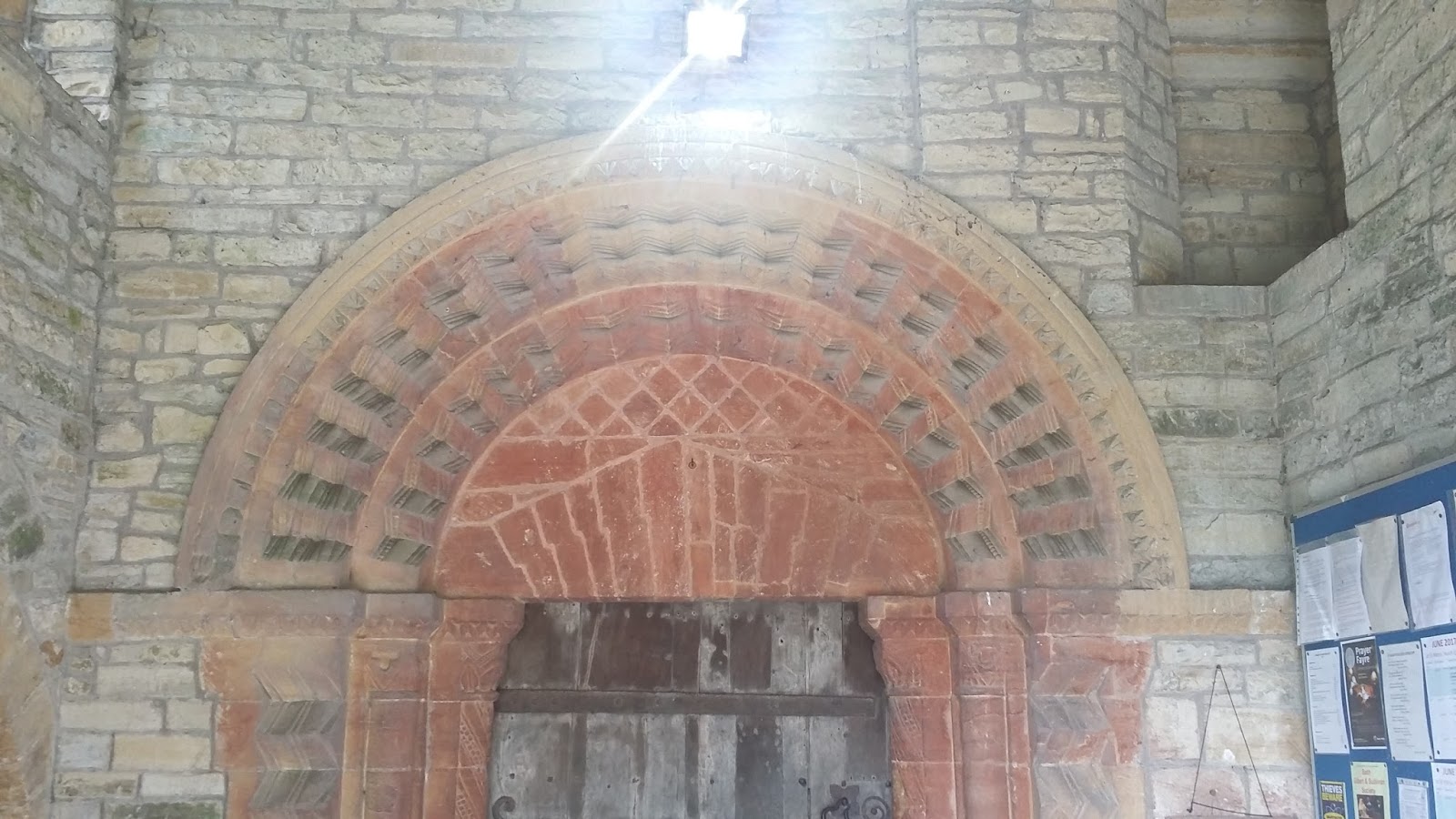
External factors meant we were glad to reach our third stop, Huish Episcopi - so called, apparently after "hiwisc" (house) in OE, and episcopi - to do with the Bishop of Wells. St Mary's church has a very fine example of a carved door, with the added delight of its reddish brown colour, possibly the result of a fire. The door had very chunky zigzag arches, with interesting designs around the top. There were two tiny creature heads on either side, and some fabulous columns with leaves and patterns at the top. A fine example. I'm glad to say that we no longer attempt madly to draw the whole thing, as was once the case when we began on these quests, but now realise that it is only possible to draw a detail or two.  Inside the church was a rather impressive window, with a lot of angels' wings and striking reds. It reminded me of the windows by Burne Jones in Birmingham cathedral. I didn't say anything at the time but it turns out the window is by Burne Jones. Fancy that!

Moving on from Huish Episcopi, we headed back towards home and decided to squeeze in a trip to
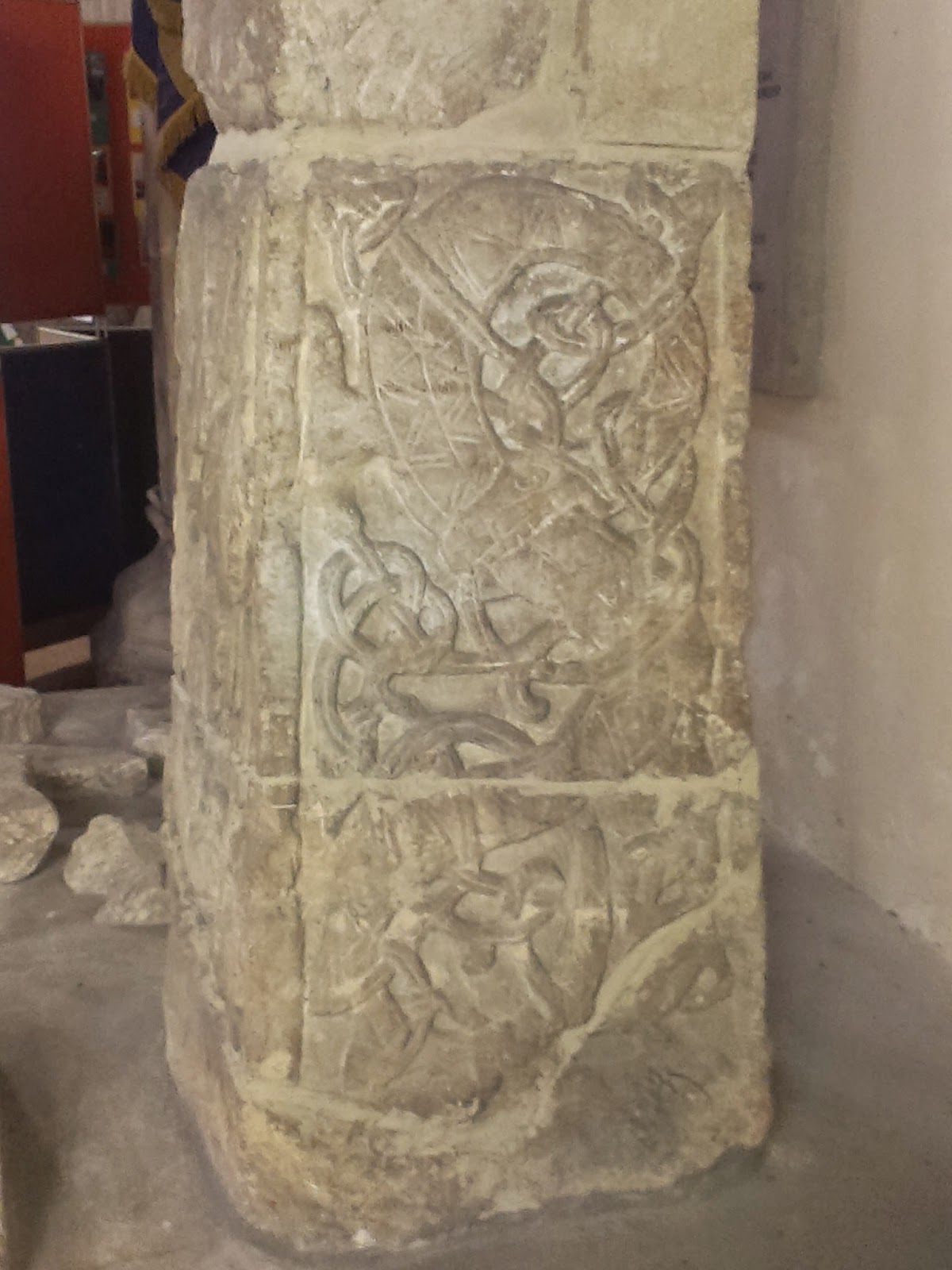
West Camel. This time we knew where it was having been on our last trip but not having had the nerve to interrupt a singing session that was taking place inside. This time however it was open and empty and we were delighted to see not just a lovely font with pleasing archway design, but one of the finest Anglo Saxon carved stones we have had the pleasure to see. This one had pride of place up by the altar, and is nicely secure. It had two sides carved with intricate and still well defined knotwork and interlacing patterns. One side definitely had two snake/dragon heads at the end of the intertwining bits. The other side might have had but the ends were more worn. It is definitely one of the best preserved pieces we have come across. And impossible to know where to begin to draw. Especially at the end of the day when we were tired. But I did an "impression" of it which was really a cop out, but it might be fun to try and do some artwork from the photos. I pondered on how they would have done the original - you would have to have had a sketch as you could easily go wrong with the under/over alternation between the patterns.


Saturday, 27 May 2017

Bibury, Windrush and Cold Aston

On a beautiful sunny day we decided to head further afield to explore the rich pickings in the Cirencester area. North east of the town is a small Cotswolds village called Bibury. We (in our ignorance?) had never heard of it, it was in the middle of the countryside. So it was to our great surprise when we turned into the main street to see coachloads of Japanese tourists standing in the road, sporting pollution face-masks and taking photos with their selfie-sticks. A look to the right confirmed why - Bibury is home to a remarkable and ultra-quaint row of weavers' cottages, that are quintissential English cuteness. I recognised them instantly as the recent location of the yellow car parade that went through the village in support of one of said cottages' residents.  Even though there were ice cream shops along the main road, we drove on to the church and were lucky to find a parking space.

What an unusual place, there was even an interesting old building backing onto the churchyard where we had our boiled eggs (now a must-have) and weak lemon drink. Many tourists had drifted up as far as the church (we are not used to being disturbed) which had several things of interest, including a deceivingly simple circle design that proved impossible to draw. Even at home. The interior had several carved features and a copy of a Saxon carving which is now safely in a museum.

Back on the road, we were spoilt for choice and headed off to Windrush in Oxfordshire (we are slowly getting further and further afield and several counties from home). It was a quiet, idyllic spot (bar the Tory posters dotted throughout the well-to-do villages) - with lovely views. What's here...? Oh my god, a DOUBLE beakhead door! Double beakheads! Previously unheard of an unseen in our travels. Not one arch of beaky creatures gripping the door, but TWO, an inner and outer arch. They had been strangely cleaned but maybe this was a good thing - just weird given that we are used to worn and weathered carvings. The cleanness of them gave them a weird new feel. But more to the point they were quite unusual beakheads. Their blank, almond shaped eyes, and long beaks, gave them a decidedly menacing feel, which we both thought, and we were rather wary of them.  My sister tripped backwards up the step and ended up sitting down which was perhaps unsurprising, given their startling appearance.


Last stop, which we squeezed in, was Cold Aston, yet another small cute Cotswold village. Unfortunately the church was next to the school - I say unfortunately because while we were there the poor innocents were marched into the church for a short lesson on kindness or something.  We however were busy engaged in the carvings in the porch, and a rich and varied treasure trove they were. My sister diligently drew the extensive saltire cross pattern filling the tympanum and some of the carved woven pattern in one of several chunks of carving set into the wall. I was intrigued by a relative of the minute head at Maperton, one almost green-mannish head with (what I thought were) leaves for hair, and a hole in his head which formed part of a drain for water (or so it seemed). He seemed quite a cheerful chap (at least in my drawing) and I was pleased with my effort.


Wednesday, 14 September 2016

Deerhurst and Upleadon

Once in a while we are on route somewhere other than a church and are tempted to squeeze some fonting into the journey. Well if we are passing near to a known site, it seems silly not to visit. Happily the Blue Book makes it easy to find somewhere not ludicrously off course.

One such stop-off was the village of Deerhurst. Luckily for us, it was well signposted as in addition to the village church and the delights therein, it has an extra building of Saxon origin, Odda's Chapel, now cared for by English Heritage. This was apparently built by Earl Odda for his brother Aelfric. Strangely someone had incorporated a farmhouse into one end in Tudor times, which looked rather odd. But the building itself held less interest for me than the contents of the nearby church, St Mary's. The existence of a second Saxon building is quite unusual. So it was not surprising that both are clearly signposted, which saved us our usual trick of hunting down every side road. In fact the church had no end of signs, with one taking us all the way round the building to the "angel" high up on the back wall, another pointing to the toilets (a rare and welcome facility for the travelling fonter) and even an array of labels inside the WC in case you weren't sure how to identify a hand dryer. But it was a joy to see that someone evidently welcomed and expected visitors.

Inside the church (diligently being cleaned by someone) we were greeted with a wonderful sight. You may think you have seen something already when you have seen a photograph, but it does not beat seeing it for real. Deerhurst's font is one of very few surviving Anglo Saxon fonts... if indeed there are any. We bought a pamphlet (one of many) on the Anglo Saxon features of the church and it suggested that Deerhurst is the best example, if it is indeed a font, which the author thought it was. It seems to fit the dimensions of the fonts we have seen, and the base, if it is the original base for a font, has the same intricate spiral/scroll pattern which decorates the top bowl. It is an elaborate pattern which suggests that it must have been an important place to have such a lovely font. We sat ready to draw. R went to look for lights to that area of the church. To my sheer amazement, sensitively done floor lights came on all around the base of the font and lit it up so you could best appreciate the carving. I have never seen a font so well appreciated and cared for by its parish and being as fond as I am of them, it felt like the pinnacle of font appreciation - if only every beautiful font could be appreciated and valued in this way. Some cost and consideration had gone into presenting this font and it is so nice to know it will be looked after.  Unlike in times gone by when it was found being used as a drinking vessel in a farmyard and rescued by a bishop.

Drawing the pattern proved more difficult. We would have needed a lot more time than we had to make any decent attempt and mine was more of a rough representation. It turned out that the swirls were quite complicated and not all the same and it made your eyes go funny looking at them for too long.

The church also has beast heads, two wonderful ones by the main door, with fangs, pointy ears and a prominent snout, not so much dragons but a cross between wolves and something else, and two at the back of the church, which according to the pamphlet, could have been adorned with paint and jewels for eyes in their time, one of which looked like a hippo to me.

Upleadon
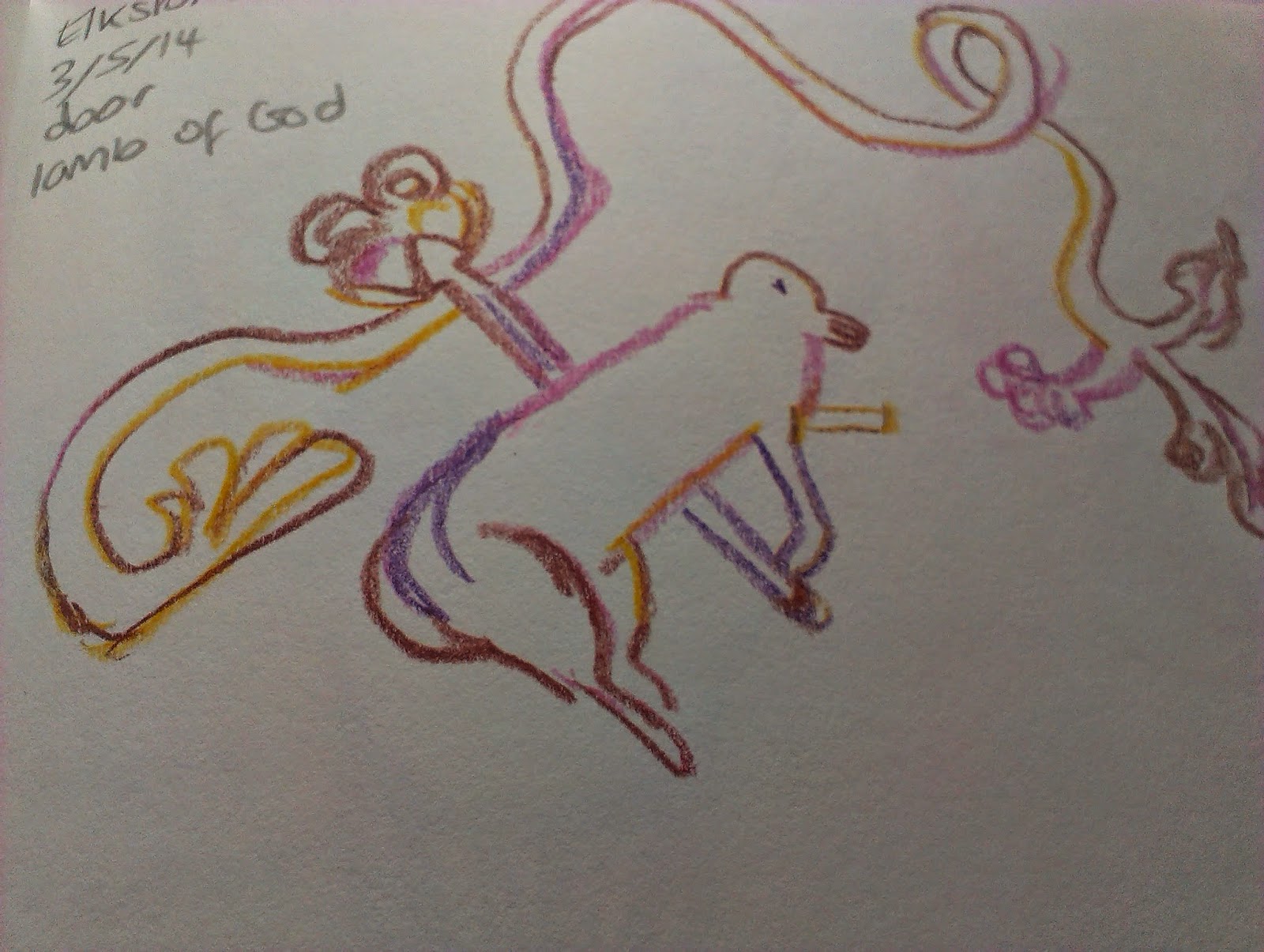
Upleadon is not far from Deerhurst and provided a good stop-off point on our return journey. However, it was not so well signposted, as usual, so we found ourselves in familiar territory driving into the village and then having to go back on ourselves, ask a stranger and then keep our eyes peeled. It was a little way out of the main village next to a large house and farm. It is very unusual with a tower of brick and timber. This one boasts a rather fine tympanum over the main door, with nothing less than a Lamb of God, complete with jaunty foot, and flanked by two "lion-like" creatures, with the requisite tails curling up under their bodies. It was not unlike the design at Pen Selwood, a thought we both had, cheeringly - we are now a walking resource on these things.  I loved it - it had a pleasing simplicity but with some unusual details such as the rather attractive circle around the lamb, which was a plain and a beaded band intertwined. As I drew it, mine seemed to go a bit haphazard and I think the carver found the same difficulty.  The animals had rather humanoid features.


There was another creature on the left hand capital of the door, with an interesting tail, and a design on the right hand one.

It may have been out of the way and harder to find than Deerhurst but it was equally pleasing and quite a peaceful spot.

Thursday, 21 July 2016

Romsey

When asked what I wanted to do for my birthday, the answer was simple. Yes, animals are always a good option but fonts (or rather, Romanesque carving) won. As a special treat we went that bit further to Romsey Abbey, near Southampton. And it really proved to be the sort of special treat you want for a special birthday, as mine was.

Before we even got inside, we were delighted to find wonderful Norman corbels high up around the outside walls. Most were of faces of people or animals and some distinctly different to those we have seen before; some faces had things inside their wide open mouths such as figures of people. There were also a number of pairs of heads. The garden outside was a lovely spot to stuff our faces so we admired the corbels as we ate.

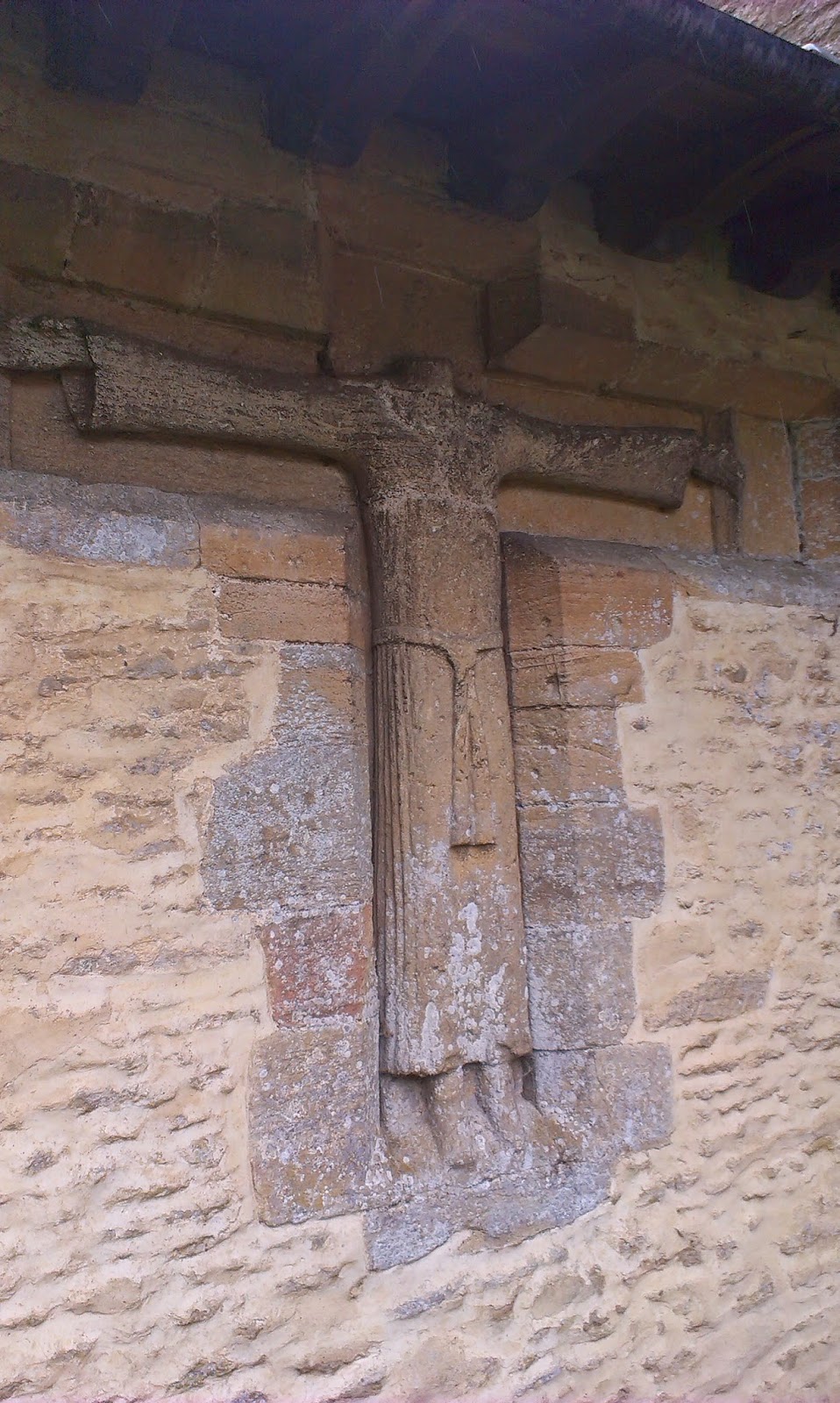
Around the corner from the main entrance was a figure of Jesus, on his cross, not unlike the one at Langford. Over this one was a hand of God. The Jesus was next to a rather fine door, I'm not sure how much of it had been touched up as it seemed in remarkably good nick.  Then more corbels (it was a bit overwhelming) and then we finally made it to the front entrance.

Inside you are struck by the high walls and lofty ceilings of the building. It has many treasures and they are keen for you not to miss any of them, as a detailed map was given to us by an interested guide (although this was once we had been round the abbey already). We were both soon going from one thing to another, doing the usual thing of "look!" and then finding something even more exciting around the next corner. In terms of Norman carvings, the place is a real gem. Towards the back of the abbey, every column seems to be topped with a carved capital - and all seem different. You have the foliage design, reminiscent of Knook, and some more unusual ones of people and animals. The abbey had provided a drawing of some of the more complicated ones, suggesting what was being depicted, but cynical and questioning as we are, we did not take everything as gospel (despite being in a church). The only problem was that all the capitals were hard to see for two reasons: the main one being the height - it was impossible to crane your neck back and to see anything in detail with them being so high above your head. And secondly, each was lit with a bulb that shone down into your eyes so you could not see very well anyway. It was a real shame and we considered writing to the abbey to see if we could get a ladder or platform from which to view them all close up, under the guise of wanting to produce a book on them.

see how high they are
The back of the abbey is just one carved capital after another and then you come across the far right hand corner, where there is a Saxon rood. Thankfully you can have a proper look at this one. The figure of Jesus on the cross and the people around him stood out from a darker coloured backgro
und... which on closer inspection appeared to have been painted in bronze enamel paint, which had been applied quite carelessly. We almost began hyperventilating at this - clearly someone had done this in the recent history of this ancient carving. I just hope the offending paint can be removed without any damage.

Luckily there were plenty more carved capitals around the corner to distract us, including a rather cute one of animals biting each other. It is just a shame we could not draw anything because we could not see it in enough detail at that distance.  Unsurprisingly, many people going round were not looking up and so were walking past, in our opinions, the best bits.


So to fully appreciate the abbey we need to return with ladders and permission to shin up them, although even then I don't think I'd be able to draw at such heady heights. But even without drawing it was the perfect place for a birthday.

Who did this!?

Friday, 29 August 2014

Bank holiday bonanza

As it was a Bank Holiday it somehow begged to be spent on a bit of a mega-trip seeking more Norman excitement - and despite the weather we did just that. It rained from the minute we set out to half an hour after we got in - but we did not let that put us off.

We decided to go to what is known by us as a "pink area" - which means that there is a cluster of churches in one area which have been rated (by us, via Pevsner) to have top quality carvings. Our ratings are based on what has been said in the book rather than our appraisal of it post-visit, and so they do not always prove accurate, but pinks usually have more than one thing of interest. It is amazing that this particular area, north of Swindon, is jam-packed full of churches with pink status, so much so that we could barely drive in any direction without encountering a pink village. Talk about being spoilt for choice.
Kencot

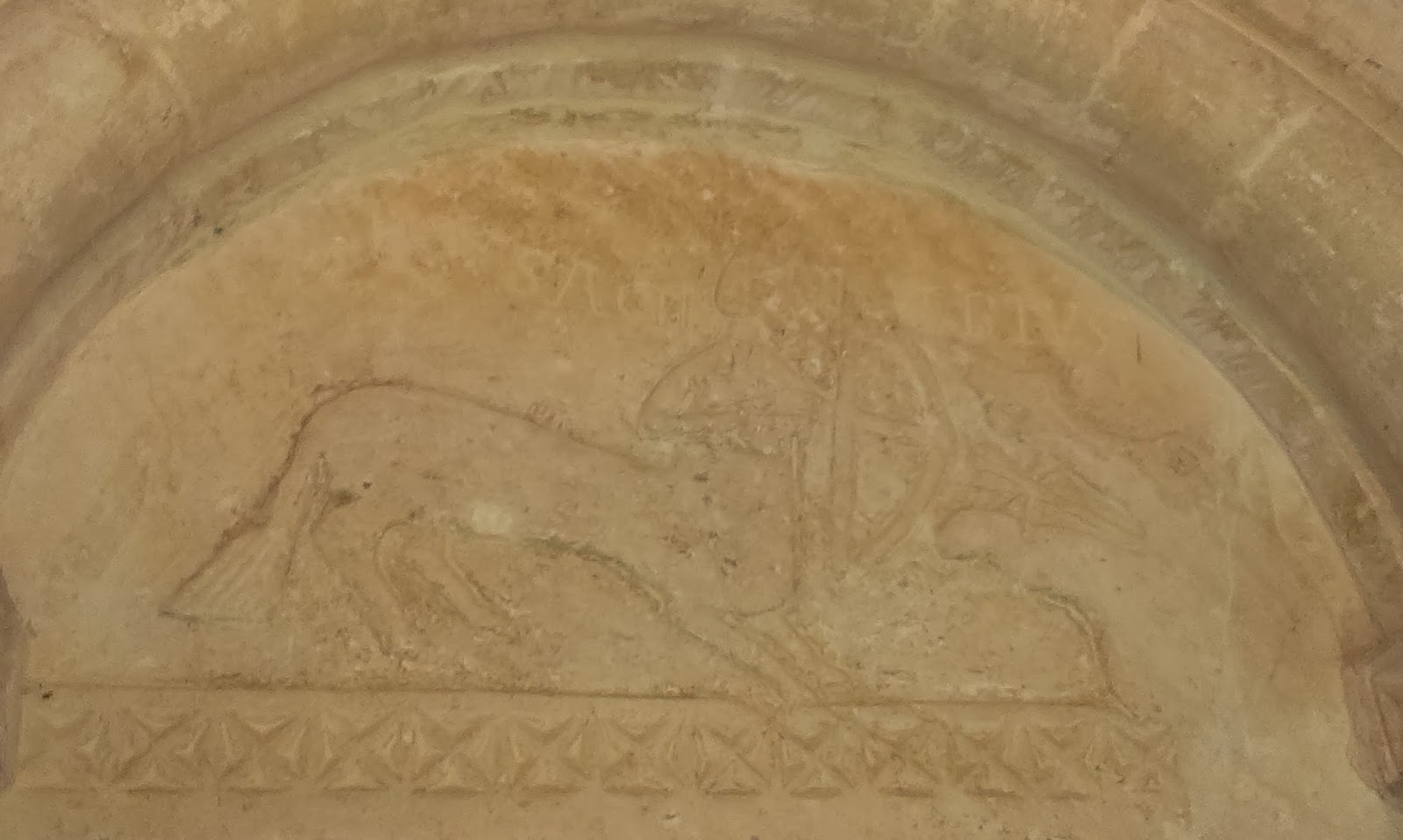
We drove to the furthest one north so that we could work our way back (probably wise, given that otherwise we could have been "just having a look at the next village" all day long).  Kencot in Oxfordshire (near to the wonderful Cotswold Wildlife Park) had a delightful little church and an equally delightful tympanum set over the main doorway. It featured Sagittarius with a bow and arrow drawn on a poor dragon's head. I loved the dragon's head, it was big and bold with a comical look and a pleasing eye and ear. Sagittarius had well observed legs and hooves and his name "Sagittarius" across the picture, which I was stupid enough to begin to write in the wrong place on my drawing!

Our next stop, on the road back south, was Langford, Oxfordshire. As soon as we approached we were amazed to see a large Saxon figure of Jesus (minus his head, poor chap) on the side of the porch. It looked very similar to the wonderful carvings at Daglingworth, Gloucestershire, because of the proportions of the figure, quite thin, with a long tunic and a rope tie around the tunic. We would have loved to draw Saxon Jesus but the rain just would not stop and it was not possible. Inside the church (accompanied by a faintly unpleasant smell) was a nice window of St Francis of Assisi and lots of birds.

Heading south again, we stopped at Inglesham, back inside the border of Wiltshire. We were not expecting what we found: the church is not one in active use but is preserved by the Churches Conservation Trust. It has escaped the sometimes ghastly make-overs done by the Victorians and as such you could see what churches used to be like before those times. Of Anglo Saxon origin, it has traces of wall paintings, wooden box pews and ancient memorials. There in the corner was an Anglo Saxon carving of Jesus and Mary, looking for all the world like some weird creepy alien face from modern times. I am not being sacrilegious, but simply describing what I saw. The features of Mary's face were rather strange, and although Jesus's facial features were a bit worn, we both thought he looked like he was an adult form on her knee, rather than a baby.

Our next stop was at the larger Highworth, where we glad to get out of the rain and find a re-positioned tympanum, over the entrance but inside the church. It was a touch too high up to see well and I did a most unsatisfactory drawing of it, but it was an interesting subject: Samson and the lion. Samson, in cloak and dress, had both hands on the lion's mouth. I feel he should have left him alone really. 

Disappointingly, Stanton Fitzwarren church was locked, despite proclamations on the notice board that we were welcome to come in and look at its history. I had been looking forward to seeing a font with detailed carvings of figures, but there are times when you are just not in the mood for ringing the church warden, especially when it was still raining and there were simply loads of other "pinks" to choose from along the way.

So we back-tracked north a little to visit Castle Eaton, and I was pleased to actually navigate accurately to the church for once. We were greeted by a pleasingly chunky font in the belltower, with a swirly foliage band around the centre, and also two more of the beautiful dragon head carvings on either side of the main entrance. These were smaller versions to the ones we have seen, but for me, equally appealing with their big toothy grins. And indeed we had had plenty to smile about in such a packed day and who cares that it rained all day, that is traditional.

Wednesday, 20 August 2014

Somerset wanderings

As we have done a lot of exploring in Wiltshire, we decided to head off into the wilds of Somerset. It may just be over the border but we both agreed that the geography and feel of the county is noticeably different to Wiltshire. I even admit I felt as if we were in a strange place, not so sure of ourselves.

Our first stop was Tellisford, a small place where it felt like locals were eyeing us warily as if they knew we were not villagers. The church was down a small mossy lane and in the front porch were two interesting heads either side of the door. I drew one with a strange beard.
Beckington was our next stop: here we found some creatures high up on the inside of the church walls, quite amusing but a bit high up to draw or see properly. The church blurb described them as lions, but given the obvious and celebrated history of the wool trade that the village had (visible on many church pictures), we thought they were more likely to be lambs. They had fluffy looking coats.

Then we headed to a place we have been before, but in the days when we were not drawing as a matter of course. Lullington is another sweet village, with an amazing door now at the back of the church, surrounded by fabulous beakheads (beaky creatures) of all descriptions. It also has a tympanum of two animal figures, carved capitals with figures and much, much more. I entertained myself by trying to capture some of the beakheads, though my cold was putting me off.

We ended the trip with a stop at Limpley Stoke. As you enter the church, the middle of the building as it is now is an amazing Saxon door, which was originally an entrance to the church on an outside wall. It was used by Saxon pilgrims making their way to Glastonbury.  In the solid narrow doorway are carved cross shapes which the pilgrims made.  It feels like a special place to stand, given that centuries ago you know people were passing through it. Its nature as a doorway gives you a real sense of stepping from one time to another. Here, if anywhere, would be the place you could walk through and find yourself in another time.


Friday, 25 July 2014

Avening and Cherington

Avening and Cherington are both in Gloucestershire and provided some key drawing opportunities. We hadn't been out drawing for a month, so we took our usual provisions and art things and set out to get back into it. Avening had quite a large church with many things to see - it was a little bit dark inside (it was a rainy day) and so we stuck to drawing what was outside the church. As you go in there is a porch and in the porchway two lovely columns with spirals. At the top of one, an unusual and interesting carved figure, which has two bodies and one head - or is it one figure but seen from both sides, as it were - slightly Picasso-esque? It had the recognisable Norman style tail heading up from underneath its body and over its back and jaunty feet. Behind its head was something indistinct like a tree.

On the other side of the door above a second column was a complex carving of foliage - with appealing chunky central shapes that looked a bit like a raspberry. It reminded us both of Rodbourne and the tree of life - similar lines and two leaves that looked almost like wings. There is a repeating theme we have seen at Whaddon where lines are joined together by a horizontal band. Like an idiot I forgot to take the photos off the temporary phone I was using so I do not have them. Inside the church were many different things including some Saxon work set in the wall and some very appealing capitals that were based on nature - there was one that had shapes which looked like ears of corn or wheat. And another a bit like grass or feathers. All very appealing but again we could not find light switches to illuminate them adequately for drawing. We managed to find a red light that turned some of the church an eerie colour, and quickly turned that off again.

Cherington just 5 minutes away, promised a Norman tympanum of two lions. We braved it through a downpour to have a look. They were quite simple figures facing each other, over the church entrance, with tails aloft (but not curved under the bodies) and surprisingly small heads. No doubt carvers had not seen many lions and these had small round faces - not quite lions - with solid stumpy legs. My sister was not totally convinced of their age but I felt they looked that old.

Teffont Magna, Stapleford and Codford St Peter (and Britford)

We had one day before I headed off to sunnier climes and so it was with some feeling of urgency that we set off to squeeze in some last minute drawing and visiting. Well, you have to take the opportunities. First stop was another of seemingly countless delightful "English" villages that I thought only existed in Midsomer Murders, one Teffont Magna, off the beaten track in Wiltshire. Inside a simple church building was some Saxon knotwork, set firmly into the wall, thankfully. There was a hole in one part of it, not sure why, and a complicated knotwork pattern. It is absorbing to set about trying to draw the interlacing lines and invariably I go wrong, but it's not really a problem; it's my interpretation. Some of it was quite worn so that part always needs a little imagination, unless you can see that the pattern was repeating and try to recreate it.
If my memory serves me correctly we went on to Britford near Salisbury next. And ended up wishing we had never been. In fact the less said about it the better, but there were some fabulous examples of knotwork there and other patterns. They were sort of hidden in a corner in the dankest, darkest, vilest smelling place I have ever been. It was not, I don't think, just damp. It felt wrong in there. Just a weird, unwelcoming feeling. It was dark: we searched on every wall for light switches, but there were none. There were high pews on the side: I peeked in gingerly and then ran away as there were strange jars all along them. I can't explain it but neither of us felt right and we simply had the strongest urge to leave. It wasn't the baby's grave in the graveyard, it wasn't just the smell, there was something not conducive to staying and certainly not to drawing. Both of us were disappointed because the carvings were fine examples, but I could not even bring myself to keep my photos of them and we spent the rest of the trip trying to rid ourselves of the taste/smell and put it out of our minds. At Stapleford we tried to focus on what was there to get back into the groove - a sweet little church with some rather amusing faces on the inside columns. I tried to draw them but my heart wasn't in it.
Things improved measurably when we decided to stop at Codford St Peter as our final stop - we have been before but not done drawing. It has a truly wonderful Saxon carving of a figure, who looks like he is dancing and holding a branch. It is done in beautiful detail and I love how light of foot he is! It seems like something that might be celebrating fertility or the harvest, with the branch. On each side of it is more carving and we have long laughed at something that described it as having "dace" and "an otter" when proper (and even brief) examination will tell you there is no fish nor otter anywhere! I thought my imagination saw things that were unlikely but really, there is nothing shaped like either creature. Codford St Peter is a calm and restful place to draw and I enjoyed having a go at drawing the carving and also the rather charming font.

Friday, 30 May 2014

Frome, Nunney and Pen Selwood

St John the Baptist church in Frome holds an unexpected delight in the shape of a Saxon carving set in the wall, with the now familiar intertwining lines (foliage? who knows?) and a serpent-like creature. It reminded me of those at Colerne and Ramsbury, our last trip. The pattern is worn at one end so it is hard to make out what is going on but the serpent creature had the same zig-zag markings as the ones in Ramsbury. A challenge to draw. Underneath they had set a seemingly Norman beast with four legs and the characteristic tail coming up from beneath. This one was like one in Ditteridge. We are now beginning to see simiarities and recognise distinctive features of both Saxon and Norman work. Oddly, the organist in this church was also practising, but not as uplifting a set of tunes, and we were glad to leave the gloomy atmosphere, although not glad to be leaving the jaunty creature.
Our second stop, Nunney, held two surprises. One good and one bad. There are the remains of a large, solid castle, which everyone had decided to visit on the same day, but it was fun to look up and imagine the rooms as they might have been. Just over a small bridge was the church and it was inside that the horrible surprise occurred. Hoping to find some fragments of Saxon carvings, we looked around in anticipation, but it was only when we consulted their leaflet that we discovered some bastard (let's not beat about the bush) had stolen three Saxon fragments in 2002.
We were quite appalled. There were drawings of them in the leaflet so we could at least see a sketch of how they were. One has a creature biting its own tail which would have been fabulous to see and draw. We drove on to our next village in utter disbelief, trying in vain to work out who would steal such things and why. It can only be for money and presumably these stones are now in some ignorant person's back garden, to make it "look nice." Those people who appreciate Saxon carving would not steal them, for they would appreciate their value as an object and their historical worth. They would want everyone to be able to enjoy them. So if you do not appreciate them for what they really are, why would you want them in your possession? It makes no sense to me. My sister investigated on the web and discovered that many carvings have been stolen and that one was up for auction for a ludicrous figure. I think that the more we publicise stolen artifacts, then perhaps there is the tiniest chance that one day someone will see them and realise what they are. It is really sad that people think their own wealth is more important than respecting what has been there for over a thousand years, which everyone should be free to enjoy. Luckily the majority of things we have seen have been too heavy to move (such as fonts) or fixed into the wall. If I was religious I would wish that Jesus would strike them down for taking it, but it is not to be. So keep your eyes peeled...

Happily nothing had been stolen from Pen Selwood, and try stealing a door lintel if you can, this one was a beauty. Two long bodied creatures facing each other with a dear lamb of God in the centre, in its own circle, carrying its own bag or notepad, who knows - it might be an artist too. The creatures were reminiscent of others with long claws, long bodies and curling tails, namely Ampney St Mary and Ditteridge. There were two human faces facing inwards over the door which were almost identical in style to the ones at Ditteridge - surely the same person. The Lamb of God was similar to that at Berwick St Leonard, which was not so far away.

Ramsbury and Hinton Parva

Wanderings recently took us to the beautiful village of Ramsbury, near Swindon, with narrow streets and old buildings. This was quite an unusual visit, as in contrast to the normal peace and quiet of the church, we were treated to the conversation of the cleaner and her friend, followed by the whine of the vacuum. However, this did not detract too much from the fine display of Saxon carving proudly displayed in one corner of the church. There were coffin lids and stones, with some very intricate patterns on all sides. The lines weaved under and over each other, and two sides also had a snakey or dragonesque creature. It was reminiscent of Colerne and the dragon carvings. The vacuuming ceased but was replaced by more melodic sounds, when the organist came to do his practice. This was quite enjoyable background music as we drew. You have to concentrate quite a lot to draw the lines accurately as they weave over and under. All the carvings were worn so in places you end up guessing what is going on, so that you can create a finished drawing. Above the knotwork and serpent, were three creatures in circles, all biting their own tales.
Our next stop was a little village called Hinton Parva, which was a much quieter spot. The church itself was smaller and lighter and suffered a little from damp. But it holds the most appealing font, with some delightful creatures and patterns. One half of the decoration is a series of figures of eight that intertwine. These are uniform until one end, where the pattern goes pleasingly wrong and completely out of line with the rest of it. We were joined by a member of the church who told us a bit more about it and also found the carver's "mistake" quite endearing. The other half of the decoration is really very entertaining. It is as you or I might draw creatures, which is why I like it so much. At one end is a snake, in the shape of a pretzel, with two birds and two fish. All of them have tiny dots for eyes. Around the side, after some foliage, is a four legged creature, on its side, resting its bottom on another bird. It is biting the end of some foliage. It is all very appealing.

Monday, 12 May 2014

Colerne and Ditteridge

Having been far in our recent travels, into Gloucestershire, we stayed local this weekend by visiting nearby Colerne and Ditteridge. (We still had to stock up on lunch snacks. Drawing requires energy).  We had visited these churches together last year but I was not into drawing things then so this time it was more memorable.
Colerne church has two parts of a Saxon cross, associated with St Aldhem's burial in Malmesbury abbey in 709AD. They are set into the wall of the church, having been found in the 1800s. It means they could be 1200 years old, which is astonishing. Both were well worn. It was hard to see what was shown on one of them, but both had interlacing figures or designs, which were quite complex. The one we chose to draw was clearer to see: it depicts two dragons, with ridged bodies and long legs that inter-weave. They appear to be biting tails as well, and I thought I could see a hint of a wing at the end of one body - but a few of the details had to be imagined, particularly for the drawing. I enjoyed drawing something quite challenging, trying to show accurately how the legs crossed over and under each other. That forced me to look properly before applying pen to paper and we stood there for quite some time (as swifts screamed outside.) Once we were home, we both realised that if we turned the dragons on their side, the drawing was symmetrical and it was much easier to see what was in the picture. We decided that it would make more sense if the stone was on its side and that originally it was probably ninety degrees to how it is currently presented.
                  Dragons on their side in Colerne
    Dragons at 90 degrees
  Then we went on to nearby Ditteridge, which continued the recurring dragon theme. Here were two dragons on the top of columns either side of the door. Facing inwards, between the door posts, were two faces, one with a curly beard. I drew both dragons, and am thinking I would quite like to do a larger piece of art with dragons as the theme.  The one on the left reminded me of the one at Harnhill, as neither of them seem to have back legs. I particularly liked how this one curved and I am pleased with my drawing.


                            Ditteridge dragon

font, Ditteridge
We had to shelter inside the church as the heavens opened (there I go again with the biblical language), and there is a lovely Norman font with circles and lines on it which I rather liked. My sister also liked the thin Norman window which had bright colours and criss crossing patterns. She has taken inspiration from our previous trip to Steeple Langford to produce a large piece of artwork, based on the designs around the Norman font there. I am impressed by its boldness and how well it evokes the sturdiness of the original stone.

Sunday, 4 May 2014

Elkstone, Stratton and Daglingworth

It is not usually sunny on a bank holiday weekend, in my recollection, so my sister and I took the opportunity to go back to the area around Cirencester to see some more Norman and Saxon church carvings that we had rated those most worth visiting ("pink" on my sister's thoroughly researched maps). Once laden with the necessary snacks, we went up to Elkstone which is between Gloucester and Cirencester. Elkstone church is well documented for having a large amount of Norman carving, both inside and outside the church. It has all the different features which you could hope to find, namely, carved "beakheads" over the arch of the doorway, sculpted tops to the columns, a tympanum, animal and people heads outside on the walls, and inside, Norman carved arches with zigzags and flowers. We did not really know where to begin.

I was drawn to two dragons' heads that were inside the church, one each side of the first arch. Both were very well preserved, due to their position, and showed rather amusing teeth. I drew the right hand one, rather inaccurately, but it shows the overall character. In front of and behind the altar were two more decorative arches, the far wall having a pleasingly irregular zigzag pattern, and flowers, (with one tiny zigzag and flower squeezed in as if they'd planned wrong), and a detailed face pattern on the ceiling.

Outside, the door reminded us of Siddington (where we could not get into the church), as it had beakheads in a similar but not identical style, with one face having two arms holding the adjacent beaks closed and a double beaked creature. As well as beakheads, there was elaborate carving on seemingly every available column top and arch. In the centre of the arch, in the semi-circular space over the door (the tympanum) was a carving of Jesus or a religious figure, surrounded by animals including a jaunty lamb of God, a bird with some writing, and two more. We drew the lamb of God, as it was too complicated to try to draw any more. The lamb of God had a curiously rounded head which reminded me of a dolphin. Possibly the first "dolphin of God"?
I also liked very much the animal heads and figures on the outside of the church, high up under the roof. They were all different and included a centaur with a bow and arrow, a goat with a beard, a deer with antlers and an animal biting its own tail. There was also one that looked suspiciously like a dinosaur. My sister found the whole place slightly overwhelming, as did I, because there was so much to look at, it was impossible to know where to begin. Sometimes less is more, and simpler things are effective in their simplicity.

We moved on to Stratton, on the outskirts of Cirencester, and once I'd corrected my poor navigation, we found the church and enjoyed our lunch in the peace of the churchyard. As we walked down to the church porchway we had that sense of excited anticipation - what will the carving be like? Will the simple description in Pevsner translate to something quite impressive to behold? (Sorry, now I am using religious language!) I think that one of the enjoyable things is not knowing what the carving will really be like, as sometimes the book has simply failed to describe how unusual or impressive something is. Happily, the tympanum above the door proved to be very unusual, showing a complicated image of weaving lines and who knows what. It was hard to make out what was there, as some is worn, but you can see a spindly legged creature with a person's head, and long claws, next to a coiled serpent, and next to them possibly two more creatures with long legs, and a lot of foliage intertwined. The book said there was supposed to be a "tree of life" but we could not see a definite tree. Beneath the tympanum were what is known as saltire crosses.

Such is the other-worldliness and sense of another time with these places, is it any wonder that we are beginning to associate them with strange things? Last week after our successful trip to Harnhill, I could have sworn blind both myself and my sister had a photo of the dragon. But on further investigation neither of us could find one. Then this week, my sister took some photos in Elkstone and then discovered they were not on her camera. We get so engrossed in the drawing that we strode off down the road before we realised we'd not photographed the tympanum at Stratton and had to go back - much to the annoyance of a poor robin who had been trying to feed her chicks in a nest in the porch and hissed at us to get out of the way.
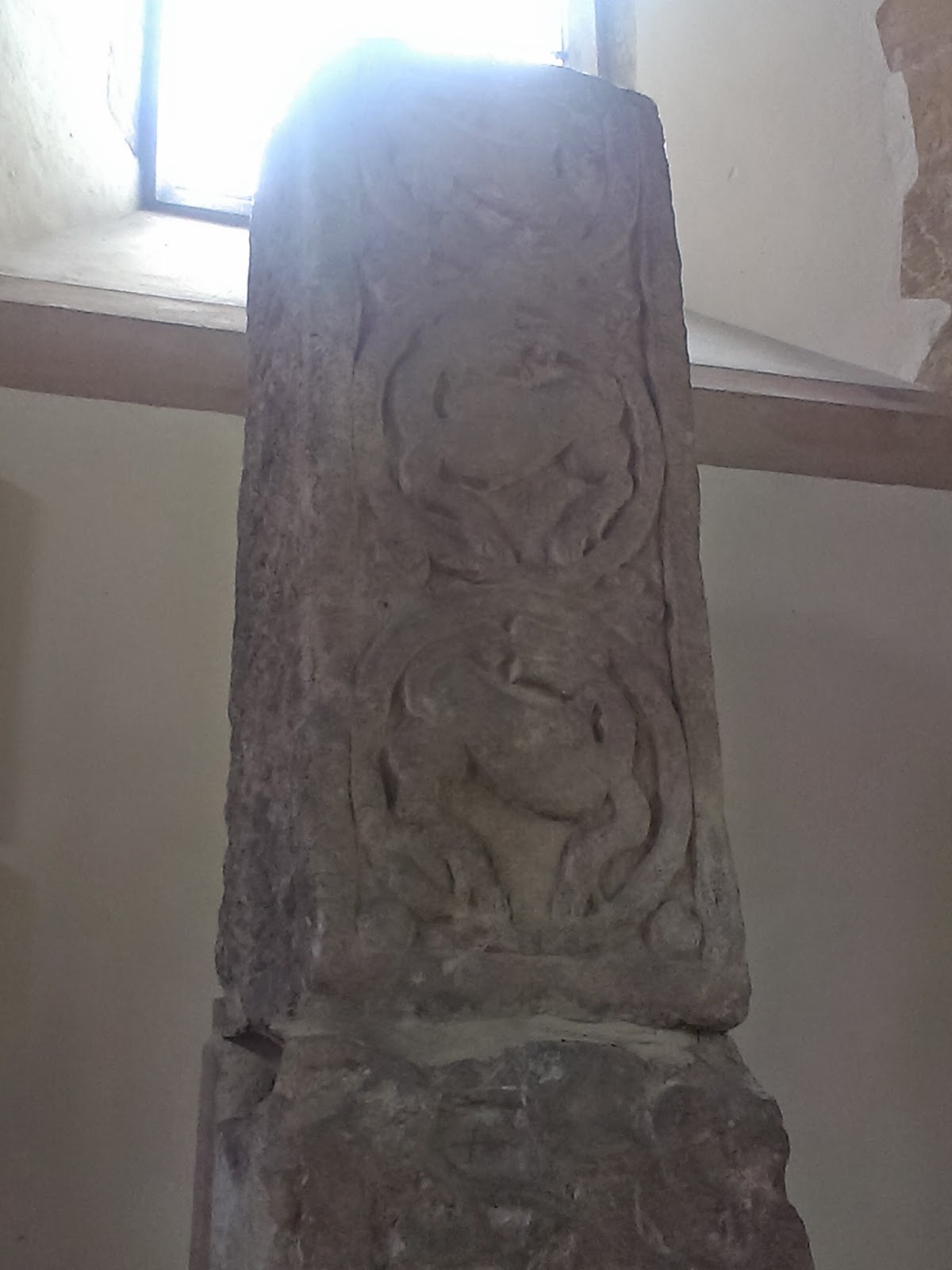
Our last stop was Daglingworth, west of Cirencester. It dated from Saxon times and had not one but four beautiful Saxon carvings, which were once, astonishingly, built into the church out of sight. I really liked these pictures, as they were done in a simple yet not naive style. One was of Jesus and the two centurions at the crucifixion, one was St Peter with his keys. The figures had interesting details such as their belts, done in a knot shape, and well observed hair and hands. They seemed so pristine. We generally prefer drawing animal shapes to human figures but these were rather impressive.