First stop Combe St Nicholas, which is in rather pleasing, hilly countryside. The outside doors were ominously shut but luckily for us, none of the churches we visited were closed that day. Once inside the church, we were immediately faced with the creature we had travelled to see. On the right hand side as you enter the building, what can only be described as a cow type creature looked down at us from atop a column. It was quite chunky with a definite square-faced, cow type mouth and nose, and cowy ears. From its mouth came lines of swirling pattern that looped round and about, ending in a sort of hand shape, or flower. The carved swirling lines are a familiar design, but never before seen emanating from a cow.

Onwards to Isle Abbots / Isle Abbotts, a village nestled so deeply in the countryside that I thought we would never get there. It was almost Melbury Bubb all over again (minus the rain) as I tried unsuccessfully to figure out which of the tiny white roads (on the road map) we were now on. They never seem to correspond to what is in front of you. My sister did well to spot roadsigns as they were nestled in the growth of summer foliage, and mostly hidden from view. We thought if the Germans had landed there in the war, they would have been completely flummoxed. Eventually we found it and had our lunch on a handy bench. The tower was huge, as were many in that area - a sign of the wealth, no doubt. Inside a delightful sandy-coloured font, four sides, the one facing us showing a rather curious creature, upside down.

Each side has a different pattern on it, quite worn, but we deciphered some animals and different patterns. I found the upside-down creature fascinating: to me it honestly looked most like a dolphin - an unsual creature for a font design, but not beyond the realms of possibility. If someone had seen one on his travels (we are not that far from water) then he might have wanted to depict it for others. It was upside down, yet none of the other sides were, making me think this was how the person had seen the creature. Perhaps leaping out of the sea. It had the bulbous head of a dolphin, with a beaky nose, and no legs but a streamlined body which ended in a sort of tail. I'm convinced anyway. Either that or it was an alien. Or a lizard. On the other sides we made out a sort of bird and a rather fetching wyvern, most interestingly shown between/behind a column design - quite an unusual feature to show something behind something else like this.
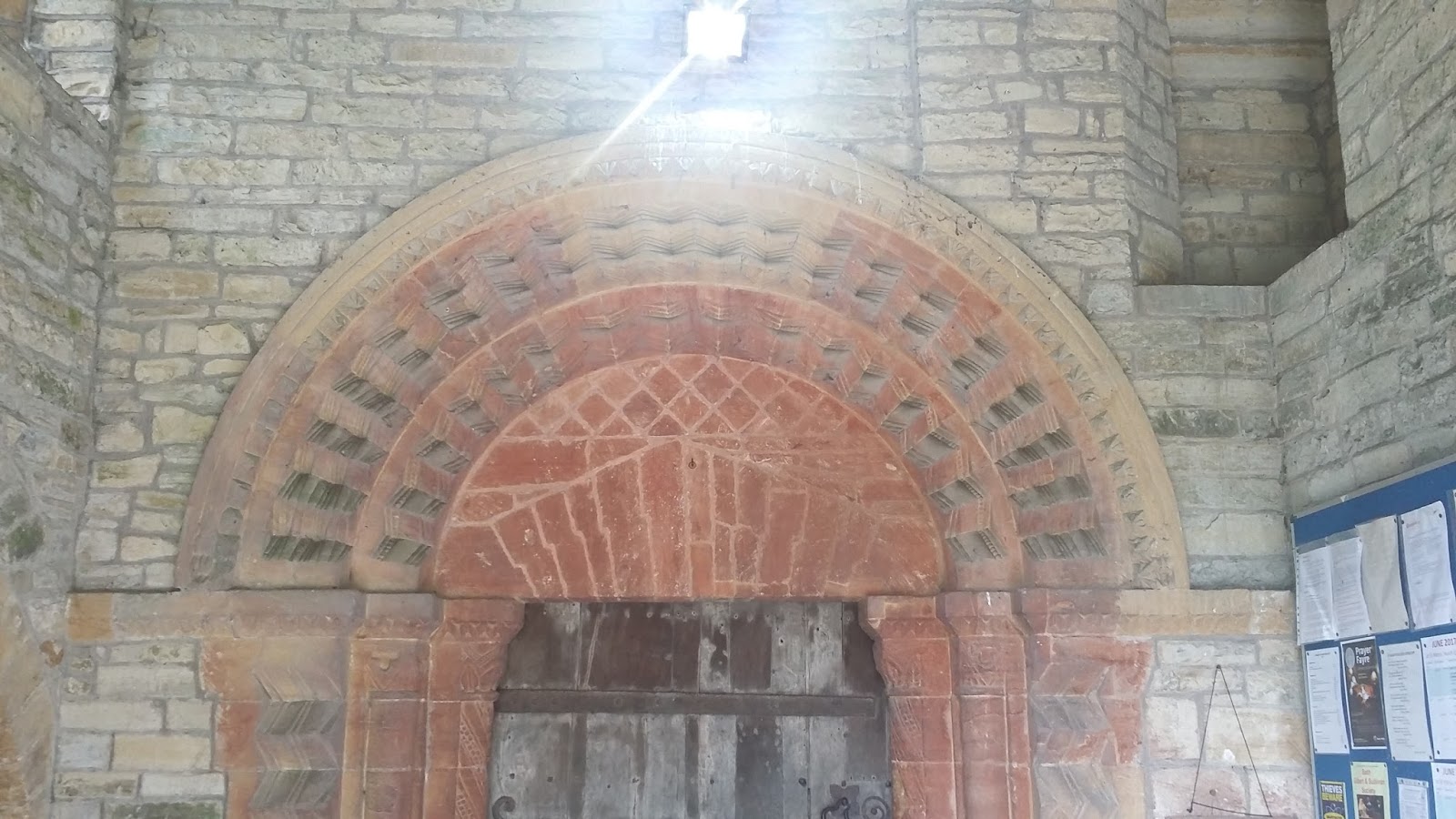 External factors meant we were glad to reach our third stop, Huish Episcopi - so called, apparently after "hiwisc" (house) in OE, and episcopi - to do with the Bishop of Wells. St Mary's church has a very fine example of a carved door, with the added delight of its reddish brown colour, possibly the result of a fire. The door had very chunky zigzag arches, with interesting designs around the top. There were two tiny creature heads on either side, and some fabulous columns with leaves and patterns at the top. A fine example. I'm glad to say that we no longer attempt madly to draw the whole thing, as was once the case when we began on these quests, but now realise that it is only possible to draw a detail or two. Inside the church was a rather impressive window, with a lot of angels' wings and striking reds. It reminded me of the windows by Burne Jones in Birmingham cathedral. I didn't say anything at the time but it turns out the window is by Burne Jones. Fancy that!
Moving on from Huish Episcopi, we headed back towards home and decided to squeeze in a trip to


