Showing posts with label zigzag. Show all posts

Saturday, 26 August 2017

Avebury and Winterbourne Monkton

With the pressures of modern life keeping our brains in a whirr (I have been forgetting to do the meditation you can tell), admittedly not the pressures of being down a mine a hundred years ago, but relief is still found in the soothing pleasures of a trip out fonting.  As it had been some time, (although a whole trip to Bristol needs updating on here), it was nice to get out, sit down and take up a pen. (My new pens. More on them later).

We travelled a by now familiar route out towards Devizes, through the weird hills and villages of Wiltshire.  Then further on to Avebury, home of the Stones.  It always strikes me as strange how many other people wake up and have exactly the same thought as we did, to go and visit them on that very day. (Although they had not had the same thought about visiting the font). However it wasn't heaving, and there were large enough spaces between other visitors not to feel like we were at Stonehenge or something.  As I had forgotten the tea flask we used it as an excuse to have a cream tea at the cafe, which was very nice.  Then we had a wander around the Stones, which are remarkably large, solid and smooth in places, and you have to wonder what it was all about. Even though we were walking round them in a circle, I got a bit disorientated but I enjoyed the calm feeling and seeing the sheep grazing in the middle.


Our main objective was of course to see the font in the local church, which has a fair few more visitors than your average village church. Most people just glanced at the font, if they noticed it at all, even though we were both sitting attempting to draw the detailed and swirling design on it, that is worn with time. The main features are two dragony/wyverny creatures with what I think were unusual amounts of detail, in the patterning down their sides. Very pleasing. I was drawing one with a particularly delightfully curving tail.  There was also a human figure, face bizarrely obliterated by a metallic thing, perhaps part of an old lock.  Above the figures were swirls reminiscent of several places, I shall have to look up - and below, an interlinking archways/pillars design very reminiscent of Durnford font.  I am sure with our extensive knowledge now, we should write a book making observations, as we have been able to see many links and similar designs throughout our travels that other people (the handful who also have this obsession) may not have seen.

We decided to squeeze in another font, just up the road in the next village, Winterbourne Monkton. My sister has visited both before as I remember seeing her previous drawings, but it is always nice to re-visit. And for me they were both new. We really were out in the middle of nowhere, or so it felt, and there were butterflies joining us as we had our picnic lunch.  This font was another elaborately carved and very striking design, which carried traces of paint from years ago, including blue and red. Then it seemed only too fitting that I used my new colour pens in their fancy case, which are fine-tipped. I am quite pleased with my drawing as I depicted different areas of the design in different colours. The bold zig-zag band that forms the main part had traces of blue on it. There is a human-oid figure with splayed out legs and arms, possibly other bits, or is this part of the whirly flower design that fits neatly above and below the zigzags. I think it was put there because if you imagine it removed, the zigzag design would not meet up neatly - you can imagine, can't you, the carver getting round to the end of the pattern and realising it was not really going to work out. A bit like the strikingly free-hand looping patterns at Hinton Parva.  I was not good at depicting the deep cut trumpet design below the zigzags, something my sister did with much more 3D success.


Sunday, 11 June 2017

Combe St Nicholas, Isle Abbots, Huish Episcopi and West Camel

Heading down in a similar direction to the Dorset day out, we set out to our furthest point, Combe St Nicholas in Somerset, with the intention of heading back and stopping off at various points between here and north of Yeovil.

First stop Combe St Nicholas, which is in rather pleasing, hilly countryside.  The outside doors were ominously shut but luckily for us, none of the churches we visited were closed that day. Once inside the church, we were immediately faced with the creature we had travelled to see.  On the right hand side as you enter the building, what can only be described as a cow type creature looked down at us from atop a column. It was quite chunky with a definite square-faced, cow type mouth and nose, and cowy ears. From its mouth came lines of swirling pattern that looped round and about, ending in a sort of hand shape, or flower.  The carved swirling lines are a familiar design, but never before seen emanating from a cow.

Onwards to Isle Abbots / Isle Abbotts, a village nestled so deeply in the countryside that I thought we would never get there. It was almost Melbury Bubb all over again (minus the rain) as I tried unsuccessfully to figure out which of the tiny white roads (on the road map) we were now on. They never seem to correspond to what is in front of you. My sister did well to spot roadsigns as they were nestled in the growth of summer foliage, and mostly hidden from view. We thought if the Germans had landed there in the war, they would have been completely flummoxed.  Eventually we found it and had our lunch on a handy bench. The tower was huge, as were many in that area - a sign of the wealth, no doubt. Inside a delightful sandy-coloured font, four sides, the one facing us showing a rather curious creature, upside down.

Each side has a different pattern on it, quite worn, but we deciphered some animals and different patterns. I found the upside-down creature fascinating: to me it honestly looked most like a dolphin - an unsual creature for a font design, but not beyond the realms of possibility. If someone had seen one on his travels (we are not that far from water) then he might have wanted to depict it for others. It was upside down, yet none of the other sides were, making me think this was how the person had seen the creature. Perhaps leaping out of the sea. It had the bulbous head of a dolphin, with a beaky nose, and no legs but a streamlined body which ended in a sort of tail. I'm convinced anyway. Either that or it was an alien.  Or a lizard. On the other sides we made out a sort of bird and a rather fetching wyvern, most interestingly shown between/behind a column design - quite an unusual feature to show something behind something else like this.

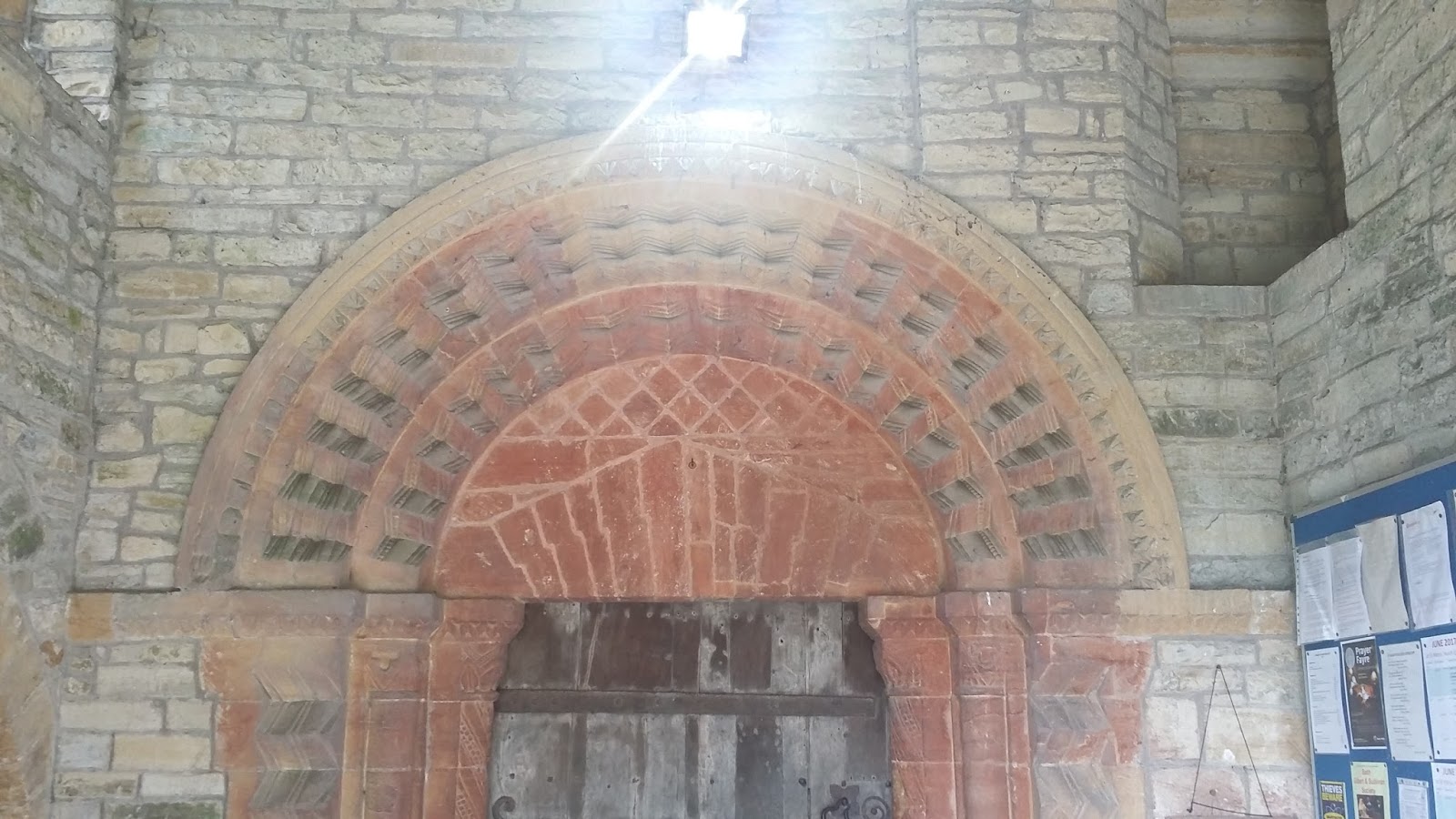
External factors meant we were glad to reach our third stop, Huish Episcopi - so called, apparently after "hiwisc" (house) in OE, and episcopi - to do with the Bishop of Wells. St Mary's church has a very fine example of a carved door, with the added delight of its reddish brown colour, possibly the result of a fire. The door had very chunky zigzag arches, with interesting designs around the top. There were two tiny creature heads on either side, and some fabulous columns with leaves and patterns at the top. A fine example. I'm glad to say that we no longer attempt madly to draw the whole thing, as was once the case when we began on these quests, but now realise that it is only possible to draw a detail or two.  Inside the church was a rather impressive window, with a lot of angels' wings and striking reds. It reminded me of the windows by Burne Jones in Birmingham cathedral. I didn't say anything at the time but it turns out the window is by Burne Jones. Fancy that!

Moving on from Huish Episcopi, we headed back towards home and decided to squeeze in a trip to
West Camel. This time we knew where it was having been on our last trip but not having had the nerve to interrupt a singing session that was taking place inside. This time however it was open and empty and we were delighted to see not just a lovely font with pleasing archway design, but one of the finest Anglo Saxon carved stones we have had the pleasure to see. This one had pride of place up by the altar, and is nicely secure. It had two sides carved with intricate and still well defined knotwork and interlacing patterns. One side definitely had two snake/dragon heads at the end of the intertwining bits. The other side might have had but the ends were more worn. It is definitely one of the best preserved pieces we have come across. And impossible to know where to begin to draw. Especially at the end of the day when we were tired. But I did an "impression" of it which was really a cop out, but it might be fun to try and do some artwork from the photos. I pondered on how they would have done the original - you would have to have had a sketch as you could easily go wrong with the under/over alternation between the patterns.