Showing posts with label dragon. Show all posts

Sunday, 11 June 2017

Combe St Nicholas, Isle Abbots, Huish Episcopi and West Camel

Heading down in a similar direction to the Dorset day out, we set out to our furthest point, Combe St Nicholas in Somerset, with the intention of heading back and stopping off at various points between here and north of Yeovil.

First stop Combe St Nicholas, which is in rather pleasing, hilly countryside.  The outside doors were ominously shut but luckily for us, none of the churches we visited were closed that day. Once inside the church, we were immediately faced with the creature we had travelled to see.  On the right hand side as you enter the building, what can only be described as a cow type creature looked down at us from atop a column. It was quite chunky with a definite square-faced, cow type mouth and nose, and cowy ears. From its mouth came lines of swirling pattern that looped round and about, ending in a sort of hand shape, or flower.  The carved swirling lines are a familiar design, but never before seen emanating from a cow.

Onwards to Isle Abbots / Isle Abbotts, a village nestled so deeply in the countryside that I thought we would never get there. It was almost Melbury Bubb all over again (minus the rain) as I tried unsuccessfully to figure out which of the tiny white roads (on the road map) we were now on. They never seem to correspond to what is in front of you. My sister did well to spot roadsigns as they were nestled in the growth of summer foliage, and mostly hidden from view. We thought if the Germans had landed there in the war, they would have been completely flummoxed.  Eventually we found it and had our lunch on a handy bench. The tower was huge, as were many in that area - a sign of the wealth, no doubt. Inside a delightful sandy-coloured font, four sides, the one facing us showing a rather curious creature, upside down.

Each side has a different pattern on it, quite worn, but we deciphered some animals and different patterns. I found the upside-down creature fascinating: to me it honestly looked most like a dolphin - an unsual creature for a font design, but not beyond the realms of possibility. If someone had seen one on his travels (we are not that far from water) then he might have wanted to depict it for others. It was upside down, yet none of the other sides were, making me think this was how the person had seen the creature. Perhaps leaping out of the sea. It had the bulbous head of a dolphin, with a beaky nose, and no legs but a streamlined body which ended in a sort of tail. I'm convinced anyway. Either that or it was an alien.  Or a lizard. On the other sides we made out a sort of bird and a rather fetching wyvern, most interestingly shown between/behind a column design - quite an unusual feature to show something behind something else like this.
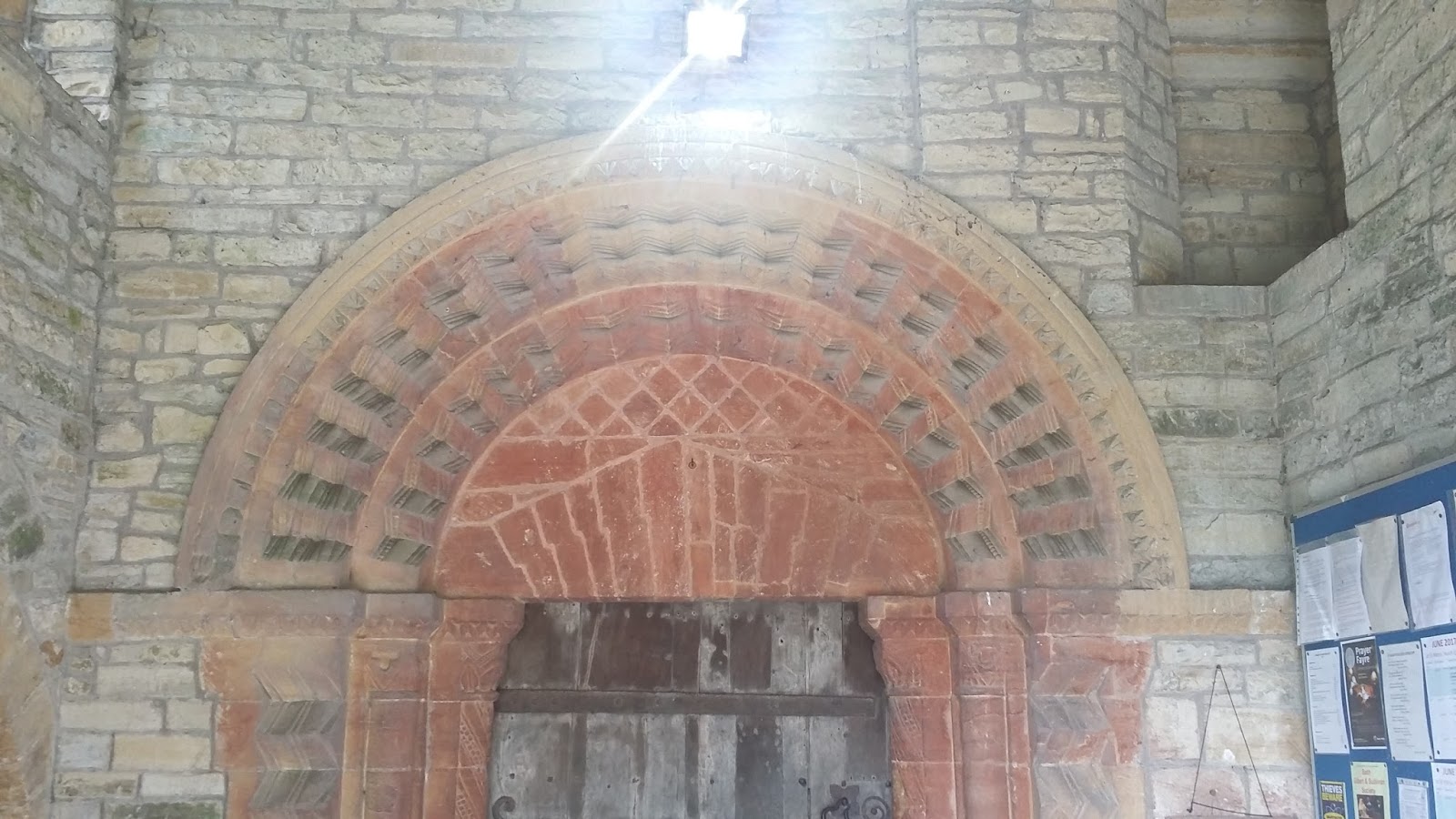
External factors meant we were glad to reach our third stop, Huish Episcopi - so called, apparently after "hiwisc" (house) in OE, and episcopi - to do with the Bishop of Wells. St Mary's church has a very fine example of a carved door, with the added delight of its reddish brown colour, possibly the result of a fire. The door had very chunky zigzag arches, with interesting designs around the top. There were two tiny creature heads on either side, and some fabulous columns with leaves and patterns at the top. A fine example. I'm glad to say that we no longer attempt madly to draw the whole thing, as was once the case when we began on these quests, but now realise that it is only possible to draw a detail or two.  Inside the church was a rather impressive window, with a lot of angels' wings and striking reds. It reminded me of the windows by Burne Jones in Birmingham cathedral. I didn't say anything at the time but it turns out the window is by Burne Jones. Fancy that!

Moving on from Huish Episcopi, we headed back towards home and decided to squeeze in a trip to
West Camel. This time we knew where it was having been on our last trip but not having had the nerve to interrupt a singing session that was taking place inside. This time however it was open and empty and we were delighted to see not just a lovely font with pleasing archway design, but one of the finest Anglo Saxon carved stones we have had the pleasure to see. This one had pride of place up by the altar, and is nicely secure. It had two sides carved with intricate and still well defined knotwork and interlacing patterns. One side definitely had two snake/dragon heads at the end of the intertwining bits. The other side might have had but the ends were more worn. It is definitely one of the best preserved pieces we have come across. And impossible to know where to begin to draw. Especially at the end of the day when we were tired. But I did an "impression" of it which was really a cop out, but it might be fun to try and do some artwork from the photos. I pondered on how they would have done the original - you would have to have had a sketch as you could easily go wrong with the under/over alternation between the patterns.


Thursday, 1 June 2017

Dorset way


Stoke sub Hamdon
Each county appears to have its own unique feel and mysterious qualities. We all know Wiltshire is weird, as it has Stonehenge, Avebury, Silbury hill etc and the form of the hills often makes it feel enclosed and slightly mysterious ...but Somerset has a different feeling again and so does Dorset. It was almost as if when we crossed the border the atmosphere changed, but perhaps I am getting too in tune with the land and picking up echoes from times gone past... Certainly Dorset, with its pleasant countryside (sadly bathed in misty cloud for half the day) was rich in top quality romanesque delights.

Navigating from the road map, your favourite navigator made her usual useless effort of "oh yes we should have turned there" as the car sailed past its turning.  Our first stop, once we found it, was St Andrew's Church in Todber, an unusual building, which was supposed to have some Saxon carving outside. Alas, said carving was no longer outside and the church was shut, so we returned through the drizzle and dripping trees to the car.  Next stop, Melbury Bubb. A small distance away but not on any direct main road. We decided to "take the cross country route".   I don't know why as I didn't have an OS map and couldn't see the best way to go, even while I was giving directions. The small white roads got even smaller on the map and even less road-like in reality.  Luckily for me I am always driven with skill and care around the English countryside and just kept the map out of sight so that the ludicrousness of our route couldn't be seen.  Eventually, having been down the tiniest and most hidden of Dorset's backroads, including via a diversion, we found Melbury Bubb (to our great relief). Most of the names around there are equally as remarkable - Piddletrenthide, Glanvilles Wootton and Huish Episcopi. Of all things.

Melbury Bubb church was, thankfully, open. A man was inside the door and evidently slightly surprised to see us. "Are you researchers?" he asked us. Well, yes, we are! Never thought of ourselves like this before but in fact that is exactly what we are and it felt good to be recognised as such! The church is apparently "always open" and no wonder - inside the door is the most amazing font ever! It was made into a font out of an existing carving and so the scene is upside down. Someone has done a drawing of it so you can see what is on there. But in fact it is not hard to see (when you have your head the wrong way round). Around the sides are a menagerie of creatures -some I swear we have never seen carved before - a stag with impressive antlers, a dog type creature, a horse... and some strange creatures in between, perhaps a lizard, perhaps a sea creature - really quite hard to tell. All with the requisite curved tails tucking up under their bodies - but in fact tails reminding me of Saxon knotwork as well, as they became a long and weaving pattern, looping in and out of themselves. I was musing there must have been a crossover between Saxon and Norman styles and so perhaps this was part of it? Lovely animal feet and the ususal characterful faces, with amusing expressions. These creatures are neither serious, or in my opinion, religious - we were debating whether they were symbolic of something religious. Perhaps. But perhaps not. Although they are not - apart from these ones - usually creatures that would have been around day to day. So here the stag and horse were interesting. But in other places - the creatures you'd expect to see would surely be wolves, badgers, hares, etc? All very interesting to think on.  It helped to draw them upside down as you were forced to draw what you saw and on turning your drawing upside down it was quite fun to see the result. A lovely spot with an absolutely amazing font. Find it if you can.

Moving on (the heavens opened, it was absurd), our next stop was Melbury Osmond. Inside the church set into the wall near the altar was a creature again with winding crossing patterns around it, this time a bit like a dragon? And possible plants?

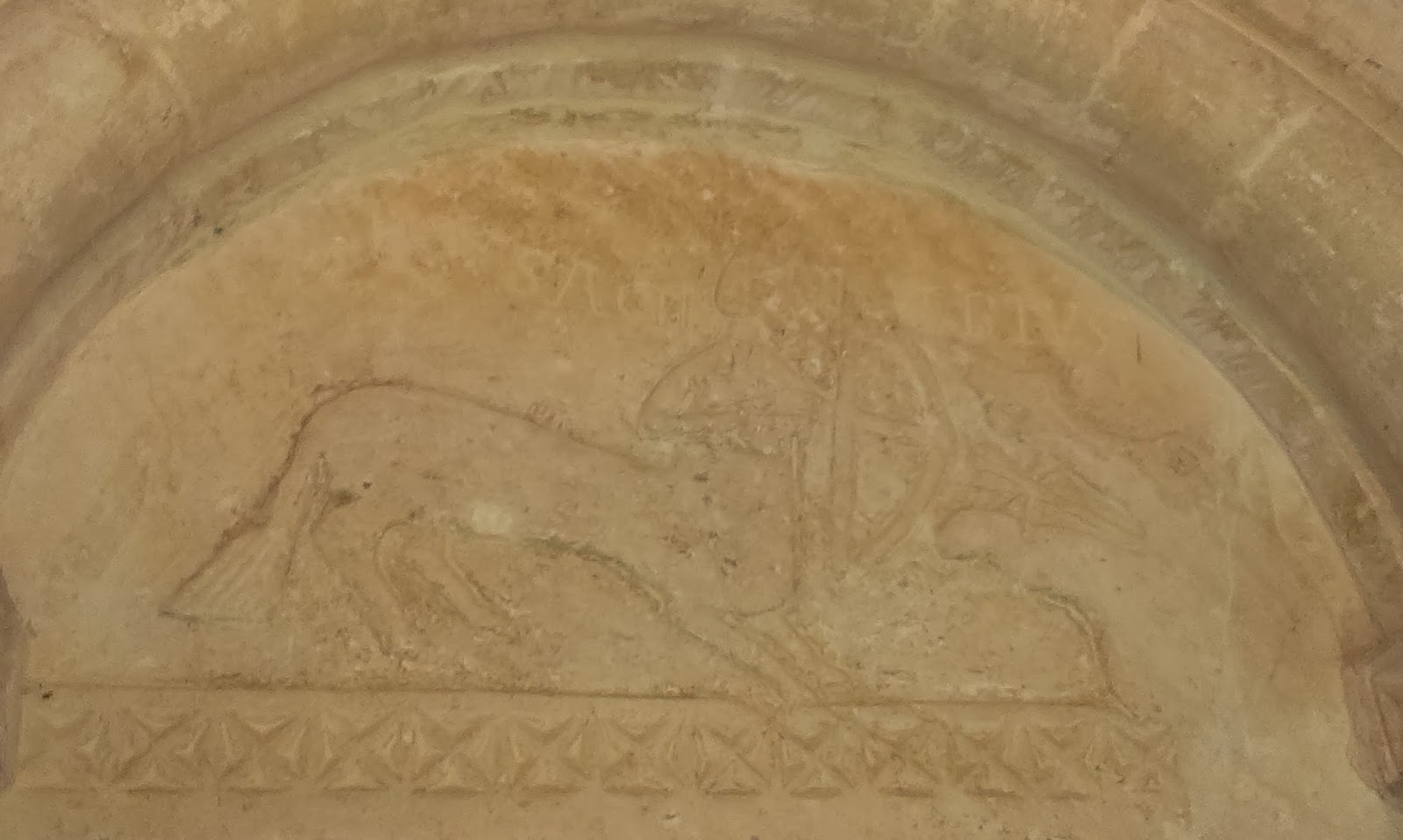
Final stop on the tour was Stoke sub Hamdon. From the notes in our sacred blue book (I say our, but the book is all my sister's hard work) the church promised many things of great excitement and it was not wrong! I may have been tired but I became quite emotional. The first thing to greet our eye was a truly wonderful tympanum. My sister is so kind, she likes the initial discovery to be a kind of gift and will often let me go first as it were, to get the full impact of the surprise. The tympanum is very well preserved (apart from a small part where we believe someone had tried to chip it away! Poor thing!)  It is spacious and airy, beautifully considered and spaced out, with a Sagitarrius, a tree of life, three gorgeous birds, a wolf/lion and a fabulous, jaunty lamb of God!  Who doesn't love a lamb of God and this one had a real way about it. The birds had a very appealing design, straight backs and all seen from different angles. They reminded both of us at once of the ones in Little Langford. Ah, we are fonts of all knowledge now (pun intended).  The other creature was possibly a lion (as in Leo) or possibly a wolf - it had a woolly neck so the lion theory fits. But whatever, it was all very nicely done and fun to draw.

That was me drawn out really, so I just had to admire the other treats inside  - the chunkiest font you ever saw with a double band of carving which meant the rest of it would have had to have been chipped out for a year and a day. The most amazing triple arches inside with different pleasing patterns, all very well preserved. Far too much for one person to take in.  On the outside wall as well there was a super-cute dragon being attacked by some stupid person (why did people treat dragons so badly?) with not just a spear but a lance as well.  I loved its curving body and amusing expression. They really knew how to draw character.

I believe Dorset could be a great place to spend more time fonting, it had a nice feel, it certainly had many hidden wonders and it is not too far to go. We have been enjoying a wealth of fonting opportunities recently so long may the good weather continue.

Rediscovery

The Time is Now revisited one of the churches we visited when we were first discovering fonting and its delights. My sister thought that maybe we had not fully appreciated the carving when we visited the first time. I was sceptical but we are both aware of what we are now calling "the Pipe Aston effect" - referring to the first time I was taken to see amazing carving at Pipe Aston but didn't appreciate it one tiny bit. I think I looked, said it was ok, and wandered off somewhere. I had no recollection of it afterwards and certainly hadn't been blown away. But then I didn't realise what I was looking at or really see it. Probably too busy looking at my phone or something.

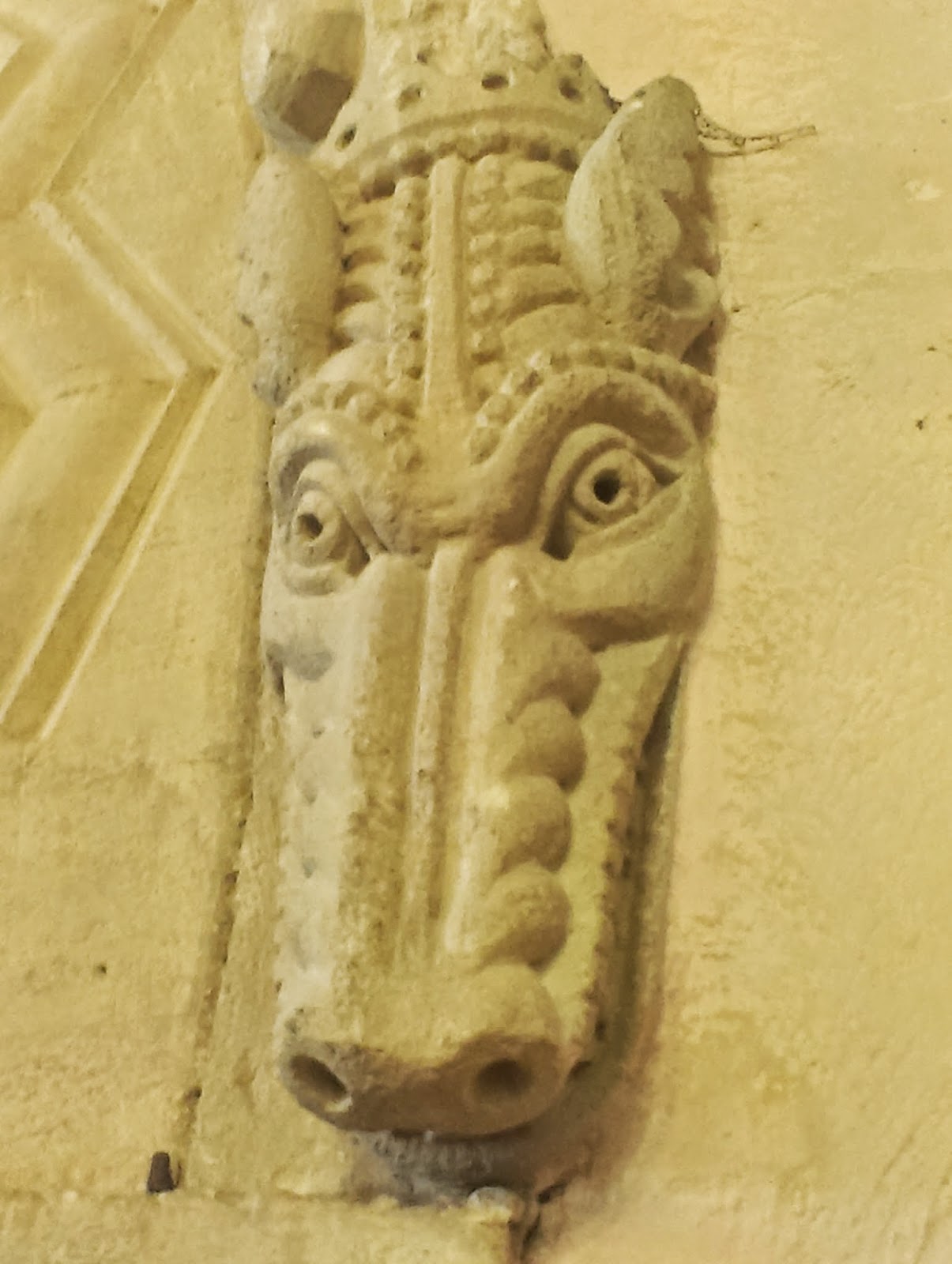
Anyway sure enough it was true when we went to rediscover this church that the carving inside was truly something special - a brilliant dragon's head and a separate piece with a most unusual design - a beaky creature, but gripping not a door, but a swirling pattern design, reminiscent of Saxon knotwork. A true gem! Both had real character and were true gems and I found it hard to believe we had seen them before but truly appreciated them. There was a third item, part of a tympanum, that although more worn, was equally impressive.

I must admit that I fell in love a little with the dragon's head, it was larger than most and had such a chirpy expression - almost a light in its large eyes.  Real character.  I didn't quite capture it in my drawing but that's always the way.  That is what I love most about the carvings, specifically the animal carvings - the artist always captures character and there seems to be real humour in them as well.

Friday, 29 August 2014

Bank holiday bonanza

As it was a Bank Holiday it somehow begged to be spent on a bit of a mega-trip seeking more Norman excitement - and despite the weather we did just that. It rained from the minute we set out to half an hour after we got in - but we did not let that put us off.

We decided to go to what is known by us as a "pink area" - which means that there is a cluster of churches in one area which have been rated (by us, via Pevsner) to have top quality carvings. Our ratings are based on what has been said in the book rather than our appraisal of it post-visit, and so they do not always prove accurate, but pinks usually have more than one thing of interest. It is amazing that this particular area, north of Swindon, is jam-packed full of churches with pink status, so much so that we could barely drive in any direction without encountering a pink village. Talk about being spoilt for choice.
Kencot

We drove to the furthest one north so that we could work our way back (probably wise, given that otherwise we could have been "just having a look at the next village" all day long).  Kencot in Oxfordshire (near to the wonderful Cotswold Wildlife Park) had a delightful little church and an equally delightful tympanum set over the main doorway. It featured Sagittarius with a bow and arrow drawn on a poor dragon's head. I loved the dragon's head, it was big and bold with a comical look and a pleasing eye and ear. Sagittarius had well observed legs and hooves and his name "Sagittarius" across the picture, which I was stupid enough to begin to write in the wrong place on my drawing!

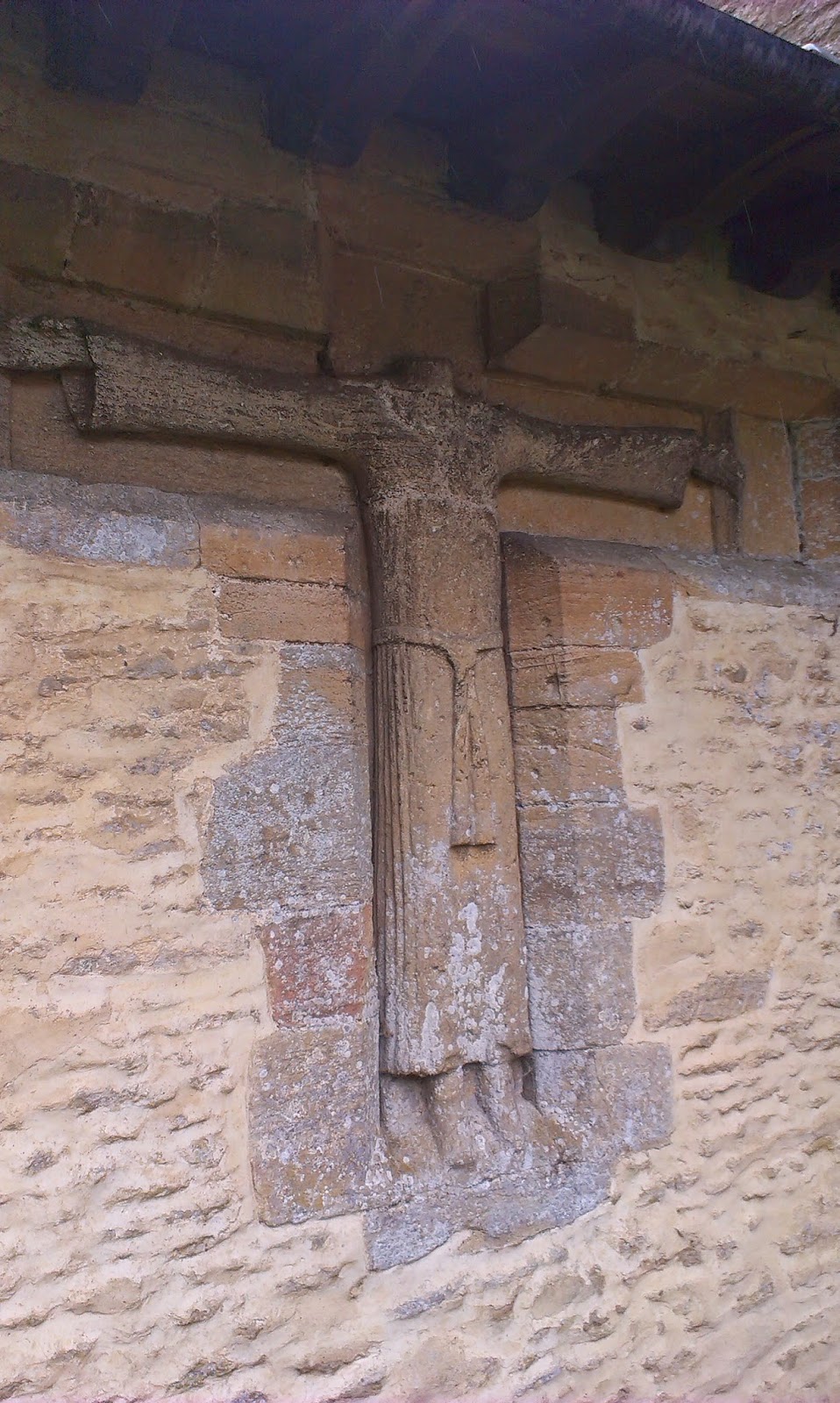
Our next stop, on the road back south, was Langford, Oxfordshire. As soon as we approached we were amazed to see a large Saxon figure of Jesus (minus his head, poor chap) on the side of the porch. It looked very similar to the wonderful carvings at Daglingworth, Gloucestershire, because of the proportions of the figure, quite thin, with a long tunic and a rope tie around the tunic. We would have loved to draw Saxon Jesus but the rain just would not stop and it was not possible. Inside the church (accompanied by a faintly unpleasant smell) was a nice window of St Francis of Assisi and lots of birds.

Heading south again, we stopped at Inglesham, back inside the border of Wiltshire. We were not expecting what we found: the church is not one in active use but is preserved by the Churches Conservation Trust. It has escaped the sometimes ghastly make-overs done by the Victorians and as such you could see what churches used to be like before those times. Of Anglo Saxon origin, it has traces of wall paintings, wooden box pews and ancient memorials. There in the corner was an Anglo Saxon carving of Jesus and Mary, looking for all the world like some weird creepy alien face from modern times. I am not being sacrilegious, but simply describing what I saw. The features of Mary's face were rather strange, and although Jesus's facial features were a bit worn, we both thought he looked like he was an adult form on her knee, rather than a baby.

Our next stop was at the larger Highworth, where we glad to get out of the rain and find a re-positioned tympanum, over the entrance but inside the church. It was a touch too high up to see well and I did a most unsatisfactory drawing of it, but it was an interesting subject: Samson and the lion. Samson, in cloak and dress, had both hands on the lion's mouth. I feel he should have left him alone really. 

Disappointingly, Stanton Fitzwarren church was locked, despite proclamations on the notice board that we were welcome to come in and look at its history. I had been looking forward to seeing a font with detailed carvings of figures, but there are times when you are just not in the mood for ringing the church warden, especially when it was still raining and there were simply loads of other "pinks" to choose from along the way.

So we back-tracked north a little to visit Castle Eaton, and I was pleased to actually navigate accurately to the church for once. We were greeted by a pleasingly chunky font in the belltower, with a swirly foliage band around the centre, and also two more of the beautiful dragon head carvings on either side of the main entrance. These were smaller versions to the ones we have seen, but for me, equally appealing with their big toothy grins. And indeed we had had plenty to smile about in such a packed day and who cares that it rained all day, that is traditional.

Sunday, 4 May 2014

Elkstone, Stratton and Daglingworth

It is not usually sunny on a bank holiday weekend, in my recollection, so my sister and I took the opportunity to go back to the area around Cirencester to see some more Norman and Saxon church carvings that we had rated those most worth visiting ("pink" on my sister's thoroughly researched maps). Once laden with the necessary snacks, we went up to Elkstone which is between Gloucester and Cirencester. Elkstone church is well documented for having a large amount of Norman carving, both inside and outside the church. It has all the different features which you could hope to find, namely, carved "beakheads" over the arch of the doorway, sculpted tops to the columns, a tympanum, animal and people heads outside on the walls, and inside, Norman carved arches with zigzags and flowers. We did not really know where to begin.

I was drawn to two dragons' heads that were inside the church, one each side of the first arch. Both were very well preserved, due to their position, and showed rather amusing teeth. I drew the right hand one, rather inaccurately, but it shows the overall character. In front of and behind the altar were two more decorative arches, the far wall having a pleasingly irregular zigzag pattern, and flowers, (with one tiny zigzag and flower squeezed in as if they'd planned wrong), and a detailed face pattern on the ceiling.

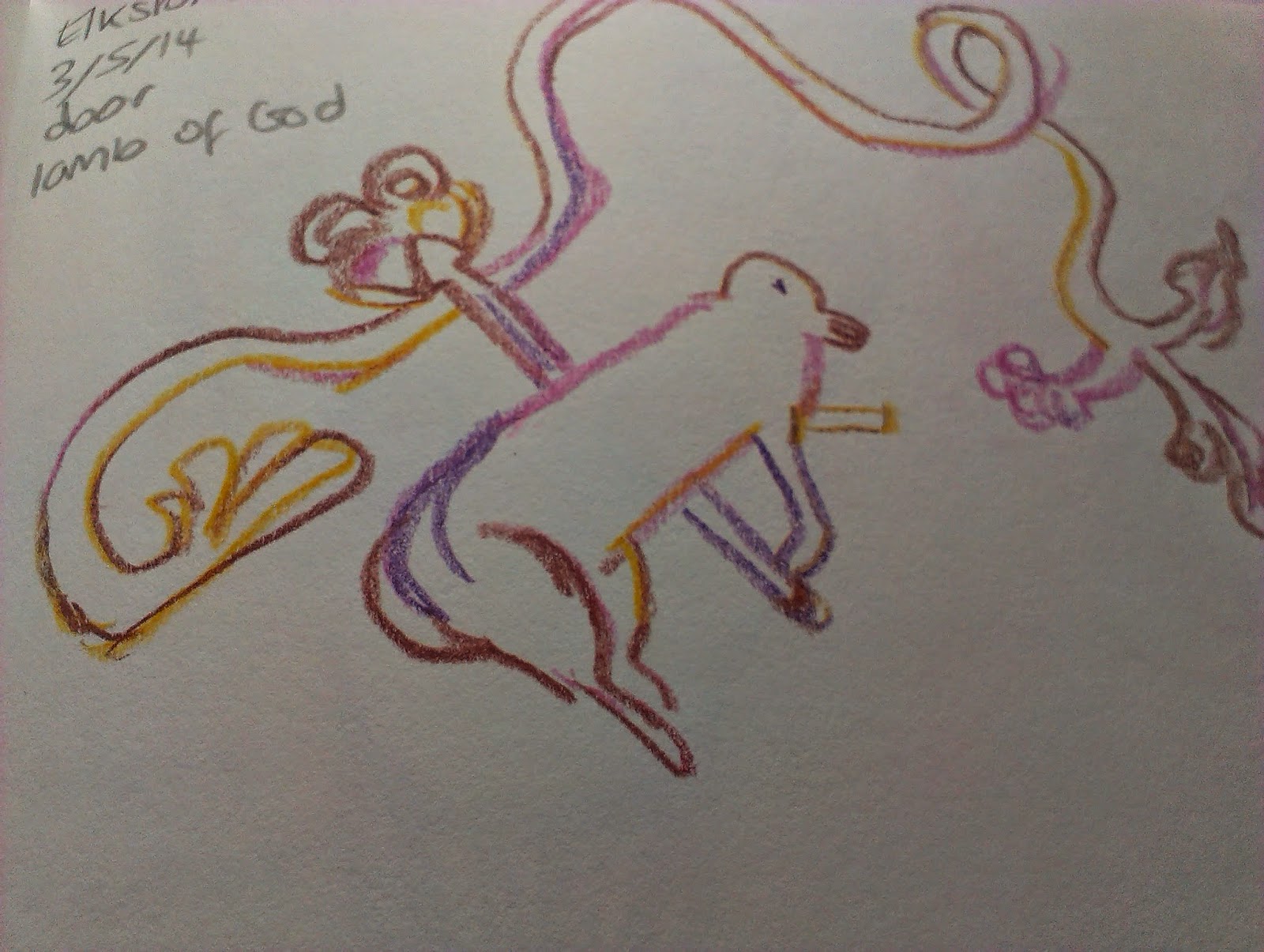
Outside, the door reminded us of Siddington (where we could not get into the church), as it had beakheads in a similar but not identical style, with one face having two arms holding the adjacent beaks closed and a double beaked creature. As well as beakheads, there was elaborate carving on seemingly every available column top and arch. In the centre of the arch, in the semi-circular space over the door (the tympanum) was a carving of Jesus or a religious figure, surrounded by animals including a jaunty lamb of God, a bird with some writing, and two more. We drew the lamb of God, as it was too complicated to try to draw any more. The lamb of God had a curiously rounded head which reminded me of a dolphin. Possibly the first "dolphin of God"?
I also liked very much the animal heads and figures on the outside of the church, high up under the roof. They were all different and included a centaur with a bow and arrow, a goat with a beard, a deer with antlers and an animal biting its own tail. There was also one that looked suspiciously like a dinosaur. My sister found the whole place slightly overwhelming, as did I, because there was so much to look at, it was impossible to know where to begin. Sometimes less is more, and simpler things are effective in their simplicity.

We moved on to Stratton, on the outskirts of Cirencester, and once I'd corrected my poor navigation, we found the church and enjoyed our lunch in the peace of the churchyard. As we walked down to the church porchway we had that sense of excited anticipation - what will the carving be like? Will the simple description in Pevsner translate to something quite impressive to behold? (Sorry, now I am using religious language!) I think that one of the enjoyable things is not knowing what the carving will really be like, as sometimes the book has simply failed to describe how unusual or impressive something is. Happily, the tympanum above the door proved to be very unusual, showing a complicated image of weaving lines and who knows what. It was hard to make out what was there, as some is worn, but you can see a spindly legged creature with a person's head, and long claws, next to a coiled serpent, and next to them possibly two more creatures with long legs, and a lot of foliage intertwined. The book said there was supposed to be a "tree of life" but we could not see a definite tree. Beneath the tympanum were what is known as saltire crosses.

Such is the other-worldliness and sense of another time with these places, is it any wonder that we are beginning to associate them with strange things? Last week after our successful trip to Harnhill, I could have sworn blind both myself and my sister had a photo of the dragon. But on further investigation neither of us could find one. Then this week, my sister took some photos in Elkstone and then discovered they were not on her camera. We get so engrossed in the drawing that we strode off down the road before we realised we'd not photographed the tympanum at Stratton and had to go back - much to the annoyance of a poor robin who had been trying to feed her chicks in a nest in the porch and hissed at us to get out of the way.

Our last stop was Daglingworth, west of Cirencester. It dated from Saxon times and had not one but four beautiful Saxon carvings, which were once, astonishingly, built into the church out of sight. I really liked these pictures, as they were done in a simple yet not naive style. One was of Jesus and the two centurions at the crucifixion, one was St Peter with his keys. The figures had interesting details such as their belts, done in a knot shape, and well observed hair and hands. They seemed so pristine. We generally prefer drawing animal shapes to human figures but these were rather impressive.


Sunday, 27 April 2014

Carved creatures, South Gloucestershire


South Cerney door
The list of places to visit to see carvings, in particular carved creatures, is increasing weekly. My sister has now been through a book about Gloucestershire and we have marked churches of interest on the Gloucestershire map. Enticingly, there were many which we gave the highest ranking, based on the fact they had very unusual things there or many different things in the same church. It was too tempting to take a longer trip than usual, heading off on a sunny day to villages south of Cirencester.  There was a whole cluster of churches in a small area, all with our top ranking.

Our trips are so that we can have fun drawing. I have a new sketchbook, which is larger and allows me to draw more freely. Armed with our usual snacks, three-coloured crayons, ink and watercolour, we set off to discover yet more Norman and Saxon inspiration.

Saxon door, inside
outside
We stopped off first at Somerford Keynes, where the church has an original Saxon doorway possibly dating from the 8th century. It is not every day you see something from around 700AD, and this doorway was a real treasure. I did not know what to expect, but as you came in through the front door, (an old wooden door with a fabulous opening mechanism), the Saxon door was just to the left on the facing wall. In Saxon style it was tall and narrow. A member of the parish had been good enough to pay for its preservation; it was open to the outside, rather than blocked in, with a very tasteful panel of engraved glass across the space. It let in the light to the church and made a real feature of the Saxon door. Full marks to whoever designed this. Outside, you had a real sense of the history and atmosphere of the doorway, and could easily imagine Saxon people using it to go into their church.  It had 2 rope-like motifs over the top, and was beautiful in its simplicity.  Inside the church, we were disgusted to read that a fragment of Saxon stone carving had been stolen a couple of years before.

beaky creatures
Further north we stopped at South Cerney. From the book, we were expecting to see "beakheads" or as we call them "beaky creatures" - a feature of Norman doors that can be found in this area. Previous beakheads we have seen are of creatures' faces over the archway of a door, some of them gripping the archway in their beaks or mouths. We approached the church and were both very excited by what we saw. There were many beaky creatures gripping the archway, plus some beautiful carvings above the door posts and forming the archway. The whole doorway was very ornate and must have taken ages. You didn't know where to look, or what to draw first, such was the detail.Inside there were some Saxon crosses, later carvings and a resin copy of a wooden head and foot from a rare 12C crucifix.

It wasn't far to the next village, Ampney St Mary, but finding the church proved a little more difficult. It was not actually in the village, but a small distance away, on the main road. It turned out the original village had been evacuated due to the Black Death and since then the new village had grown up further away from the church. This church has a carving over a now blocked up doorway, which is very unusual and appealing. It has a long-bodied, skinny lion, with long legs, stretched over two faces that look almost cat-like, but are attached to long, almost crescent shaped bodies - who knows what they really are (some suggest a serpent
Ampney St Mary
but I am not convinced). Next to them is a creature with a bird's head, four legs and a long forked tail. (Both this tail and the lion's tail curl up over the bodies). The inside of the church was equally pleasing and there is a nice atmosphere: all over the walls are the remains of some medieval murals, which must have been very impressive in their day. There is another ancient wooden door and a simple and sturdy Norman font with a zigzag design. If you venture up towards the altar, you will see a stone screen and suddenly notice that one side of the church is leaning outwards at an alarming angle, which is a shame.

On the route back, we passed Harnhill, so we had to call in and see St Michael fighting a dragon, over the doorway. It was a little green, but the actual carving was charming and very bold. The dragon had its tongue out and was a really nice shape; I also liked St Michael's clothes, and noticed he too had wings...
St Michael and dragon, Harnhill

At our last stop, Siddington, we were disappointed to find the church padlocked at the gate. I find it hard to believe this is necessary in these small places. It prevented us from seeing the Norman font which sounded like it had impressive decoration. However, we could peak through the netting across the doorway to look at yet more beaky creatures - these however, did not somehow hold the same appeal as those at South Cerney. We thought maybe it was because they seemed more uniform, more flatter, and also looked newer - although I believe were also Norman. An interesting and unusual thing to note about them is how one beakhead had two arms, each reaching out to its neighbour and holding their beaks shut! The beak of the creature on the left was even pulled slightly towards the hand.