Showing posts with label Cirencester.. Show all posts

Sunday, 4 May 2014

Elkstone, Stratton and Daglingworth

It is not usually sunny on a bank holiday weekend, in my recollection, so my sister and I took the opportunity to go back to the area around Cirencester to see some more Norman and Saxon church carvings that we had rated those most worth visiting ("pink" on my sister's thoroughly researched maps). Once laden with the necessary snacks, we went up to Elkstone which is between Gloucester and Cirencester. Elkstone church is well documented for having a large amount of Norman carving, both inside and outside the church. It has all the different features which you could hope to find, namely, carved "beakheads" over the arch of the doorway, sculpted tops to the columns, a tympanum, animal and people heads outside on the walls, and inside, Norman carved arches with zigzags and flowers. We did not really know where to begin.

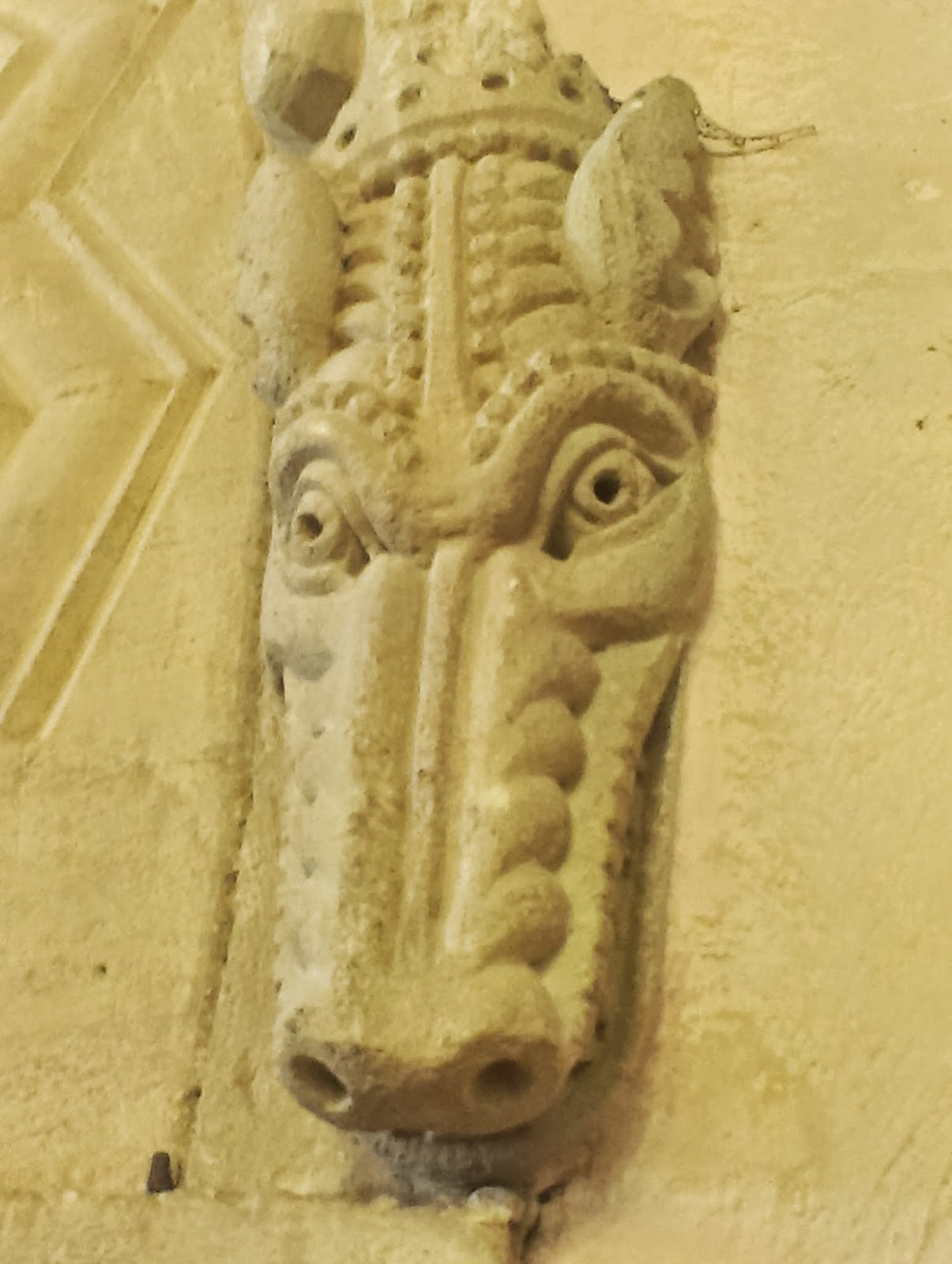
I was drawn to two dragons' heads that were inside the church, one each side of the first arch. Both were very well preserved, due to their position, and showed rather amusing teeth. I drew the right hand one, rather inaccurately, but it shows the overall character. In front of and behind the altar were two more decorative arches, the far wall having a pleasingly irregular zigzag pattern, and flowers, (with one tiny zigzag and flower squeezed in as if they'd planned wrong), and a detailed face pattern on the ceiling.

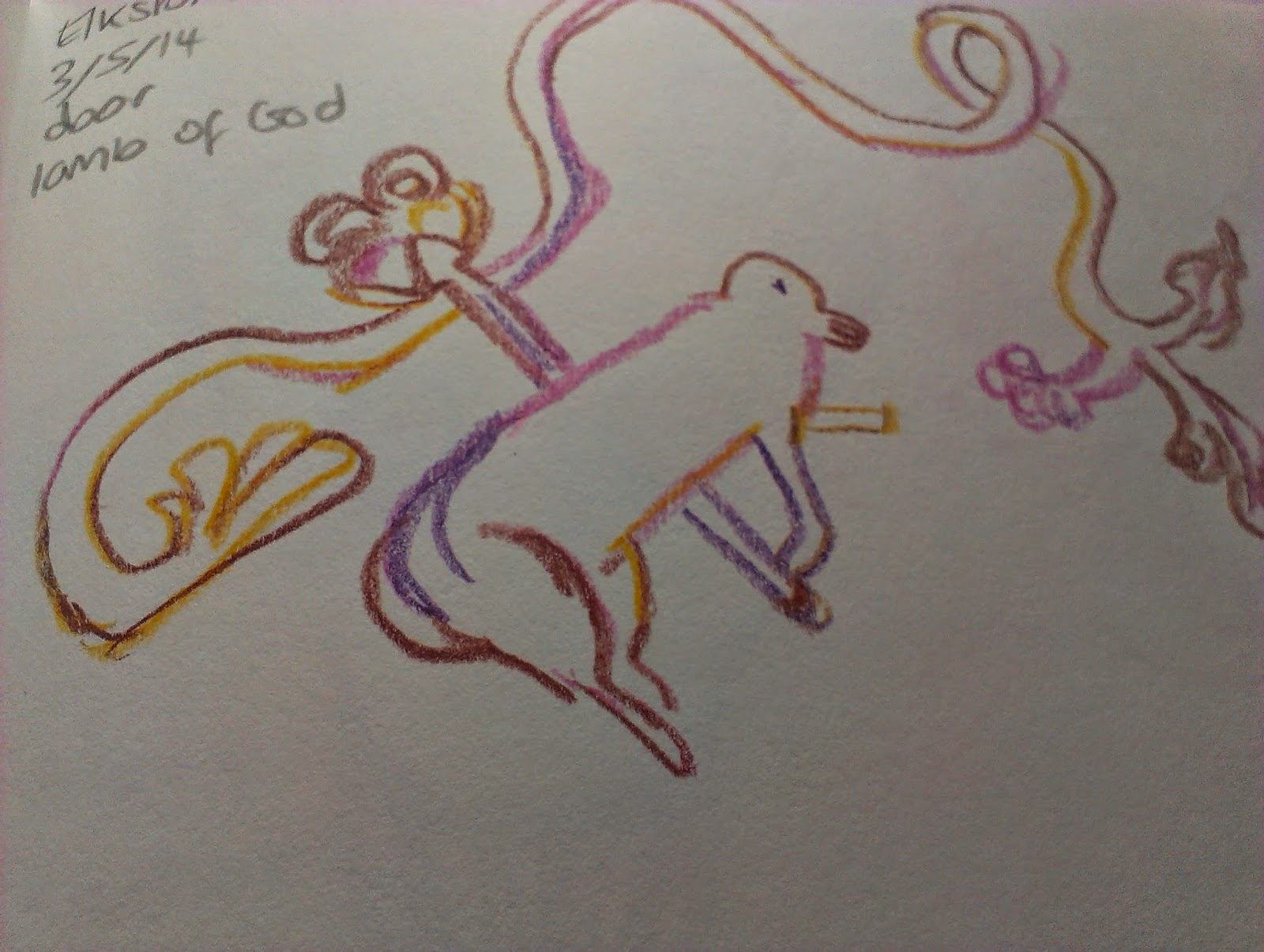
Outside, the door reminded us of Siddington (where we could not get into the church), as it had beakheads in a similar but not identical style, with one face having two arms holding the adjacent beaks closed and a double beaked creature. As well as beakheads, there was elaborate carving on seemingly every available column top and arch. In the centre of the arch, in the semi-circular space over the door (the tympanum) was a carving of Jesus or a religious figure, surrounded by animals including a jaunty lamb of God, a bird with some writing, and two more. We drew the lamb of God, as it was too complicated to try to draw any more. The lamb of God had a curiously rounded head which reminded me of a dolphin. Possibly the first "dolphin of God"?
I also liked very much the animal heads and figures on the outside of the church, high up under the roof. They were all different and included a centaur with a bow and arrow, a goat with a beard, a deer with antlers and an animal biting its own tail. There was also one that looked suspiciously like a dinosaur. My sister found the whole place slightly overwhelming, as did I, because there was so much to look at, it was impossible to know where to begin. Sometimes less is more, and simpler things are effective in their simplicity.

We moved on to Stratton, on the outskirts of Cirencester, and once I'd corrected my poor navigation, we found the church and enjoyed our lunch in the peace of the churchyard. As we walked down to the church porchway we had that sense of excited anticipation - what will the carving be like? Will the simple description in Pevsner translate to something quite impressive to behold? (Sorry, now I am using religious language!) I think that one of the enjoyable things is not knowing what the carving will really be like, as sometimes the book has simply failed to describe how unusual or impressive something is. Happily, the tympanum above the door proved to be very unusual, showing a complicated image of weaving lines and who knows what. It was hard to make out what was there, as some is worn, but you can see a spindly legged creature with a person's head, and long claws, next to a coiled serpent, and next to them possibly two more creatures with long legs, and a lot of foliage intertwined. The book said there was supposed to be a "tree of life" but we could not see a definite tree. Beneath the tympanum were what is known as saltire crosses.

Such is the other-worldliness and sense of another time with these places, is it any wonder that we are beginning to associate them with strange things? Last week after our successful trip to Harnhill, I could have sworn blind both myself and my sister had a photo of the dragon. But on further investigation neither of us could find one. Then this week, my sister took some photos in Elkstone and then discovered they were not on her camera. We get so engrossed in the drawing that we strode off down the road before we realised we'd not photographed the tympanum at Stratton and had to go back - much to the annoyance of a poor robin who had been trying to feed her chicks in a nest in the porch and hissed at us to get out of the way.

Our last stop was Daglingworth, west of Cirencester. It dated from Saxon times and had not one but four beautiful Saxon carvings, which were once, astonishingly, built into the church out of sight. I really liked these pictures, as they were done in a simple yet not naive style. One was of Jesus and the two centurions at the crucifixion, one was St Peter with his keys. The figures had interesting details such as their belts, done in a knot shape, and well observed hair and hands. They seemed so pristine. We generally prefer drawing animal shapes to human figures but these were rather impressive.


Sunday, 27 April 2014

Carved creatures, South Gloucestershire


South Cerney door
The list of places to visit to see carvings, in particular carved creatures, is increasing weekly. My sister has now been through a book about Gloucestershire and we have marked churches of interest on the Gloucestershire map. Enticingly, there were many which we gave the highest ranking, based on the fact they had very unusual things there or many different things in the same church. It was too tempting to take a longer trip than usual, heading off on a sunny day to villages south of Cirencester.  There was a whole cluster of churches in a small area, all with our top ranking.

Our trips are so that we can have fun drawing. I have a new sketchbook, which is larger and allows me to draw more freely. Armed with our usual snacks, three-coloured crayons, ink and watercolour, we set off to discover yet more Norman and Saxon inspiration.

Saxon door, inside
outside
We stopped off first at Somerford Keynes, where the church has an original Saxon doorway possibly dating from the 8th century. It is not every day you see something from around 700AD, and this doorway was a real treasure. I did not know what to expect, but as you came in through the front door, (an old wooden door with a fabulous opening mechanism), the Saxon door was just to the left on the facing wall. In Saxon style it was tall and narrow. A member of the parish had been good enough to pay for its preservation; it was open to the outside, rather than blocked in, with a very tasteful panel of engraved glass across the space. It let in the light to the church and made a real feature of the Saxon door. Full marks to whoever designed this. Outside, you had a real sense of the history and atmosphere of the doorway, and could easily imagine Saxon people using it to go into their church.  It had 2 rope-like motifs over the top, and was beautiful in its simplicity.  Inside the church, we were disgusted to read that a fragment of Saxon stone carving had been stolen a couple of years before.

beaky creatures
Further north we stopped at South Cerney. From the book, we were expecting to see "beakheads" or as we call them "beaky creatures" - a feature of Norman doors that can be found in this area. Previous beakheads we have seen are of creatures' faces over the archway of a door, some of them gripping the archway in their beaks or mouths. We approached the church and were both very excited by what we saw. There were many beaky creatures gripping the archway, plus some beautiful carvings above the door posts and forming the archway. The whole doorway was very ornate and must have taken ages. You didn't know where to look, or what to draw first, such was the detail.Inside there were some Saxon crosses, later carvings and a resin copy of a wooden head and foot from a rare 12C crucifix.

It wasn't far to the next village, Ampney St Mary, but finding the church proved a little more difficult. It was not actually in the village, but a small distance away, on the main road. It turned out the original village had been evacuated due to the Black Death and since then the new village had grown up further away from the church. This church has a carving over a now blocked up doorway, which is very unusual and appealing. It has a long-bodied, skinny lion, with long legs, stretched over two faces that look almost cat-like, but are attached to long, almost crescent shaped bodies - who knows what they really are (some suggest a serpent
Ampney St Mary
but I am not convinced). Next to them is a creature with a bird's head, four legs and a long forked tail. (Both this tail and the lion's tail curl up over the bodies). The inside of the church was equally pleasing and there is a nice atmosphere: all over the walls are the remains of some medieval murals, which must have been very impressive in their day. There is another ancient wooden door and a simple and sturdy Norman font with a zigzag design. If you venture up towards the altar, you will see a stone screen and suddenly notice that one side of the church is leaning outwards at an alarming angle, which is a shame.

On the route back, we passed Harnhill, so we had to call in and see St Michael fighting a dragon, over the doorway. It was a little green, but the actual carving was charming and very bold. The dragon had its tongue out and was a really nice shape; I also liked St Michael's clothes, and noticed he too had wings...
St Michael and dragon, Harnhill

At our last stop, Siddington, we were disappointed to find the church padlocked at the gate. I find it hard to believe this is necessary in these small places. It prevented us from seeing the Norman font which sounded like it had impressive decoration. However, we could peak through the netting across the doorway to look at yet more beaky creatures - these however, did not somehow hold the same appeal as those at South Cerney. We thought maybe it was because they seemed more uniform, more flatter, and also looked newer - although I believe were also Norman. An interesting and unusual thing to note about them is how one beakhead had two arms, each reaching out to its neighbour and holding their beaks shut! The beak of the creature on the left was even pulled slightly towards the hand.