Showing posts with label lamb of god. Show all posts

Thursday, 1 June 2017

Dorset way


Stoke sub Hamdon
Each county appears to have its own unique feel and mysterious qualities. We all know Wiltshire is weird, as it has Stonehenge, Avebury, Silbury hill etc and the form of the hills often makes it feel enclosed and slightly mysterious ...but Somerset has a different feeling again and so does Dorset. It was almost as if when we crossed the border the atmosphere changed, but perhaps I am getting too in tune with the land and picking up echoes from times gone past... Certainly Dorset, with its pleasant countryside (sadly bathed in misty cloud for half the day) was rich in top quality romanesque delights.

Navigating from the road map, your favourite navigator made her usual useless effort of "oh yes we should have turned there" as the car sailed past its turning.  Our first stop, once we found it, was St Andrew's Church in Todber, an unusual building, which was supposed to have some Saxon carving outside. Alas, said carving was no longer outside and the church was shut, so we returned through the drizzle and dripping trees to the car.  Next stop, Melbury Bubb. A small distance away but not on any direct main road. We decided to "take the cross country route".   I don't know why as I didn't have an OS map and couldn't see the best way to go, even while I was giving directions. The small white roads got even smaller on the map and even less road-like in reality.  Luckily for me I am always driven with skill and care around the English countryside and just kept the map out of sight so that the ludicrousness of our route couldn't be seen.  Eventually, having been down the tiniest and most hidden of Dorset's backroads, including via a diversion, we found Melbury Bubb (to our great relief). Most of the names around there are equally as remarkable - Piddletrenthide, Glanvilles Wootton and Huish Episcopi. Of all things.

Melbury Bubb church was, thankfully, open. A man was inside the door and evidently slightly surprised to see us. "Are you researchers?" he asked us. Well, yes, we are! Never thought of ourselves like this before but in fact that is exactly what we are and it felt good to be recognised as such! The church is apparently "always open" and no wonder - inside the door is the most amazing font ever! It was made into a font out of an existing carving and so the scene is upside down. Someone has done a drawing of it so you can see what is on there. But in fact it is not hard to see (when you have your head the wrong way round). Around the sides are a menagerie of creatures -some I swear we have never seen carved before - a stag with impressive antlers, a dog type creature, a horse... and some strange creatures in between, perhaps a lizard, perhaps a sea creature - really quite hard to tell. All with the requisite curved tails tucking up under their bodies - but in fact tails reminding me of Saxon knotwork as well, as they became a long and weaving pattern, looping in and out of themselves. I was musing there must have been a crossover between Saxon and Norman styles and so perhaps this was part of it? Lovely animal feet and the ususal characterful faces, with amusing expressions. These creatures are neither serious, or in my opinion, religious - we were debating whether they were symbolic of something religious. Perhaps. But perhaps not. Although they are not - apart from these ones - usually creatures that would have been around day to day. So here the stag and horse were interesting. But in other places - the creatures you'd expect to see would surely be wolves, badgers, hares, etc? All very interesting to think on.  It helped to draw them upside down as you were forced to draw what you saw and on turning your drawing upside down it was quite fun to see the result. A lovely spot with an absolutely amazing font. Find it if you can.

Moving on (the heavens opened, it was absurd), our next stop was Melbury Osmond. Inside the church set into the wall near the altar was a creature again with winding crossing patterns around it, this time a bit like a dragon? And possible plants?

Final stop on the tour was Stoke sub Hamdon. From the notes in our sacred blue book (I say our, but the book is all my sister's hard work) the church promised many things of great excitement and it was not wrong! I may have been tired but I became quite emotional. The first thing to greet our eye was a truly wonderful tympanum. My sister is so kind, she likes the initial discovery to be a kind of gift and will often let me go first as it were, to get the full impact of the surprise. The tympanum is very well preserved (apart from a small part where we believe someone had tried to chip it away! Poor thing!)  It is spacious and airy, beautifully considered and spaced out, with a Sagitarrius, a tree of life, three gorgeous birds, a wolf/lion and a fabulous, jaunty lamb of God!  Who doesn't love a lamb of God and this one had a real way about it. The birds had a very appealing design, straight backs and all seen from different angles. They reminded both of us at once of the ones in Little Langford. Ah, we are fonts of all knowledge now (pun intended).  The other creature was possibly a lion (as in Leo) or possibly a wolf - it had a woolly neck so the lion theory fits. But whatever, it was all very nicely done and fun to draw.

That was me drawn out really, so I just had to admire the other treats inside  - the chunkiest font you ever saw with a double band of carving which meant the rest of it would have had to have been chipped out for a year and a day. The most amazing triple arches inside with different pleasing patterns, all very well preserved. Far too much for one person to take in.  On the outside wall as well there was a super-cute dragon being attacked by some stupid person (why did people treat dragons so badly?) with not just a spear but a lance as well.  I loved its curving body and amusing expression. They really knew how to draw character.

I believe Dorset could be a great place to spend more time fonting, it had a nice feel, it certainly had many hidden wonders and it is not too far to go. We have been enjoying a wealth of fonting opportunities recently so long may the good weather continue.

Wednesday, 14 September 2016

Deerhurst and Upleadon

Once in a while we are on route somewhere other than a church and are tempted to squeeze some fonting into the journey. Well if we are passing near to a known site, it seems silly not to visit. Happily the Blue Book makes it easy to find somewhere not ludicrously off course.

One such stop-off was the village of Deerhurst. Luckily for us, it was well signposted as in addition to the village church and the delights therein, it has an extra building of Saxon origin, Odda's Chapel, now cared for by English Heritage. This was apparently built by Earl Odda for his brother Aelfric. Strangely someone had incorporated a farmhouse into one end in Tudor times, which looked rather odd. But the building itself held less interest for me than the contents of the nearby church, St Mary's. The existence of a second Saxon building is quite unusual. So it was not surprising that both are clearly signposted, which saved us our usual trick of hunting down every side road. In fact the church had no end of signs, with one taking us all the way round the building to the "angel" high up on the back wall, another pointing to the toilets (a rare and welcome facility for the travelling fonter) and even an array of labels inside the WC in case you weren't sure how to identify a hand dryer. But it was a joy to see that someone evidently welcomed and expected visitors.

Inside the church (diligently being cleaned by someone) we were greeted with a wonderful sight. You may think you have seen something already when you have seen a photograph, but it does not beat seeing it for real. Deerhurst's font is one of very few surviving Anglo Saxon fonts... if indeed there are any. We bought a pamphlet (one of many) on the Anglo Saxon features of the church and it suggested that Deerhurst is the best example, if it is indeed a font, which the author thought it was. It seems to fit the dimensions of the fonts we have seen, and the base, if it is the original base for a font, has the same intricate spiral/scroll pattern which decorates the top bowl. It is an elaborate pattern which suggests that it must have been an important place to have such a lovely font. We sat ready to draw. R went to look for lights to that area of the church. To my sheer amazement, sensitively done floor lights came on all around the base of the font and lit it up so you could best appreciate the carving. I have never seen a font so well appreciated and cared for by its parish and being as fond as I am of them, it felt like the pinnacle of font appreciation - if only every beautiful font could be appreciated and valued in this way. Some cost and consideration had gone into presenting this font and it is so nice to know it will be looked after.  Unlike in times gone by when it was found being used as a drinking vessel in a farmyard and rescued by a bishop.

Drawing the pattern proved more difficult. We would have needed a lot more time than we had to make any decent attempt and mine was more of a rough representation. It turned out that the swirls were quite complicated and not all the same and it made your eyes go funny looking at them for too long.

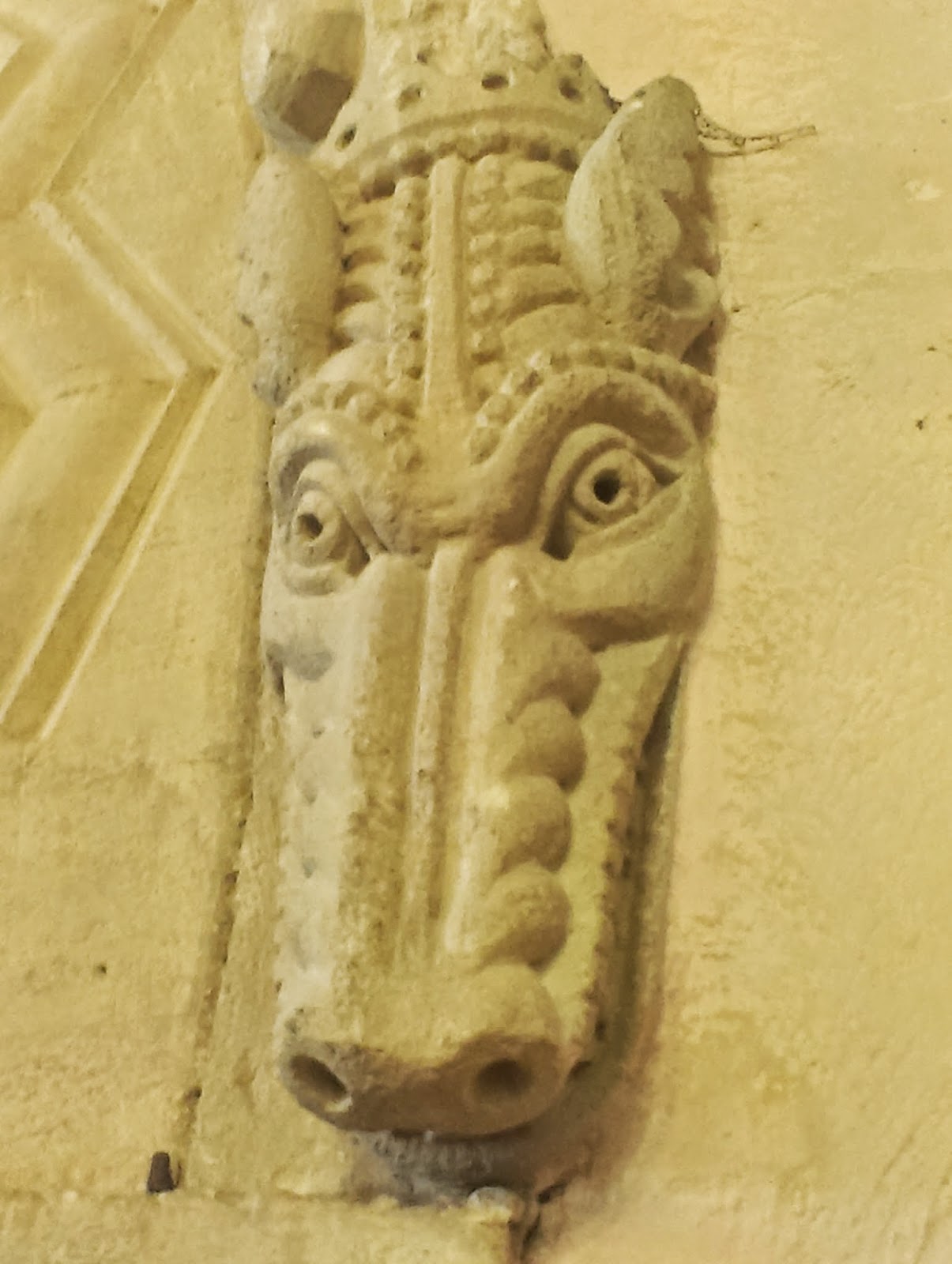
The church also has beast heads, two wonderful ones by the main door, with fangs, pointy ears and a prominent snout, not so much dragons but a cross between wolves and something else, and two at the back of the church, which according to the pamphlet, could have been adorned with paint and jewels for eyes in their time, one of which looked like a hippo to me.

Upleadon
Upleadon is not far from Deerhurst and provided a good stop-off point on our return journey. However, it was not so well signposted, as usual, so we found ourselves in familiar territory driving into the village and then having to go back on ourselves, ask a stranger and then keep our eyes peeled. It was a little way out of the main village next to a large house and farm. It is very unusual with a tower of brick and timber. This one boasts a rather fine tympanum over the main door, with nothing less than a Lamb of God, complete with jaunty foot, and flanked by two "lion-like" creatures, with the requisite tails curling up under their bodies. It was not unlike the design at Pen Selwood, a thought we both had, cheeringly - we are now a walking resource on these things.  I loved it - it had a pleasing simplicity but with some unusual details such as the rather attractive circle around the lamb, which was a plain and a beaded band intertwined. As I drew it, mine seemed to go a bit haphazard and I think the carver found the same difficulty.  The animals had rather humanoid features.


There was another creature on the left hand capital of the door, with an interesting tail, and a design on the right hand one.

It may have been out of the way and harder to find than Deerhurst but it was equally pleasing and quite a peaceful spot.

Wednesday, 29 June 2016

Escape to the New Forest

No, not escape from the EU, but from the awful result of the referendum. We took off for the day to a new area of the country for me, the New Forest and very pretty it is too.  It was relaxing to be driven through the leafy lanes and to see the ponies. There are a lot of posh houses and we had the chance to see many as I inexpertly misdirected my sister several times and gave us a longer-than-necessary tour around the villages.

It was a weird sort of day, of course, but the pocket of green helped calm us after a few rants, and being out fonting was the perfect thing to do.  Four villages had been chosen, first of all Minstead, which proved tricky to get into. We drove down a lane that said Road Closed and indeed it was closed, so we chose to walk through and look for the church on foot. We tried using our sixth sense but after wandering down several roads and also asking some passers by, we realised the church was miles off and that we needed the car. So we stopped for a sandwich, under a tree, in a peaceful spot.

The church itself was quite weird, looking more like a house than a church. It was a bit unusual inside as well but the font was a cracker and reminded me slightly of Steeple Langford as it had four rectangular sides each with its own picture. But the pictures were more elaborate here and harder to make out on two sides. One, described by the church as Jesus's baptism, was three figures - but very hard to see who they were or what they were doing. One looked like it was holding a hammer, or was it holding a person? One looked like an alien. One was possibly an angel with wings. A second side had strange designs too, hard to make out. A third had a rather appealing animal, with two bodies and one head, which is not unlike other animals we have seen. The head looked very like the Cheshire cat, with a grinning mouth.  The fourth side was sadly hard to see as it was too close to a wall. It was, to our delight, a long-bodied but appealing Lamb of God, holding the requisite staff in one foot.
"Are you doing the flowers?" asked a woman who came in, who somehow reminded me of Samantha Cameron. I ignored her because it was such a stupid question,  but she repeated it and we both answered no. Obviously not as the flowers were done and sitting on top of the font. It became an amusing line to ask each other in the other churches we visited during the day.

Second stop was Landford, which also proved awkward to find, giving the day an edge of weirdness. We stopped for a lemonade at a carvery inhabited by only 2 men at the bar and the landlady, and I dared to ask where the church was. The older bloke kindly told us but neither of us really understood what he said. I thought he said something about Royal Gibraltar, the referendum still on my mind, but knew he couldn't have done. After much driving around we chanced upon an Indian restaurant, the Royal Jaipur, on the main road and I was quite chuffed I wasn't going completely mad. The church itself was away from the village and sadly locked, but there were two nice Norman capitals either side of the door, which we drew.

We moved on to Breamore, just outside the New Forest, again stumped as to the whereabouts of the church (I was just using the road map which let's face it, is useless for finding churches). We found this one through a mixture of luck and sense, as there was a "Breamore House" on the map and often posh houses are near the church and luckily there it was. It was a sweet Saxon church with tall windows, and a lovely Saxon archway inside with some writing over the top. Sadly my drawing of it was less than accurate so it looked very odd. There was some fine "ropework" carving as well.

Final stop was Damerham, north east of Fordingbridge. The church was on its own again, stuck down a lane. In the porchway was a rather wonderful tympanum of a horse and knight, vanquishing some poor soul down on the ground. We agreed the carver must have liked horses or certainly observed them well as the horse was accurately depicted. We particularly liked the way its hoof rested on the person lying down, who appeared to be holding an axe. There was attention to detail, as the horse had some decoration and the people's clothes did too. Rather pleasingly my own interpretation of it came out well.

Sunday, 18 October 2015

Dinder, Doulting, Chesterblade, Holcombe, Leigh on Mendip

Back on the road and this time we ventured into Somerset, out towards Shepton Mallet area. First stop was Dinder, where we found some creatures who were possibly dragon heads, like we have seen before, but on closer inspection seemed more like dogs. They definitely had dog noses, and no dragons' teeth, and pointy ears. So dogs they were. A knowledgeable and interested woman who was helping out in the church took the time to talk to us about them and seemed genuinely interested in art. Not one of these people who can't understand why we are drawing them. Which was a nice change.  The dogs had been rescued from somewhere and had been placed end to end over a window, so that they were not in the usual dragon door arch position. They were quite pleasing, as was the pretty and hidden village of Dinder (despite "no turning" notices where there was really no need. We turned anyway, at speed).

St Aldhelm's well
When we finally got to Doulting (because I was once again too slow to signal the turning), we investigated the church (some unusual capitals in the foyer) and then made our way down a slope to a spring, St Aldhem's well.  Surprisingly it was a busy spot as two cars came to fill up a variety of vessels with the holy water while we were there.  I learned to recognise a liverwort (there were some fine examples) and there was some moss as well. The water was (although it is a cliche) crystal clear, quite remarkably so, and being a holy well I had to sample the water. It tasted slightly minerally but not unpleasant. The water poured out from a hidden and peaceful channel at the back, through into a deep animal trough, which I thought was nice. It was pleasing to think of cattle and horses drinking from the holy spring.

Chesterblade
On to Chesterblade, a tiny, quiet spot with nice views over the hills. The church was small and cute and had a pleasingly tub shaped font. Very appealing. We examined it in detail, as a church leaflet made out it had once had a carved band around the middle. There was a slight discolouration in the stone there at about that spot, but neither of us could see evidence that it had been chipped away or bring ourselves to believe that anyone would have gone to such trouble. Now, convinced we are like experts on the Antiques Roadshow who have seen enough examples of something to recognise things by sight, we did not know of any example of anyone defacing a font in this way and for no obvious reason. So we concluded the chap who drew the font with the band on it had either embellished it himself or got confused with another font (as it is easy to do if you do not write down where you have been). Either way it was rather bizarre and my sister was right to question. Do not believe everything just because it is written down. If we have learnt one thing, it is surely that.   The doorway had two lovely capitals, one a face, with unusually prominent ears, and the other a very pleasing swirly design which on reflection reminds me of a Walnut Whip.  There were also two tiny faces, which proved harder to draw than bigger ones.  Oh and apparently we missed a lamb of god, outside. Our favourite. But sometimes you just get overloaded.

Holcombe Old Church
Next stop (it is remarkable afterwards how long we keep going for), in the quiet spot of Holcombe Old Church, down a lane out of the way and a really peaceful place if you are going to be buried somewhere.  A load of ducks were nearby as we could hear raucous quacking from somewhere. They always sound like they're laughing at something.  Holcombe had a rather appealing porch archway, with a two twirly columns and a really nice interwoven design which could be good for inspiration for making something one day.  I liked how we are now so confident in our churchyard environment we just moved a bench and sat in front of it to draw - well it is tiring to stand all the time - and of course no one came and said, what are you doing, anyway. It was too out the way.

On the way back we squeezed in one final stop (well, it seems worth it when you still have some energy) at Leigh on Mendip. The font here was a simple two-scallop design that reminded both of us of a bottom - it had that pleasing shape about it, it has to be said. There was a little bit of embellishment on the curved corners, but overall it was quite a chunky and cheeky font.


Tuesday, 20 May 2014

Fantastic Fonts

The obsession is now reaching more and more counties. My sister has read Pevsner's books on different counties and noted the Norman and Saxon carvings which we must now somehow get to see. I even found myself reading Pevsner last week and watching a dvd about him. At the weekend we were lucky enough to be driving through Shropshire and Herefordshire and this meant that we went near to two fonts which Pevsner described as outstanding examples of what is known as the "Herefordshire School" carving, which refers to what may have been a certain group of masons working in this area, and Worcestershire, in the 1100s. The most well known example is Kilpeck, which I am sure we will get to one day.  But the two fonts we saw over the weekend were in one word, amazing.

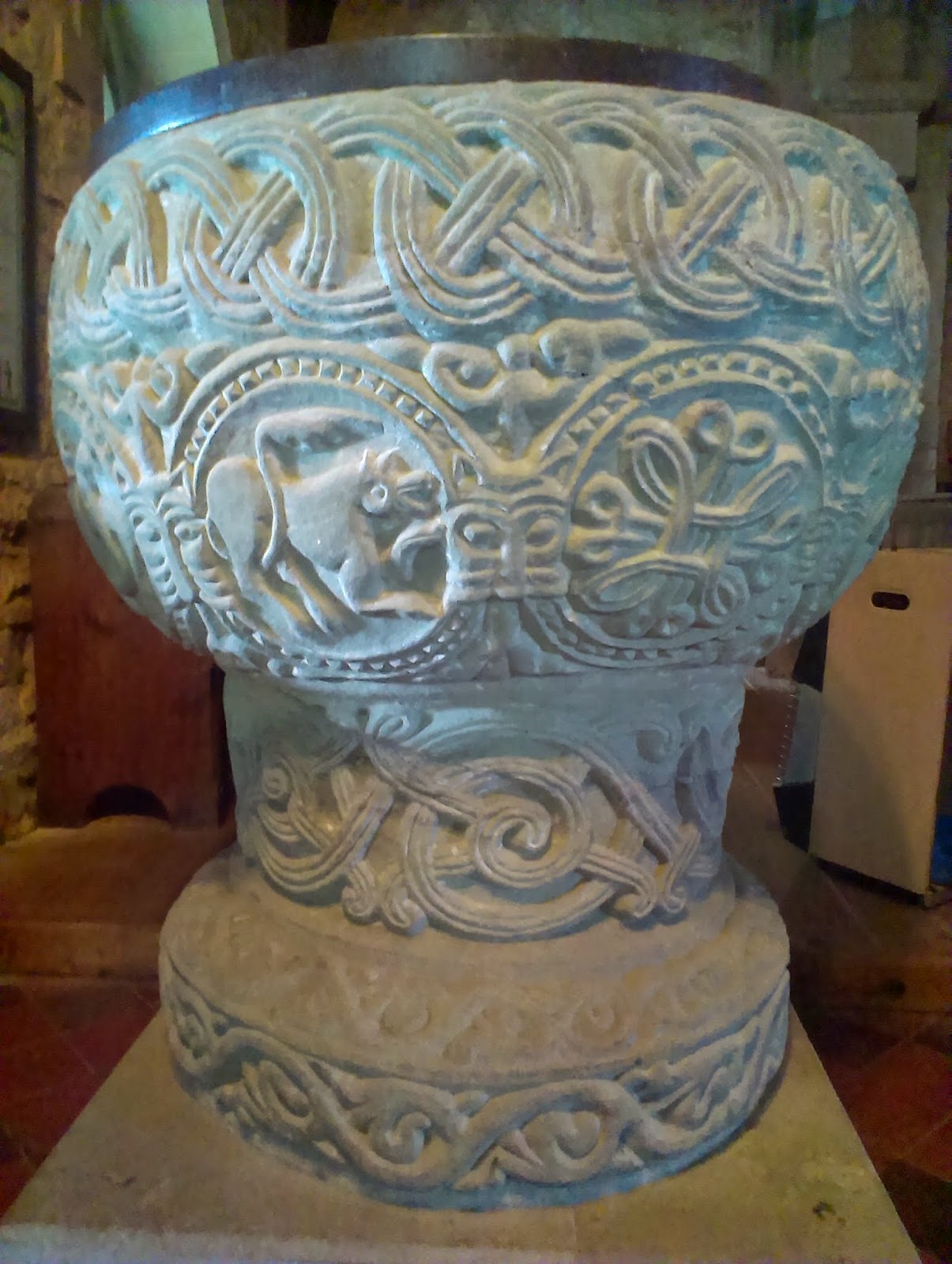
The first one seemed to be in the back of beyond, in Stottesdon, a village in Shropshire. It was tucked out of the way and it seemed very dark inside, so that we had to open the front doors to get a decent look at the font. It was very large, and covered in the most impressive carvings. Both of us stood and stared in amazement (once we could see it clearly). The top has a wide band of interlaced plaiting around it, the centre has animals in circles, and cats' faces where the circles touch. We were both thrilled to see another lamb of God and this one - yet again - looked like a dolphin's head. Perhaps it is hard to carve lambs or perhaps they were copying the style of the time.  There was a rather appealing bull/cow/type creature, a dragon biting its own tail (possibly) and some excellent birds. The base was very fancy as well, with interlacing designs. It was all very impressive.

Hidden out of view, behind the ugly organ, was a tympanum over the south door. It was hard to see in the gloom and looked quite worn anyway - there were two upside down creatures and a third upright one.

We were unimpressed by the arrival of a woman who was more bothered about why we had (inadvertently) turned on the lights at the end of the drive, instead of sharing with us how lucky she was to be a member of a church with such an amazing example of a font of the Herefordshire school.

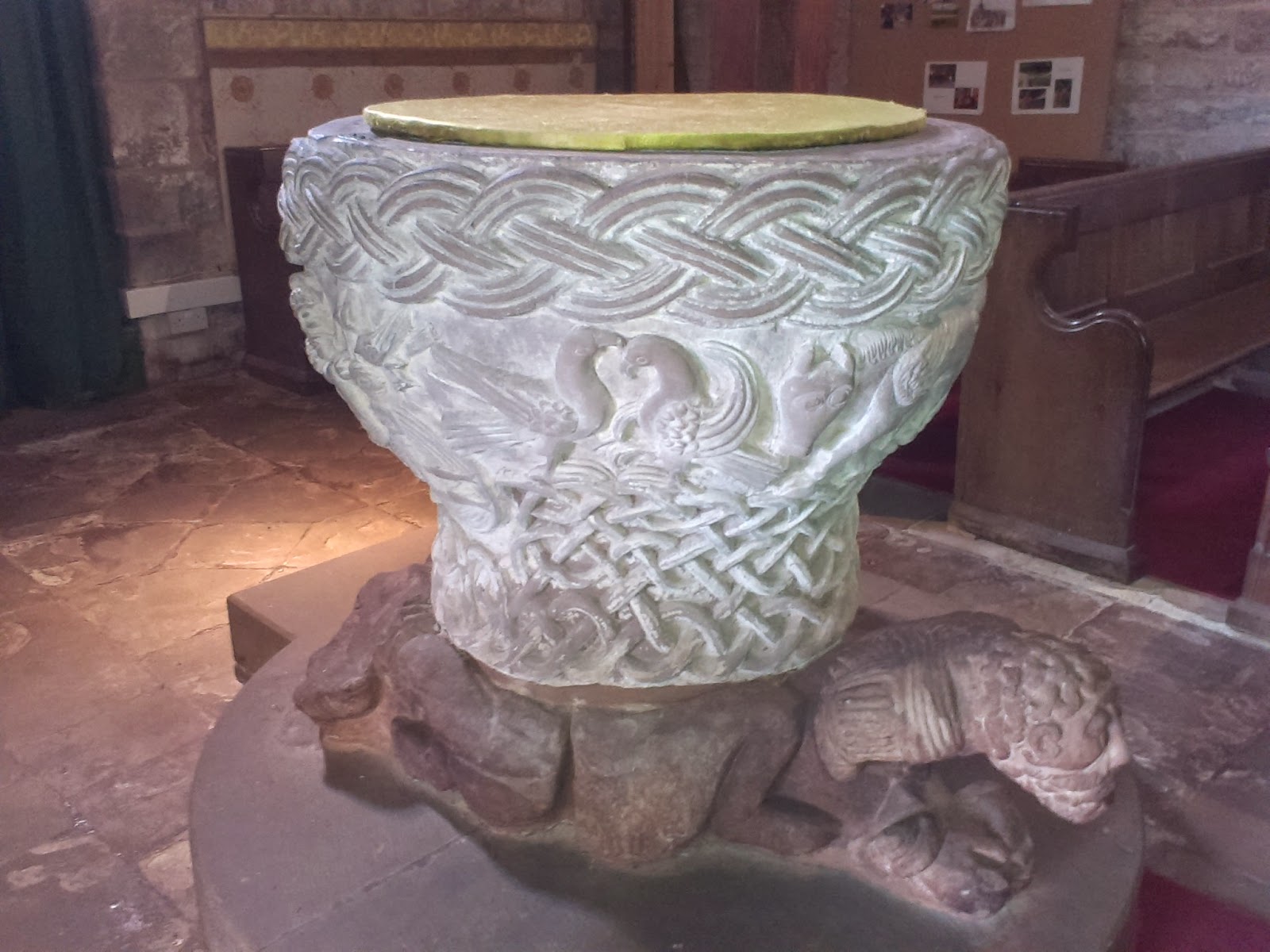
But if we thought that was good, Castle Frome held even more excitement. We nearly didn't stop to see it and we nearly didn't find the right village, but it was a good job we did. The church is really sweet and sits out of the way of the village. The outside is unusual and the porch and doorway is plain - because of this I wondered naively whether it would be good. But the door swung open and my sister literally gasped with excitement: inside, not hidden this time in darkness, is a marvellously ornate and beautifully carved font - very large and round, carved from one block, sitting on a base of strangely crouching figures (two that have lost their heads). The carving on the font was deep and sort of chunky, very tactile, although I managed to keep my hands off it, and so impressive. Around the bowl are the four evangelists in symbolic form: an angel, an eagle, a lion and a very charming bull. There are also two wonderfully observed birds, with their claws touching and their beaks jaunty, as well as a depiction of Jesus at his baptism, with John the Baptist, the hand of God and the Holy Spirit in the form of a dove. Jesus is particularly well done as he is standing in a pool of rippled water and you see the shape of his body through the ripples. In the pool are some fabulous fish.  My sister noticed that the human figures all had ankles with little circles on them, like an ankle joint.

It was better than tv and I imagine that these sort of pictures would have entertained the people of their time in much the same way that good tv can do these days. We were pleased because we actually noticed some similarities to the other font, and how the creatures all have long claws, and how the lion's tail comes up and curves over his body, exactly like the creatures at Ampney St Mary. We then read that these are features of the Herefordshire School style.

The base of the font was an intricate knotwork of patterns. No doubt it would have been tricky to draw. Sadly we were unable to stay long enough to draw this font, but it is one I would love to return to. The birds were particularly pleasing and the whole thing was beautifully preserved. The church community seemed to value and appreciate what they have there, from what I could see. If you are ever passing by, pop in. You will not be disappointed.

Sunday, 4 May 2014

Elkstone, Stratton and Daglingworth

It is not usually sunny on a bank holiday weekend, in my recollection, so my sister and I took the opportunity to go back to the area around Cirencester to see some more Norman and Saxon church carvings that we had rated those most worth visiting ("pink" on my sister's thoroughly researched maps). Once laden with the necessary snacks, we went up to Elkstone which is between Gloucester and Cirencester. Elkstone church is well documented for having a large amount of Norman carving, both inside and outside the church. It has all the different features which you could hope to find, namely, carved "beakheads" over the arch of the doorway, sculpted tops to the columns, a tympanum, animal and people heads outside on the walls, and inside, Norman carved arches with zigzags and flowers. We did not really know where to begin.

I was drawn to two dragons' heads that were inside the church, one each side of the first arch. Both were very well preserved, due to their position, and showed rather amusing teeth. I drew the right hand one, rather inaccurately, but it shows the overall character. In front of and behind the altar were two more decorative arches, the far wall having a pleasingly irregular zigzag pattern, and flowers, (with one tiny zigzag and flower squeezed in as if they'd planned wrong), and a detailed face pattern on the ceiling.

Outside, the door reminded us of Siddington (where we could not get into the church), as it had beakheads in a similar but not identical style, with one face having two arms holding the adjacent beaks closed and a double beaked creature. As well as beakheads, there was elaborate carving on seemingly every available column top and arch. In the centre of the arch, in the semi-circular space over the door (the tympanum) was a carving of Jesus or a religious figure, surrounded by animals including a jaunty lamb of God, a bird with some writing, and two more. We drew the lamb of God, as it was too complicated to try to draw any more. The lamb of God had a curiously rounded head which reminded me of a dolphin. Possibly the first "dolphin of God"?
I also liked very much the animal heads and figures on the outside of the church, high up under the roof. They were all different and included a centaur with a bow and arrow, a goat with a beard, a deer with antlers and an animal biting its own tail. There was also one that looked suspiciously like a dinosaur. My sister found the whole place slightly overwhelming, as did I, because there was so much to look at, it was impossible to know where to begin. Sometimes less is more, and simpler things are effective in their simplicity.

We moved on to Stratton, on the outskirts of Cirencester, and once I'd corrected my poor navigation, we found the church and enjoyed our lunch in the peace of the churchyard. As we walked down to the church porchway we had that sense of excited anticipation - what will the carving be like? Will the simple description in Pevsner translate to something quite impressive to behold? (Sorry, now I am using religious language!) I think that one of the enjoyable things is not knowing what the carving will really be like, as sometimes the book has simply failed to describe how unusual or impressive something is. Happily, the tympanum above the door proved to be very unusual, showing a complicated image of weaving lines and who knows what. It was hard to make out what was there, as some is worn, but you can see a spindly legged creature with a person's head, and long claws, next to a coiled serpent, and next to them possibly two more creatures with long legs, and a lot of foliage intertwined. The book said there was supposed to be a "tree of life" but we could not see a definite tree. Beneath the tympanum were what is known as saltire crosses.

Such is the other-worldliness and sense of another time with these places, is it any wonder that we are beginning to associate them with strange things? Last week after our successful trip to Harnhill, I could have sworn blind both myself and my sister had a photo of the dragon. But on further investigation neither of us could find one. Then this week, my sister took some photos in Elkstone and then discovered they were not on her camera. We get so engrossed in the drawing that we strode off down the road before we realised we'd not photographed the tympanum at Stratton and had to go back - much to the annoyance of a poor robin who had been trying to feed her chicks in a nest in the porch and hissed at us to get out of the way.

Our last stop was Daglingworth, west of Cirencester. It dated from Saxon times and had not one but four beautiful Saxon carvings, which were once, astonishingly, built into the church out of sight. I really liked these pictures, as they were done in a simple yet not naive style. One was of Jesus and the two centurions at the crucifixion, one was St Peter with his keys. The figures had interesting details such as their belts, done in a knot shape, and well observed hair and hands. They seemed so pristine. We generally prefer drawing animal shapes to human figures but these were rather impressive.


Monday, 24 March 2014

Knook and Berwick St Leonard

While I am living in Wiltshire, I have been exploring the area with my sister. We have been going to churches which have interesting historical carvings from hundreds of years ago, including Norman and Saxon times. Neither of us are religious but we are interested in the carvings and we both like to draw them. My sister has compiled a list of churches which have interesting features, so we have spent many a happy weekend visiting a few at a time. The carvings are often very impressive and it must be because they are part of the church that they have survived so well.

Today we went to the village of Knook, in Wiltshire, to the small church of St Margaret. On the back wall of the church, outside, is a carved tympanum, over what is now a blocked up doorway. This is thought to be pre-Norman carving, and although it has weathered, you can see something which looks like curving foliage, or a pattern, and perhaps figures of animals. I find I can see figures of animals in most carvings, but that is because animals are a source of great pleasure to me. My sister could see two animals' heads near the top and we both thought there appeared to be two creatures facing each other in the middle, at least one had a tail and a foot showing.  Drawing them was very absorbing and good fun. I am not excellent at drawing but as with all creative things, it is good to practise. I find it therapeutic and satisfying. While you are concentrating on seeing the shapes and interpreting this on paper, you are not thinking about anything else. It is a welcome break from day to day issues. We were being observed by a couple of churchyard rats, from time to time.

Inside the church, (a welcome respite from the cold wind), there were two Norman carvings at the tops of pillars. One was more detailed than the other and had two images of flowers/plants (pictured). The other was more asymmetrical with a less well defined but more organic, like interlacing stems or plants. I thought I could even see snakes, or a dolphin shape.

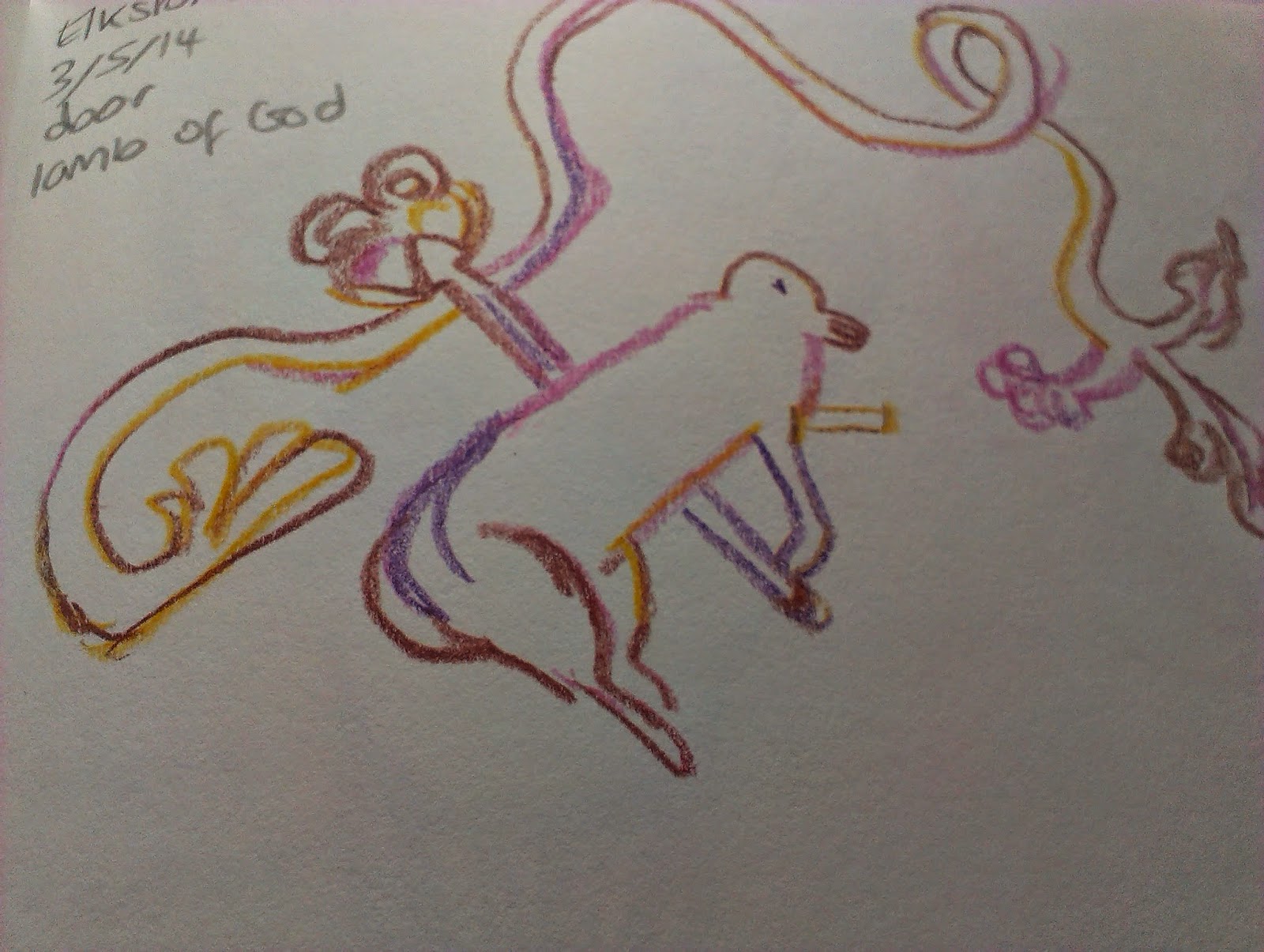
After a brief look at the nearby River Wylye, we drove on further south to Berwick St Leonard. Above the door into the church is an "agnes dei" or Lamb of God. It is of Norman origin and high over the door.  I liked it as it had quite a jaunty figure and I was pleased with my drawing. It looked to me like it was holding a handbag between its front legs. I don't suppose it was, but I could only see it in that way and so that is how I drew it. As we drew, two lovely partridges hopped over the churchyard wall. On the outside of the church there was another Norman tympanum, with flower shapes. My sister drew this but I chose to say hello to the real lambs in a nearby field.

As we left the churchyard, we came across a rather beautiful beetle, who was quite large and had a lovely blueish purple tinge. We think it is a black oil beetle.

There is something refreshing about going to see these carvings and drawing them. How strange it would be for the person who carved them to imagine that in 1000 years' time, some people would be looking at them and drawing them in multi-coloured crayons. When you look at them and then try to create an impression of them on paper, you are really seeing what is there, rather than just glancing at things as we do every day. It takes time to observe them and I feel that it makes a connection across time to the craftsman, when we stop and consider how much time and skill he put into it originally. Thinking about the centuries between us somehow gives me perspective on things today and it positions me in time; centuries of people have gone before us and centuries of people will follow. What will people be drawing in 1000 years from our time? And will there still be drawing then?